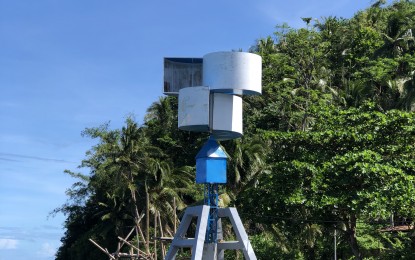
ILOILO CITY — A remote island barangay in Concepcion, Iloilo is turning to wind energy to keep the lights on and strengthen disaster preparedness, following the rollout of a vertical axis wind turbine (VAWT) under the Department of Science and Technology’s Project DAGAT.
Barangay Botlog is among three island communities in Western Visayas selected for the pilot program formally known as Driving Advancement, Generating Access, and Transforming Small Island Communities, a DOST-led initiative aimed at boosting energy security and resilience in isolated areas.
DOST Western Visayas Regional Director Engr. Rowen Gelonga said the project tailors technology to the specific needs of each island community.
“For every island, we introduce a different intervention,” Gelonga said in a phone interview. “In Barangay Botlog, wind energy was identified as the most suitable option to provide an additional and reliable power source, especially during emergencies.”
The newly installed VAWT system converts wind into electricity to power shoreline streetlights and supply energy to the barangay hall, where residents can charge mobile phones and small appliances. The turbine, with a one-kilowatt capacity, can generate enough electricity to power more than 200 light bulbs, Gelonga said.
Streetlights were provided by the local government unit, while the turbine system itself was installed through the DOST project. The setup is currently undergoing a dry run to test performance and reliability before any expansion.
“If the system performs well, we can explore broader uses for the electricity it generates,” Gelonga added.
To ensure continuous power during periods of low wind, the system was designed with auxiliary solar panels, allowing energy generation during daytime and calm weather conditions.
Beyond renewable energy, Project DAGAT also places a strong emphasis on disaster risk reduction. An automated weather station was installed in Barangay Botlog, and residents were trained to interpret weather data and understand basic disaster preparedness measures.
The project was formally unveiled during a ceremony on December 19 in the island barangay.
Project DAGAT is a collaborative effort involving DOST, Central Philippine University (CPU), and Northern Iloilo State University, with funding support from the Department of Economy, Planning and Development through its Innovation Grant Program. Gelonga noted that data gathered from the Botlog pilot will help refine wind turbine designs and improve efficiency, adding that CPU established a wind energy research center three years ago where key system components were tested.
Two other island communities are also part of the pilot program. In Unisan Island, Nueva Valencia, Guimaras, the project focuses on a water desalination facility in partnership with John B. Lacson Foundation Maritime University. In Mararison Island, Culasi, Antique, the initiative centers on disaster preparedness, including weather monitoring systems, evacuation mapping, and emergency response training.
“The goal is to deliver solutions that directly respond to the real needs of island communities,” Gelonga said. “These technologies are meant to help them become more self-reliant, safer, and better prepared for disasters.”