
Porky business as usual
‘When access to health care depends on a politician’s endorsement, something deeply wrong has taken root not only legally but morally.’

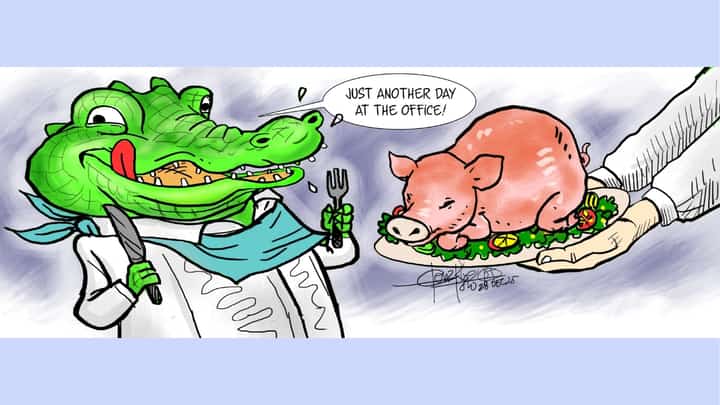
Congress leaders have repeatedly assured the public that the 2026 budget is free of pork barrel, a claim critics dispute and say is being amplified by the Palace as part of an image overhaul for President Ferdinand Marcos Jr.
A thorough review of the 2026 proposal concluded that old habits never die, based on the House, Senate and Bicameral Conference Committee (Bicam) versions of the General Appropriations Bill (GAB).
Despite the open Bicam, where the proceedings were livestreamed, horse-trading occurred outside the public hearing.
“In the past, the Bicam was secret. There were even so-called small committees where only a few people decided what would be changed in the budget. There was no livestream, no public records. That is why questionable insertions often found their way in,” according to Akbayan Rep. Chel Diokno.
However, since the public raised concerns and applied pressure, there is now a livestream and a written report.
The budget, nonetheless, featured greater patronage, or padrino politics, to compensate for the loss of the so-called hard pork, namely the infrastructure deals that have been brought to the fore by the flood control scandal.
These “soft pork” are assistance programs such as Medical Assistance for Indigent and Financially Incapacitated Patients (MAIFIP), Assistance to Individuals in Crisis Situation and Tulong Panghanapbuhay sa Ating Disadvantaged/Displaced Workers.
Since these programs largely depend on legislators’ discretion, the beneficiaries are often those with connections to them or who are close to them.
“Health care and government services are rights of every Filipino. They should not have to be begged for by politicians,” Diokno said.
He quoted Catholic Bishops’ Conference of the Philippines (CBCP) president Cardinal Pablo Virgilio David as saying, “When access to health care depends on a politician’s endorsement, something deeply wrong has taken root not only legally but morally.”
Many medical and health professional groups argued that, rather than MAIFIP, the funds should be allocated to the Philippine Health Insurance Corp. (PhilHealth), which oversees the Universal Health Care (UHC) Act and provides direct patient services.
Diokno revealed that senators tried to reduce the assistance programs and clarify their rules, but in the Bicam, the funding swelled again.
“Even with safeguards, it is still wrong if politicians have influence. Health, education and social protection are rights, not favors. They must be delivered through rules-based and rights-based systems, not through patronage or political recommendations,” he added.
The 2026 GAB also contained projects inserted during the Bicam and are possible sources of kickbacks.
“The Department of Public Works and Highways budget became a major issue. It even led to a deadlock because the Senate wanted only P570 billion, while the House wanted P624 billion,” Diokno revealed.
According to Diokno, the DPWH and members of the House contingent in the Bicam warned that if the budget were reduced, as many as 10,000 projects would not be implemented, but they did not present any itemized breakdown.
The inconsistency lies in the Bicam announcing P20.7 billion in savings from DPWH to be transferred to PhilHealth.
“If there were savings, does that mean the original request was excessive? How can we be certain there is no padding? DPWH still has a long way to go in restoring public trust,” he averred.
The legislator raised concerns about Unprogrammed Appropriations (UA), which he described as funds whose destination is unclear and whose activation date is unknown.
In the House version of the budget, the UA amounted to P243 billion, the Senate reduced it to P74 billion, but in the Bicam it was restored to P243 billion.
The UA is considered a conduit for pork-barrel spending because projects displaced by politicians’ late-minute insertions are assigned to the UA, which must seek funding.
Since a large portion of public funds still goes to pork and patronage, the 2026 budget bill remains a politician’s, rather than the people’s, contract.