
Rexy Dorado: The entrepreneur betting on Filipino science fiction
Despite the dark, dystopian worlds he often builds, Rexy Dorado insists that hope remains central to his work.


For Rexy Dorado, writing was never a side pursuit — it was the starting point. Long before he became a tech entrepreneur or a publisher, Dorado wanted to be a novelist. In high school, that ambition shifted toward screenwriting. Then life, as it often does, intervened.
“For a long time, I was kind of trying to earn the ability to be able to maybe write one day,” Dorado tells DAILY TRIBUNE in an exclusive interview. “And then I realized, no — I need to just actually take a step and do it now.”
That realization came after nearly seven years spent building Kumu, the Filipino livestreaming platform he co-founded alongside Roland Ros. While Kumu is often discussed in terms of community-building and digital belonging, Dorado’s role in the company was driven by a different but complementary obsession: Filipino stories.
“My half of the equation was building something for the creator economy,” he explains, “so that we can have more Filipino stories, media, and cultural products.”
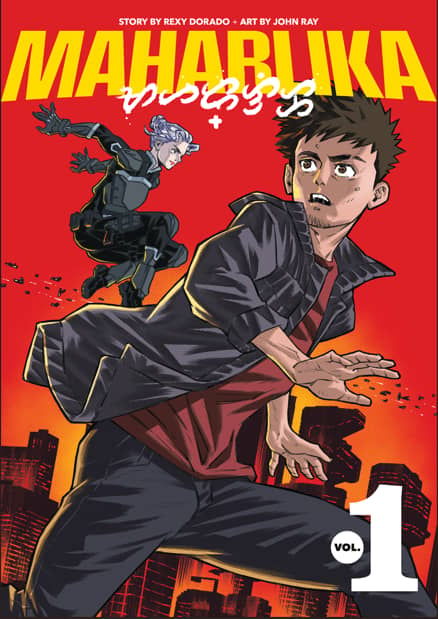
'MAHARLIKA' volume one.
During his time at Kumu, Dorado found himself gravitating toward projects that left something tangible behind — creative works that could outlast platforms and algorithms. He points to Kumu-backed efforts such as a film produced with director Cathy Garcia-Molina and funded through livestreaming, partnerships with comics publishers, and the early careers of artists and bands who found their first audiences on the platform.
“What I was proudest of,” he says, “was asking: can we leave something people will still read, listen to, or watch 100 years from now?”
That question ultimately pushed him back to writing. While still at Kumu, Dorado wrote Maharlika, a science fiction comic later published under Penlab, a comics platform Kumu briefly acquired. Earlier this year, he returned to the project to release its second volume — this time with renewed clarity about what he wanted his creative life to look like.
Stepping away from his full-time role at Kumu in 2023 was not a rejection of entrepreneurship. Dorado now straddles both worlds: storyteller and builder, artist and strategist.
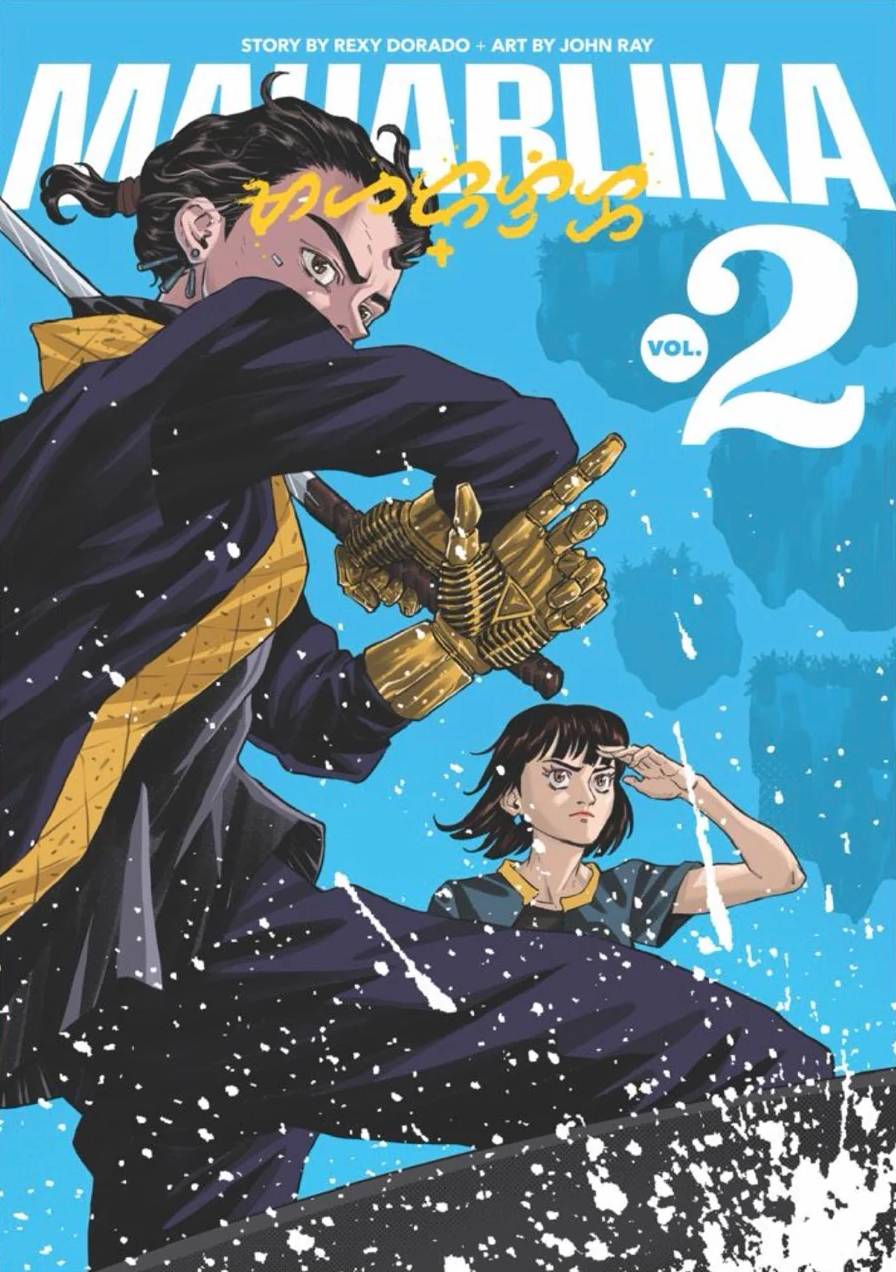
'MAHARLIKA' volume two.
The problem isn’t the stories
When asked about the challenges of bringing Filipino stories to a global market, Dorado is quick to reject the idea that the issue lies in content.
“From a raw material perspective, the stories speak for themselves,” he says.
With a large domestic audience and a global diaspora of more than 10 million Filipinos, he believes there is already a built-in market hungry for stories that resonate culturally and emotionally.
Filipino creators, Dorado argues, are uniquely positioned to reach global audiences. “We speak English, and we’re exposed to American, Japanese, and Korean culture,” he says. “That gives us a kind of fluency.”
The real obstacles, he says, are structural. Distribution channels are limited. Funding is scarce. Artists are rarely paid enough to focus on their craft full-time.
“There’s no one in the Philippines who can pay an artist to drop their day job and just draw comic pages,” Dorado says. “And internationally, no one is really looking to hire Filipinos to do that either.”
That gap, between creative potential and economic reality, is where Dorado’s entrepreneurial background comes into play. Building Kumu taught him how to think in terms of systems, sustainability, and scale. Now, he’s applying those lessons to comics, publishing, and eventually animation.
Why science fiction?
Dorado’s creative output leans heavily toward science fiction and fantasy, genres he sees not as escapist but interrogative.
“The best sci-fi is a commentary on the present,” he says. “You create a future to explore questions about us right now.”
Maharlika, for instance, is set in a speculative future but grapples with themes of power, rebellion, and who gets to shape what comes next. The genre, Dorado argues, is especially relevant in times of rapid technological and social change.
“With AI, robotics, and automation, all of that has implications on how Filipinos live and work,” he says. “Sci-fi is an important tool to think through how we navigate that.”
His influences are global but deeply thematic. Films like Blade Runner shaped his interest in questions of memory and humanity, while anime series such as Neon Genesis Evangelion and Steins;Gate left a lasting mark with their explorations of mental health, fate, and free will.
“You can draw a pretty clear line between those stories and Maharlika,” he says.
Growing Filipino sci-fi scene
Dorado is careful not to position himself as a lone voice. He sees Maharlika as part of a slowly expanding ecosystem of Filipino speculative fiction. He cites works like Tablay, a Filipino mecha novel now being adapted into a graphic novel, and D.E.I.E. (Department of Irregular Extermination), which imagines a dystopian authoritarian state through a distinctly local lens.
Fantasy, he notes, has long had a foothold in Philippine comics, from Trese to mythology-inspired works that laid the groundwork for today’s independent creators.
“The demand to make these stories has always been there,” Dorado says. “And the demand to read them is there too. What’s missing is the channel between them.”
Looking ahead
Despite the dark, dystopian worlds he often builds, Dorado insists that hope remains central to his work.
“My stories are about change,” he says. “Change is really hard, but it’s worth fighting for.”
Violence, conspiracy, and suffering are present in his narratives, but never as spectacle. Progress, in Dorado’s worlds, is slow and costly — and that’s precisely the point.
“It’s not a power fantasy,” he says. “Nothing is easy. The hope at the end is something you really earn.”
Dorado’s ambitions are both intimate and expansive. As a writer, he’s working toward a collection of short Filipino sci-fi love stories. As an entrepreneur, he’s focused on building a company that can systematically invest in Filipino intellectual property.
Maharlika is just one part of that vision. Two more serialized comics are currently in development, with more on the way. Early work has also begun on adapting Maharlika into an animated film.
The goal, Dorado says, is not just to publish stories, but to give them the time, budget and care they deserve.
“If we can do even a fraction of what Shonen Jump did for Japanese stories,” he says, “it’s worth doing.”