
Tragedy in plain view
Legislators wield significant influence over these programs, as they serve as the gatekeepers to medical assistance and other government services, such as scholarship.

The General Appropriations Bill (GAB) was supposed to be the litmus test for the lawmakers’ avowed reforms to eliminate the pork barrel from the 2026 national budget and the results were disastrous.
The seduction of the wellspring of money lodged in the yearly appropriations was too much to resist for legislators who had to maintain the patronage programs aside from the allocable insertions.
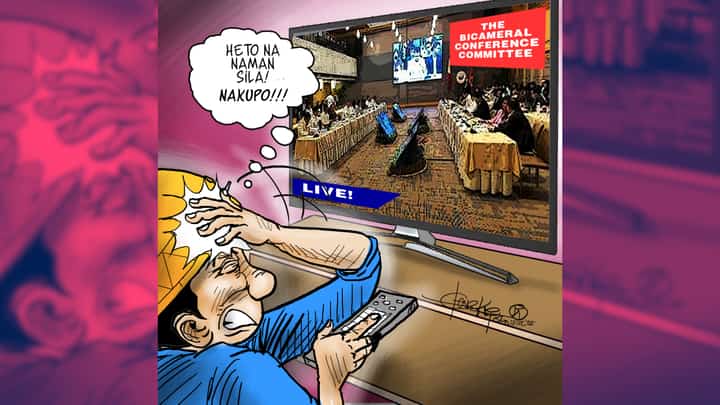
The Bicameral Conference Committee (Bicam), livestreamed, concluded its deliberations and the final version of a draft General Appropriations Bill is expected.
The financial assistance programs, which require legislative endorsement, included in the proposed budget are the Medical Assistance for Indigent and Financially Incapacitated Patients (MAIFIP), the Assistance to Individuals in Crisis Situations (AICS), Tulong Panghanapbuhay sa Ating Disadvantaged/Displaced Workers (TUPAD), and the Tulung Dunong.
All of these are, in one way or another, forms of social aid (ayuda) that displace rules-based social schemes, such as the flagship Pantawid Pamilyang Pilipino Program (4Ps).
Legislators wield significant influence over these programs, as they serve as the gatekeepers to medical assistance and other government services, such as scholarships.
Even the provision against political patronage, which seeks to bar politicians from participating in the ayuda schemes, will not deter their use for partisan gain.
The proof of the pudding is in the eating, according to budget pundits, who underscored the P120 billion increase in allocations for the aid schemes over that of the national expenditure program (NEP), indicating that these remain the pet projects of legislators.
Despite the provision, members of Congress continue to have leeway in determining how the funds are allocated and to which districts, which shouldn’t be the role of legislators.
The implementing agencies should design the programs for how the funds will be dispersed and targeted.
Under the ayuda schemes, a guarantee letter from a politician is needed. Thus, instead of obtaining services from the Philippine Health Insurance Corp. (PhilHealth), which implements the Universal Health Care Act (UHCA), the budget bill has the MAIFIP, which is allocated to lawmakers.
Instead of focusing on strengthening the UHCA, the bill pushes the patronage system using the argument that the country still doesn’t have a good healthcare program.
Unprogrammed appropriations (UA), a vehicle for pork barrel spending, reached P250 billion in the budget proposal, while several last-minute insertions were identified.
Through the livestream, the Bicam was exposed as a horse-trading arena for the House of Representatives and the Senate rather than a body to reconcile the different provisions of the budget bills of both chambers.
It became evident that the Bicam has been transformed into the most powerful branch of the legislature, where new programs and line items in the budget are created.
It must be remembered that President Ferdinand Marcos Jr. vowed to exercise his veto power if the enrolled bill deviates from the NEP.
Yet compromises with Congress, including the sudden loss of urgency in prosecuting the big fish in the corruption scandal, will weigh heavily on the final composition of the 2026 national budget.
More broadly, the transactional politics that President Marcos has descended to amid his declining survey numbers may prove to be the single most significant determinant for the final budget.