
P500 Noche Buena: Notes on a scandal

Don’t mess with Filipinos when it comes to food. Chow is taken seriously this side of the globe.
When the late Cory Aquino was just warming her seat as president of the Republic, she gauged the state of the country’s economy by the price of galunggong (round scad). That stunt backfired on her as the price of this fish variety kept rising and rising until it became unaffordable to the poor. Today, galunggong sells at P400 a kilo at the Pritil market in Tondo.
Until Rowena Guanzon’s meltdown early this week, the internet was abuzz with food talk. The piece de resistance was Department of Trade and Industry Secretary Cristina Roque and her “P500 Noche Buena” suggestion. What was she thinking? But instead of simply eating humble pie when the whole country turned against her, she put the stove on high until the pot reached boiling point by insisting that one can buy three medium-sized tubs of leche flan for P99. Ma’am, please tell me where you buy this sweetmeat? I’ll just keep one tub and you can have the other two.

DEPARTMENT of Trade and Industry Secretary Cristina Roque
PHOTOGRAPH by john carlo magallon for DAILY TRIBUNE
This P500 Noche Buena scandal inspired The Butcher to write about food and food props used on TV and in the movies. If you must know, catering eats up a huge chunk of the production budget and this is the reason why some producers try to scrimp on food on the set.
Emilia Blas of Lea Productions was said to have been so stingy that during a press conference for one of her films, she told two reporters to share a bottle of Coke. She was, however, considerate enough to have provided two glasses and didn’t expect those scribes to drink from the same bottle. She may have been thrifty, but, at least, she observed the rules of proper hygiene.
Below are more stories about food and food props in the local showbiz industry:
Nova Villa ate stale food while playing Gloria Macapagal
In 1965, Nova Villa, then a very young actress, was cast in the biopic of President Diosdado Macapagal. The movie was titled Poor Boy from Lubao, which was used as a propaganda tool for Macapagal’s reelection.

NOVA Villa
PHOTOGRAPH courtesy of instagram/nova villa
A lot of the scenes were shot in Malacanang since the Macapagals, the official Palace residents that time, were behind this project. Nova played the role of the teenage Gloria Macapagal.
While shooting a breakfast scene at the Palace dining hall, the food props used were the usual middle-class Pinoy morning fare: fried rice, egg and a low-end brand of ham. Real food was used. In the middle of filming, however, production was asked to pack up because there was going to be a Malacanang official dinner for some foreign dignitaries and the dining hall had to be cleared. The plates with food were taken away.
When they continued the scene the next day, the same plates with the fried rice, egg and ham reappeared. Almost 24 hours had passed and the food had gone bad. But the cast members were still expected to eat the food on the table. Nova still cringes at the memory. She remembers eating teeny-weeny bites of the spoiled food and called on all the saints in heaven to spare her from food poisoning.
Macapagal, by the way, lost in his bid for re-election. Was it karma for serving spoiled food?
Is this why Marvin Agustin is into food business?
This story comes from Ai-ai de las Alas. The incident happened during a meal scene for the first edition of Tanging Ina.
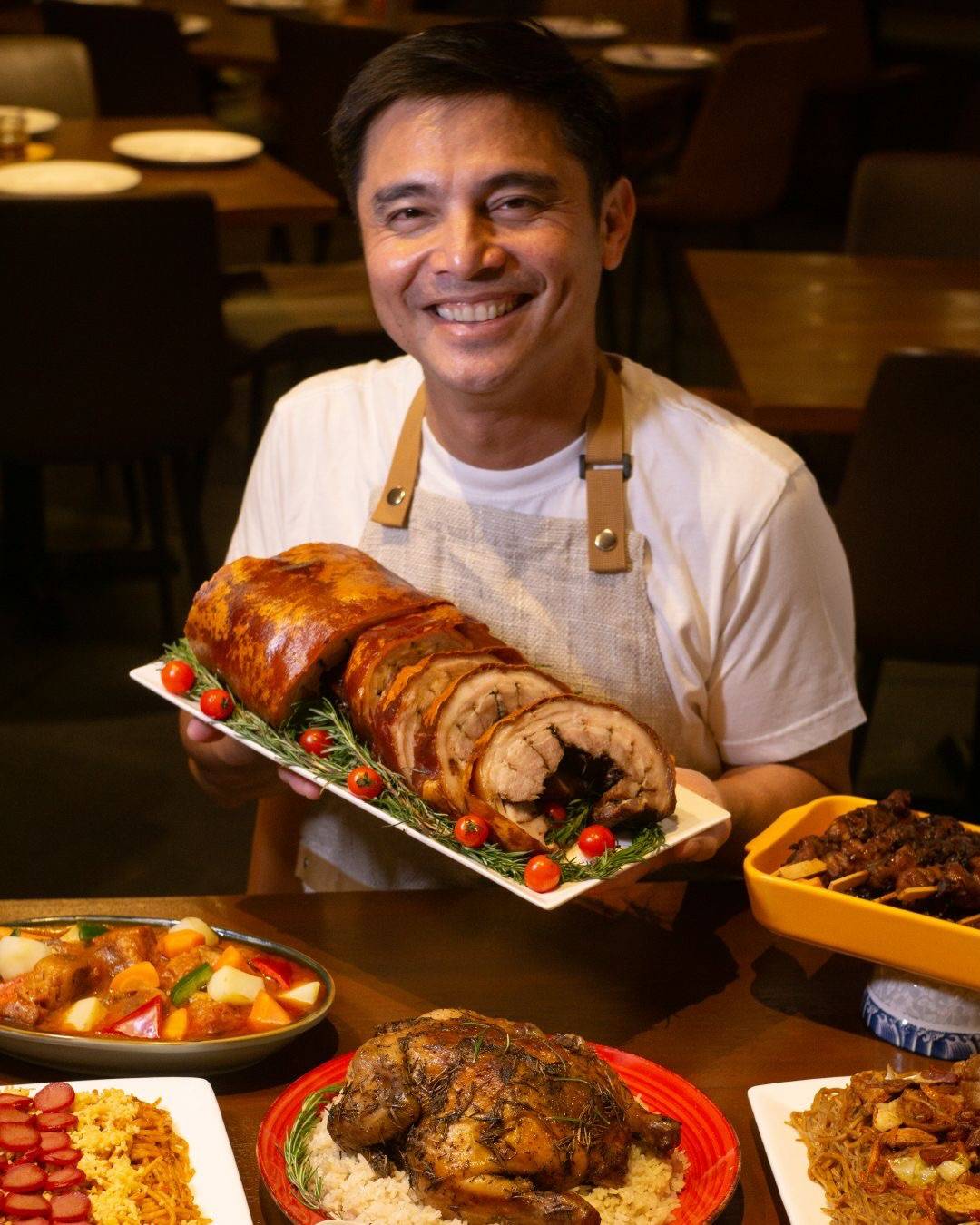
MARVIN Agustin
PHOTOGRAPH courtesy of instagram/marvin agustin
While the late director Wenn Deramas was giving instructions to the technical crew, the young cast members, led by Marvin Agustin, helped themselves to the food props on the table – a platter of stewed meat. When the director turned around and found the food props gone, he went berserk because that meant a delay in the shoot. The production designer had to buy food again and that took time.
Deramas started screaming at Marvin and company: “Hindi ba kayo pinapakain sa bahay (“Don’t they let you eat at home)?!” Could that be the reason why Marvin started his food business? After all, stewed meat followed by a dessert of severe scolding isn’t what you’ll call an ideal meal.
Rated PG
When I appeared in my first picture in 1995, the principal photography was in Baguio City. Produced by Regal Films, the title of the movie was Angels. It was budgeted at P5 million, which was huge that time. In those days, film companies managed to churn out films at P2 million or P3 million at the most.
On my first shooting day, all I was made to do was run. It wasn’t an easy task since I was wearing leather shoes and I had to follow a muddy trail.
When lunch came, we were given the usual blue plastic tray that had rice, chicken curry and a piece of banana. Today, the meal is served in porcelain plates protected by Saran Wrap. That’s for the “artistas.” For the crew, they make do with meals in Styrofoam lunch boxes. The meal is the same for everyone though – rice, chicken curry still and the eternally present banana. The difference is just in the container.
As for the quantity, nothing has changed. It’s still the dieter’s delight – small portions that make everyone beg for more.
During that Baguio shoot, there were no snacks served in-between meals. By 4 p.m., I was so hungry that when I looked at the olive-skinned Dina Bonnevie, she looked green to me. And I wasn’t hallucinating when I heard Ronaldo Valdez’ stomach growl.
Even if we wanted to drive to town to buy food, we were not allowed to leave the set. Everyone was on standby because the next scene to be shot was a big one that required the presence of all cast members.
Aga Muhlach must have noticed that everyone around him were starting to look like newly-released inmates from Auschwitz that he fetched some 10 packs of Sky Flakes from his vehicle. As soon as he dropped the crackers on the table, what followed was an all-star mad rush. Elbowing each were award-winning actors: Michael de Mesa, Elizabeth Oropesa, Jaime Fabregas, Nova Villa, Lito Legaspi and, yes, Ronaldo Valdez. The scene was Rated PG. PG for Patay-Gutom.
To our disappointment, that film was never finished. I was already in Manila to attend to my then weekly TV show when trouble erupted in the Baguio set. Apparently, the child actors (a whole lot of them) felt they were overworked and filed a case with the Department of Labor and Employment against the director, Vit Romero. Regal Films decided to shelve the project.
The stars of the film had no reason to complain because we all got compensated. And as an added bonus, we all lost weight without having to sweat.
Budget cuts equals lower ratings?
Around 2003, ABS-CBN decided to get a foreign-based consulting group to check where the network could cut costs. Production budget was slashed and that affected catering. To save on Styrofoam cups, a new rule was imposed: if you wanted coffee, bring your own mug.
After austerity measures were set in place, the ranking of ABS-CBN drastically shifted. It was No. 1 then, but slid down to No. 2 by 2004. That made GMA the top network for 10 years.
Maybe it was mere coincidence. There must have been other factors that enabled GMA to wrest the crown away from ABS-CBN. But that taught ABS-CBN a hard lesson: Saving on styro cups simply wasn’t worth it.
In 2014, GMA was still flying high as the No. 1 network. But instead of rewarding its people for all the hard work, management cut corners instead. GMA decided to hire the same consulting firm that brought ABS-CBN down to its knees.
To save on money, meal allowance was again sacrificed. Prior to the budget slash, P80 was allotted per person during shoots — regardless of status. The star of the show ate the same food as the utility men, which was just fair.
And in 2014, P80 was still sufficient to feed a person. That was the cost of a value meal in McDonald’s or Jollibee. But following the recommendation of the consulting group, the P80 meal allowance was reduced to P50. A P30 difference was significant 10 years ago.
Manny Pacquiao had a program in GMA that time. The show’s executive producer was put in a quandary. How does one feed a Manny Pacquiao for P50? The P80 meal allowance was already a challenge even for a B.S. Math major running for honors. And now, the Pambansang Kamao had to make do with a meal worth P50!
Management may not have noticed it, but there were a lot of disgruntled network employees then. And it didn’t help that GMA kept posting its profits.
History truly has a way of repeating itself. By 2015, ABS-CBN was back on top. Of course, half a decade later, Channel 2 lost its franchise to operate on free TV. But that was an entirely a political matter.
Charo Santos, who had no hand in the bring-your-own-mug policy, always knew how to take care of her staff. When she served as executive producer during the filming of Himala in 1982, she kept reminding key people in production to make sure everyone is happy on the set “because that will show on screen.”
Himala is now a classic. It was voted best Asia-Pacific Film of All Time by the CNN. Its production may have encountered logistical problems during filming, but everyone was said to have been generally happy during the entire Ilocos shooting.
Food is a source of happiness for people, particularly Filipinos who are big on traditions. The P500 Noche Buena costing of Trade Secretary Roque, therefore, doesn’t make Pinoys happy.
Let them eat ham. Let them eat spaghetti. Let them eat fruit salad – or macaroni. All that for P500, according to Roque. No cake?
If Roque fancies herself to be another Marie Antoinette, she is well-advised to think again. The delusional queen, after all, had a tragic ending.