
Films and film festivals raise concerns over HIV, smoking among youth


Apart from the alarmingly high incidence of HIV (human immunodeficiency virus) infection among Filipino youth today, which uses the entertainment media to let the people know about its documented threat nationwide, there’s another menace on the young whose alarm is sounded off through the entertainment media: youth addiction to cigarette smoking and vaping.
There’s a festival of short films now going on in Pasig City dubbed as “TobaccOFF NOW! Film Festival.” It is showing 25 short films made by young people themselves. The screening venue is the Metro Manila Film Festival Auditorium on the 5th floor of the new Metro Manila Development Authority Head Office in Pasig City.
The movies were also shown at QC’s Maki+Fiesta 2.0 on 11 to 12 December at the Ishmael Bernal Gallery and Videotheque at University of the Philippines in Diliman, Quezon City.
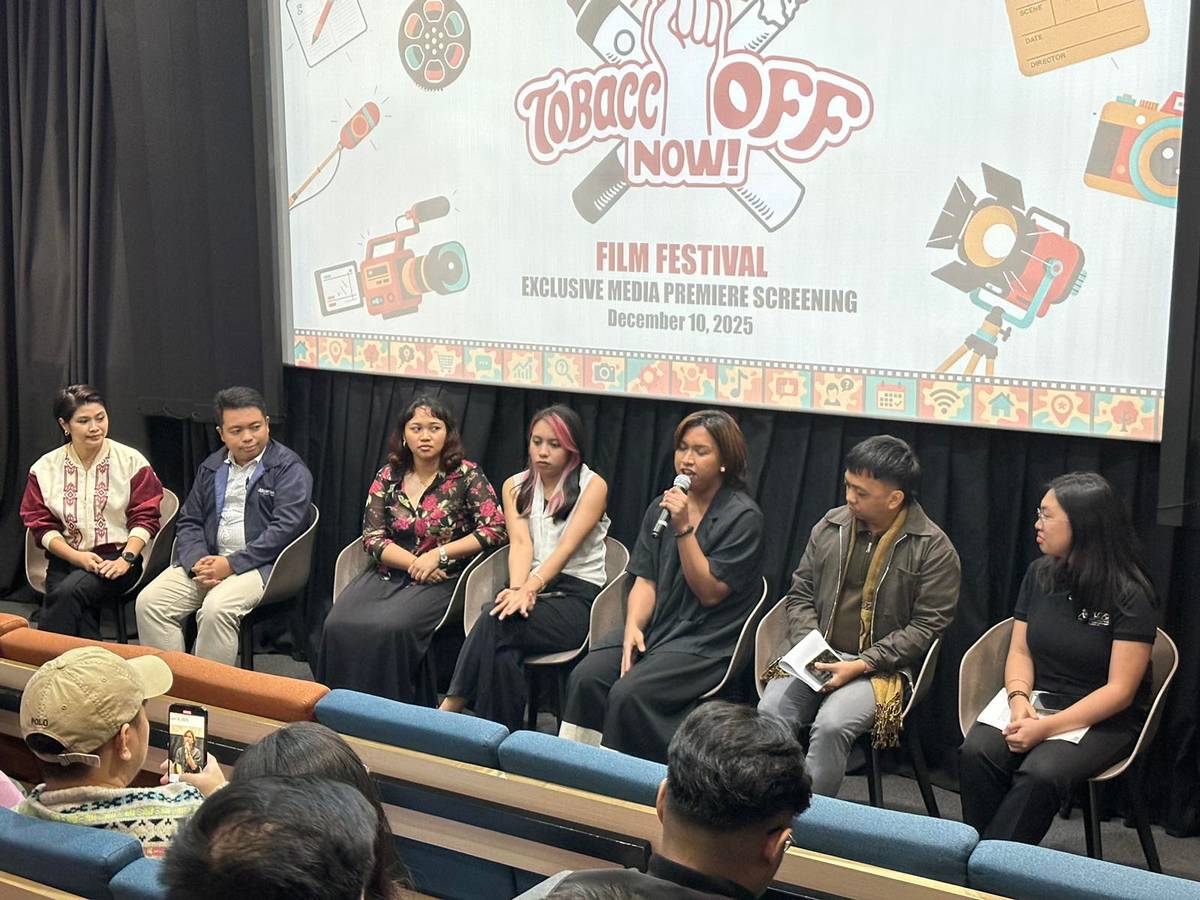
PANELISTS at the press conference for ‘TobaccOff Now’ at Cinema 76.
Photo by Danny Vibas for DAILY TRIBUNE
The press was treated to a preview of five of the short films on 10 December at Cinema76 in Tomas Morato Avenue Extension, a stone’s throw away from ABS-CBN studios.
The films we previewed were engaging, and their respective directors attended the screening. The organizers stressed that festival is part of a growing national movement that empowers the next generation to use storytelling and creativity as a tool for social change.
Amber Studios organized the festival in partnership with the Metropolitan Manila Development Authority (MMDA), Metro Manila Film Festival, and leading health and advocacy organizations, including Health Justice Philippines, Parents Against Vape and the Philippine Smoke-Free Movement.
At the press preview, the organizers said the festival is part of a nationwide movement to empower youth voices in shaping a healthier, tobacco-free future. They stressed that the making of the films involved months of “intensive” mentorship under esteemed journalists and filmmakers, resulting in stories that are “raw, honest, and thus, credible.” The mentors included Jacque Manabat, Chiara Zambrano, Tops Brugada and Jobert Monteras.
Through mentoring sessions, hands-on workshops and collaborative ideation, the participants developed short films that explore the evolving landscape of youth culture — shedding light on the struggles, influences and transformation shaped by tobacco and nicotine products.
“The festival gives young people the platform to tell their own stories — raw, authentic and unfiltered,” said Manabat of Amber Studios.
She added: “We’ve seen how tobacco and vape products increasingly target the youth through appealing designs, flavors and online strategies. These films help make sense of the realities behind those tactics and the impact they leave on young lives.”
Throughout the boot camp, mentors guided participants in developing their narrative voice, strengthening their visual style and exploring the deeper emotional truths behind their stories.
As professional filmmaker Rochelle Ona of the Metro Manila Film Festival (MMFF) staff said about the power of creating narratives: “Storytelling is a form of power — and these young filmmakers are learning to wield it with purpose. What moved me most was their honesty. The resulting films don’t preach; they reveal.
“And when young people reveal their own truths, it becomes impossible to ignore. And we, at MMDA and MMFF are very happy that we have supported this important advocacy.”
Meanwhile, as of the latest comprehensive data from the 2019 Global Youth Tobacco Survey (GYTS), about 12.5 percent of Filipino youth (ages 13 to 15) currently use tobacco products, with 10.8 percent smoking cigarettes and a higher 14 percent using e-cigarettes (vapes), highlighting vapes as a significant concern, though more recent reports show continued use and efforts to curb the “vaping epidemic” among youth despite existing laws.
But what about HIV infection among the young?
Here’s the latest available statistics: There will be more than 250,000 people living in the country with HIV by the end of this year, according to the Department of Health. As of the latest tally in September this year, there are 149,375 Filipinos in the country already identified as being HIV positive.
As of late 2023 data, individuals aged 15 to 24 years old (youth sector) accounted for about 29-34 percent of all reported HIV cases in the country. Reportedly, the youth sector consistently accounts for a significant proportion of the epidemic in the archipelago.
An average of 61 young Filipinos were diagnosed every day, as per a 2025 news report, highlighting the rapid increase in this demographic.
The more heartbreaking recent report comes from Koronadal City in Mindanao about a seven-year-old boy recorded as the youngest among at least 142 new cases found positive for HIV in South Cotabato this year.
John Arlo Codilla, head of the Disease Prevention and Control Unit of the South Cotabato Integrated Provincial Health Office (IPHO), said they were looking at the possibility that the child could have contracted the virus through sexual abuse or exploitation since he could not have acquired it from his mother.
“We’ve ruled out the mother-to-child transmission since she tested negative for HIV,” Codilla said in Filipino.
He said cases of HIV were recorded in various parts of the province from January to September 2025.
Of the total HIV cases in South Cotabato this year, 134 are males and eight are females, including the four who are pregnant, Codilla said.
The majority of the HIV cases belong to the 25 to 34 age bracket, followed by the 15 to 24 age group.
People’s attention to the alarming rate of increase in the number of young people who are HIV positive was galvanized by the recent publication of the book “Stigma: Batang Poz 2,” authored by Segundo Matias Jr. who began his public career as a film-TV scriptwriter. He wrote the scripts for Kristine (2010), Kumusta ka aking mahal? (1993) and Sana kahit minsan (1992).
Matias also has Palanca awards for his novels for children. His latest book is a sequel to Batang Poz, his groundbreaking 2018 novel, which ABS-CBN’s iWant turned into a TV series of the same title in 2019. Paolo Gumabao, Mark Nuemann, Awra Briguela and Fino Herrera made up the series’ lead cast, with Chris Martinez as director.
Matias is considered the popularizer of the slang “poz” as a euphemism for being positive to HIV.
In the new novel, there’s a young woman character, pregnant and HIV positive. Some of the characters in the sequel were also in the first novel, all males who have sex only with persons of the same gender.
National Artist for Broadcast and Films Ricky Lee attended the launch of the second novel at a book-publishing office in QC. Two of his novels have a male gay character whose mother is a lesbian. No one though is HIV positive.