




Bad budget doing encore
Across the 2023, 2024, 2025 budgets, cuts in the NEP totaled P1.5 trillion, which were reallocated elsewhere.

Text size
Across the 2023, 2024, 2025 budgets, cuts in the NEP totaled P1.5 trillion, which were reallocated elsewhere.
The annual tampering with the national budget in the Bicameral Conference Committee (Bicam) — that started with the administration of President Ferdinand Marcos Jr. in 2023 — is unique, as it was a previously unknown practice.
A person who is authoritative in the field of fiscal management — former Budget Secretary Butch Abad — has marveled at the ingenuity of legislators to raise a pork barrel.
The key to the racket is the Bicam assuming power greater than the House of Representatives and the Senate combined and even the President, since the body can change eight months’ work in crafting the budget from the President’s National Expenditure Program (NEP) to the General Appropriations Bill of Congress in just one day.
The changes happen in the highly secretive Bicam proceedings, where intense horse trading between the Senate and the House happens regarding discretionary funds.
Across the 2023, 2024 and 2025 budgets, cuts in the NEP totaled P1.5 trillion, which were reallocated elsewhere.
“In our time, this would never have happened unnoticed — too many people watch the budget because they have interests. Anyone affected should have protested,” Abad said.
Changes to the budget should occur only during the House and Senate floor meetings, when everything is on the record, including who proposed what and who objected.
In 2023, almost P397 billion was cut from the President’s budget after the third reading of the budget bill.
“They created a pool of funds with full discretion. It had no name because it was unprecedented. They created new projects or added to others, like the Ayuda para sa Kapos ang Kita Program (AKAP), which did not exist in the 2022 NEP,” Abad pointed out.
The slashing of almost P400 billion from the budget also had never happened in the budget’s history, “not when I was secretary for six years, nor when I was a congressman,” the budget chief of the late President Noynoy Aquino said.
“Worse, it happened again in 2024 and 2025,” Abad noted.
He said that if the Philippine Health Insurance Corp. (PhilHealth) controversy had not happened in December 2024, the scheme would have continued until next year’s budget.
The budget preparation process starts with the President meeting with leaders of both chambers of Congress before he formally submits the outlay.
In the meeting, the President lays out his nonnegotiable priorities while telling the legislators that district requests are included in the NEP.
In effect, the message of the meeting is that the President has his priorities and Congress has theirs, so the delineations must be respected, or the Chief Executive can exercise his veto power.
“That’s why things ran smoothly during our time — we always approved the budget early, even in December. It was never reenacted,” Abad said.
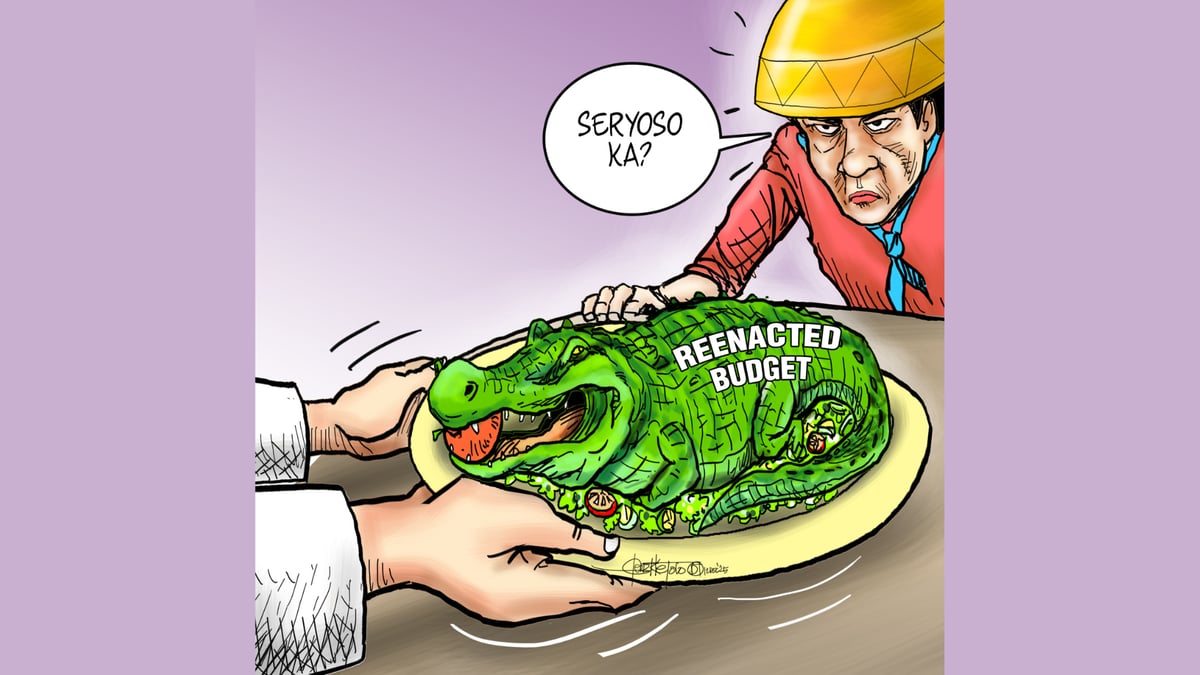
According to Abad, a reenacted budget is never preferable to a regular budget because the government’s entire budget becomes a lump sum at the President’s disposal.
“Congress surrenders its power to approve the budget and the development plan loses its funding because last year’s budget is reenacted,” he said.
The President thus assumes the power to reallocate funds and to stall development projects.
President Marcos and his allies may resort to a reenacted budget because it will be far simpler than pushing through with the insertions and reallocations needed to assemble a political kitty for 2028.
With the sluggish pace of work on the 2026 budget, it is increasingly likely that the country will again operate under the 2025 General Appropriations Act, the most corruption-ridden budget law in history.
