
Budget thieves all over gov’t
The Constitution has no provisions that contemplate the UA; thus, the justice said the SC is duty-bound to nullify it.

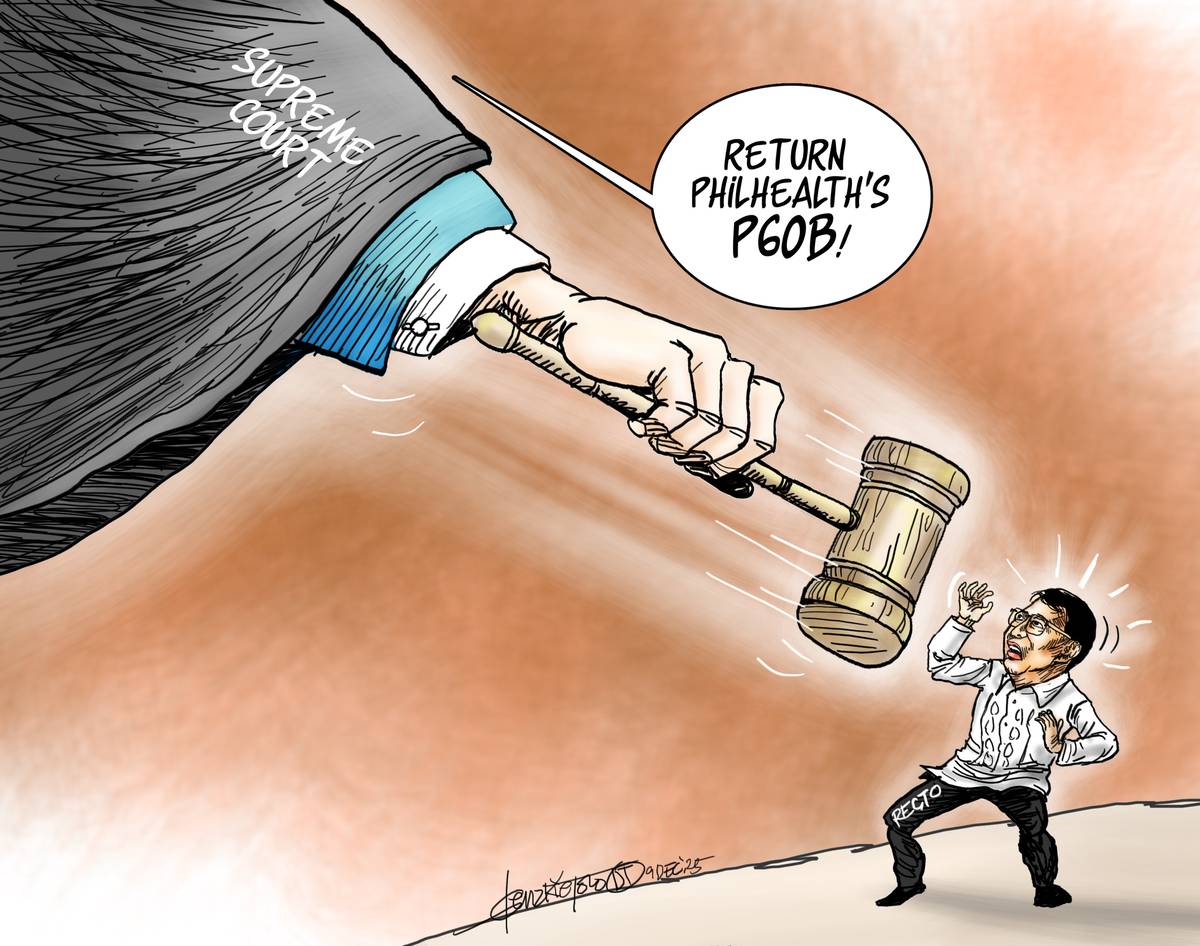
In the Supreme Court deliberations that led to the decision ordering the government to respect the mandate of the Philippine Health Insurance Corp. (PhilHealth) and to return the P60 billion taken by former Finance secretary, now Executive Secretary, Ralph Recto, deeper issues were brought to light.
In a separate opinion to the majority ruling, Associate Justice Ramon Paul Hernando said the notorious unprogrammed appropriations (UA), “in any form, are unconstitutional.”
The UA portion in the yearly budget is the repository of items the funding for which is contingent on additional funds, excess revenues, or new borrowings.
Thus, it follows that projects contained in the budget receptacle are not priorities of the administration.
For the past three years, however, the UA has mutated into a conduit for pork barrel, has ridiculously ballooned, and has found that many of the flagship projects should have received guaranteed funding.
A genius, adept in circumventing the 2013 High Tribunal ruling invalidating the Priority Development Assistance Fund (PDAF), had thought of a scheme to free up space in the budget for pet projects of legislators by displacing key projects, including foreign-assisted deals, which have committed funding. The government pays fees if these are missed.
Hernando warned that the fiscal powers of government are never untethered from constitutional limits, and “those limits are at their most exacting when the funds at stake safeguard the people’s right to health.”
In arguing that the UA violates the Constitution, Hernando said the standby provision creates “an unregulated space where discretion replaces discipline, and where the temptations of greed and corruption inevitably find room to operate.”
“Inclusion of the UA in the General Appropriations Act (GAA) is repugnant to the Constitution,” he added.
While unprogrammed funds are not lump-sum funds that are prohibited under the Charter, they cannot be “embodied in the GAA,” according to Hernandez.
According to the magistrate, the UA should be legislated through a special appropriations law.
The Constitution has no provisions that contemplate the UA; thus, the justice said the SC is duty-bound to nullify it.
The diversion of P89.9 billion from PhilHealth’s reserves was enabled by a “legally defective mechanism and executed through an excess of executive authority,” Hernandez indicated.
He traced the inception of the UA in the 1989 GAA, amounting to only P9.7 billion.
Now, cumulatively from 2022 to 2025, the average annual UA was about P634 billion, more than double the pre-2022 average of P150 to P200 billion.
Considering that unprogrammed appropriations do not have guaranteed or definite funding sources, these do not fall within the meaning of “a budget of expenditures and sources of funding,” as contemplated under the Constitution, Hernandez stated.
At most, the UA is considered a rider to the GAA, since unprogrammed funds do not relate to expenditures by funding source.
A rider is defined as a provision or clause added to a bill that is not directly related to its primary purpose. Its insertion is prohibited under the Constitution, according to Hernandez.
In its 2013 ruling, the High Court declared all forms of pork barrel illegal. Yet every budget cycle, a new fiscal abomination emerges.
Flouting the pork barrel ban remains at the core of the corruption in Congress.