




A season of dark horses


Text size
THE main cast of 'Bar Boys: After School.'
Photograph courtesy of 901 Studios
Buddies, associates? One happy family?
A traditional dish called zongzi is served during China’s Dragon Boat Festival, which falls in June. It is a rice…
Divina credited the firm’s achievements to its members, thanking them for their ‘hard work, dedication, teamwork, and…
‘Sec. Vince Dizon, please explain how this finding of your own team should not be flagged as a ghost project in Taguig.’
A dark horse, as defined by the Merriam-Webster Dictionary, is “a usually little-known contender that makes an unexpectedly good showing.” By this definition, two entries in the 51st edition of the Metro Manila Film Festival (MMFF) fit the description: Kip Oebanda’s Bar Boys: After School and Shigo Praico’s 1775, Joey de Guzman’s 2025 and Ian Loreñas’s 2050 — the trilogy that comprises Shake, Rattle and Roll: Evil Origins.
Little-known contender
Why is Bar Boys a dark horse? It is independently produced by 901 Studios, whose trio con brio — Leo Liban, Carlos Ortiz and Jon Galvez — are three relatively young gentlemen who believe that their film’s greatest ace is its story. Despite the lawlessness and ugliness that have become part of our daily lives, these movie mavericks firmly believe that there are still a few good men and women who fight for the truth and nothing but the truth, who remain fair and just, and who follow the dictates of their conscience and heart — practicing law not just as a career but as a profession and vocation.
Director Oebanda (Liway, Balota) shares screenplay credits with Carlo Enciso Catu (Kung Paano Hinihintay ang Dapithapon, Happy Crush) and Zig Dulay (Firefly, Green Bones), which is another of the film’s strengths. The narrative is part reunion, part the friends who stay and leave, with challenges and complications thrown at you — where “adulting” is no longer just a concept or a what-if, but something that slaps you hard in the face.
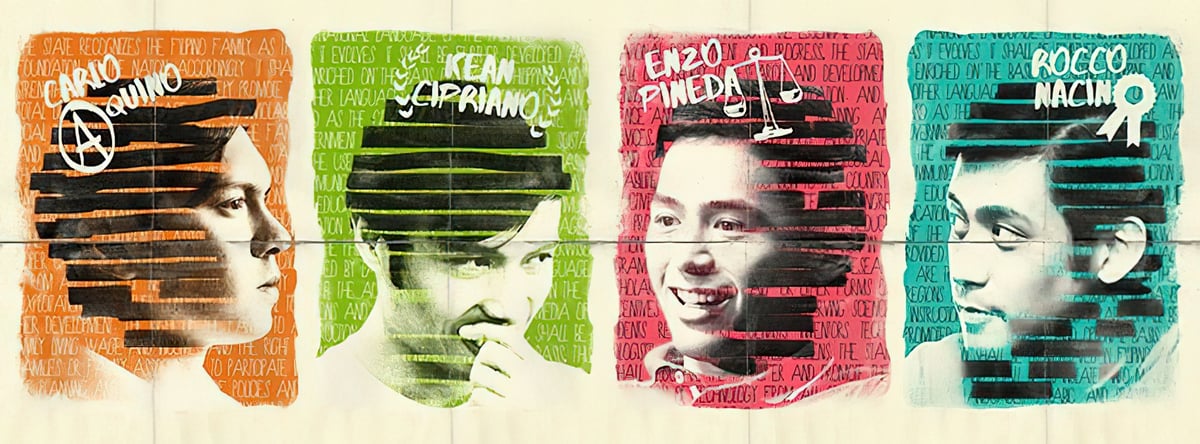
Another appeal of this dark horse is its casting. A mix of the original actors — Carlo Aquino, Rocco Nacino, Kean Cipriano and Enzo Pineda — reprise their roles as Erik Vicencio, Torran Garcia, Joshua Zuniga and Christian Carlson. They are joined by a new set of talents: Will Ashley (Arvin), Sassa Gurl (Trisha), Emilio Daez (Ziggy), Therese Malvar (CJ), Klarisse de Guzman (Mae) and Glaiza de Castro (Jazz).
Oebanda said, “It’s all about growing up. It separates the boys from the men, the girls from the ladies. It’s life no longer seen in pastel, glossy, sunshiny hues. It’s about illusions being shattered, dreams becoming real — but not easily. It’s a love letter to all of us, and a reminder that we can get more out of life if we fight for it, work for it, and commit to making it better — if not the best.”
An unexpectedly good showing
Regal Films’ Shake, Rattle and Roll: Evil Origins is also a dark horse, by virtue of being a strong contender for one of the top box-office spots in the annual MMFF — if not the number one film that will reign this Yuletide season.
Its biggest wind beneath its cinematic wings is the mother-and-son producing team Roselle Monteverde and Atty. Keith Monteverde, who ensured that the 16th rebirth of their horror franchise fulfills its promise of bringing to the silver screen the menace and mayhem of Evil Origins.
The Monteverde scion said: “Evil Origins is definitely a level-up version of the Shake, Rattle and Roll horror franchise. It pushed creative boundaries. It employed distinct directorial visions and talented screenplay writers. The cast of each episode was meticulously chosen. We gave the public quiet and atmospheric horror — palpable and throbbing — in 1775. 2025 brings a modern, chaotic, frenzied energy. And a dystopian Philippines and how to survive it is the now and the normal in 2050.”
The weaving of three distinct horror stories set in different timelines, yet forming one continuing narrative, brings a new kind of excitement, power, and potency to the franchise whose first anthology included Baso, Pridyider and Manananggal.
The narratives of Evil Origins explore themes of faith, friendship, loyalty, resilience, and survival in the face of various evils — folkloric, mythical and man-made.
Adding even more star power to the latest version of the anthology is its multigenerational cast, which includes Shake, Rattle and Roll damsels-in-distress Manilyn Reynes and Janice de Belen; superstar Richard Gutierrez; YouTube sensation Ivana Alawi; actresses Carla Abellana and Loisa Andalio; and a roster of millennial and Gen Z stars led by Seth Fedelin and Francine Diaz.
Shake, Rattle and Roll: Evil Origins slays with its exploration of Filipino folklore and its emphasis on the many forms of evil and the ways to confront them. It is a cinematic and cultural triumph, declaring that in the battle between good and evil, the good always triumphs — and evil always gets its comeuppance.
