
Landslides turn Sri Lanka village into burial ground
‘This is a cemetery now. We don’t want to live in this village anymore.’
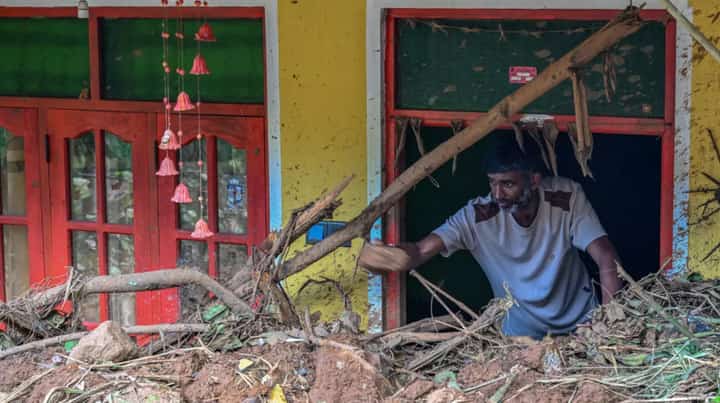
VK Muthukrishnan, 42, removes debris from his house following landslides in the aftermath of Cyclone Ditwah in Hadabima village near Sarasavigama on December 4, 2025
AFP photo
KANDY (AFP) — Electrician V. K. Muthukrishnan ran to help when a lightning-fast mudslide flattened his neighbor’s home in rural Sri Lanka — only to see his own house swept away minutes later.
A friend whom he directed to the disaster site to aid rescue efforts was also killed in the second cascade of mud and boulders.
“I have nightmares, thinking that I sent my friend to his death,” a tearful Muthukrishnan said as he showed Agence France-Presse (AFP) reporters the wreckage of his modest home, destroyed on 27 November.
“But it could have been more.”
AFP was among the first news outlets to enter the stricken central province of Kandy, where the main road had been cut off for over a week due to falling boulders and landslides.
Reporters managed to get in when the road opened briefly on Thursday, before it shut again for urgent repairs.
In picturesque Hadabima village, surrounded by mountains on one side and a river on the other, 24 people were buried in last week’s mudslides.
That is a fraction of the national toll of 481 deaths, more than half in the tea-growing central hills. Heavy rains triggered by “Cyclone Ditwah” had saturated the mountainsides and made them unstable.
‘A cemetery now’
Tailor Adish Kumaran, 41, said his sister and brother-in-law were buried when they rushed to rescue a neighbor whose home was damaged.
“They were also caught up in a second slide,” Kumaran told AFP, adding that six bodies had not yet been recovered.
“This is a cemetery now. We don’t want to live in this village anymore,” he said.
Nationwide, some 345 people remain missing, according to official figures.
The government has said about 25,000 houses have been damaged or completely destroyed and has promised state help to rebuild.
But the main agency dealing with the recovery effort says Sri Lanka will need up to $7 billion for the task, much of it from international donors.
It is a vast sum for the island of 22 million people, still reeling from an economic meltdown in 2022.
Tea factory worker Mariah Sivakumar, 39, said her immediate priority was her three school-going children.
“All their books and clothes have been lost in the floods,” she said from a relative’s home after authorities warned her own house was at risk from a landslide.
She said there was no way she and her husband -- also a tea factory worker -- could afford to buy new uniforms and textbooks for the children, let alone build a new house.