




Ex-Thai central bank chief urges flexible policy
Text size
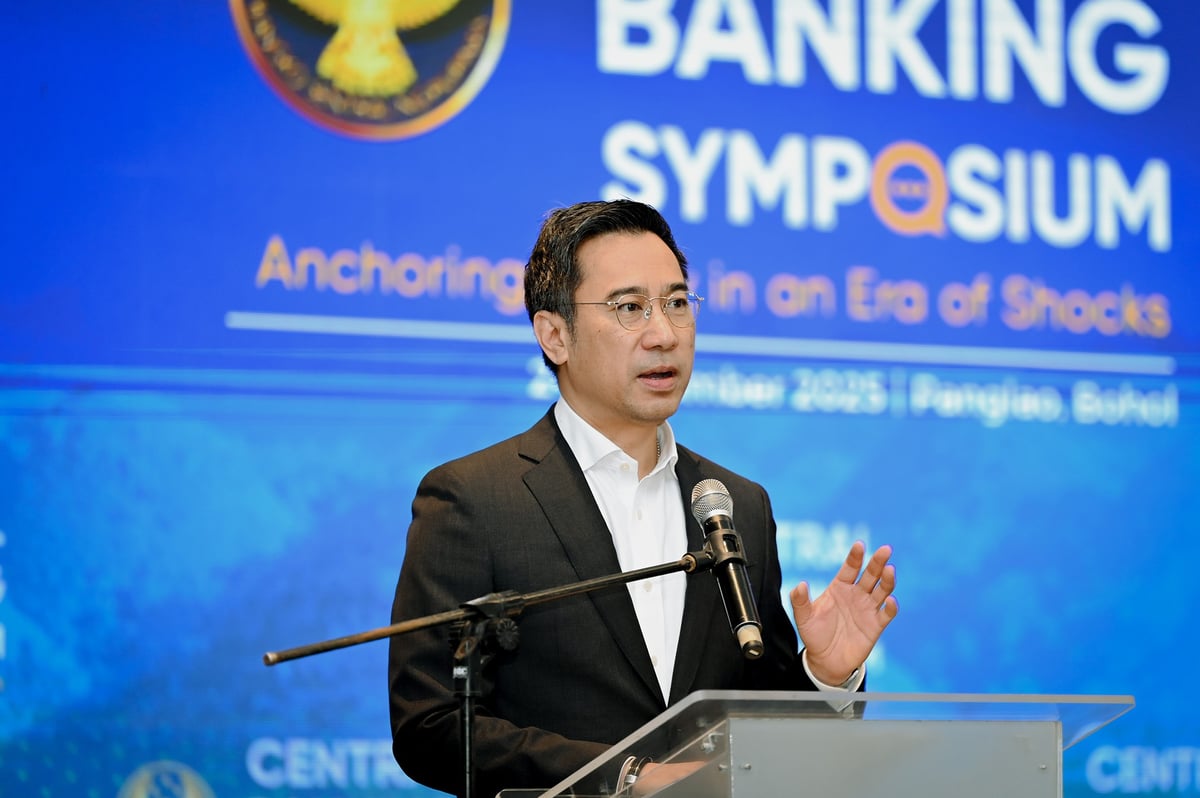
PANGLAO, BOHOL – Central banks should adopt a more flexible approach to monetary policy to better withstand external economic shocks, according to former Bank of Thailand Governor Dr. Sethaput Suthiwartnarueput.
Speaking at the Bangko Sentral ng Pilipinas (BSP)’s inaugural Central Banking Symposium at the Bellevue Resort in Panglao, Bohol on 24 November, Suthiwartnarueput cautioned against rigid numerical targets, saying adaptability allows central banks to respond more effectively to global uncertainty.
“There's a danger, in my view, that when we focus too much on very specific [numerical] outcomes, that it leads us to suboptimal outcomes,” he said.
“When we focus too much on these precise numerical targets, we end up focusing too much on things that we can measure, because we can measure them, and less so on things that are important, but that we cannot measure so precisely, like financial stability,” he added.
He argued that inflation targeting should be expressed as a range rather than a single number, noting that overly precise targets may limit the effectiveness of monetary policy in the medium and long term.
“If we focus too much on inflation targeting and specific numerical targets... we might give less or inappropriate attention to other things that are very important, again, like financial stability,” he said.
The BSP has applied a similar approach, setting its inflation target at 2 to 4 percent rather than a fixed 3 percent to allow more flexibility for monetary action, including potential rate cuts.
Suthiwartnarueput also said central banks must be more reactionary than preemptive in policymaking. This “optionality,” he noted, reduces uncertainty for investors and consumers. “In a world where there's a lot of noise and uncertainty, I think the last thing we should do as policy makers is keep adding to that noise and uncertainty,” he said.
He advocated an outlook-oriented rather than purely data-dependent approach, warning that reacting excessively to volatile short-term data may amplify uncertainty rather than anchor expectations. He also highlighted the value of foreign exchange intervention (FXI), when used in a timely and limited fashion, as a tool to stabilize markets.
The BSP has echoed this stance, repeatedly saying it only intervenes during periods of extreme volatility and otherwise allows the foreign exchange market to move freely.
Suthiwartnarueput closed by emphasizing the importance of strong buffers—such as well-capitalized banks, ample liquidity, and sufficient foreign exchange reserves—as the foundation for monetary flexibility.
“When our banking sector is solid and we have enough capital and liquidity buffers, we're able to handle interest rate flexibility. When we have adequate buffers on foreign exchange reserves... buffers are going to continue to be critical,” he said.
Themed “Anchoring Policy in an Era of Shocks,” the BSP’s Central Banking Symposium brought together global financial and economic experts to help make economic research and policy communication clearer and more accessible to the public.
Housing is probably the biggest issue affecting people the world over.
Malacañang on Monday called for a more thorough investigation into the questioned flood control projects in Taguig…
The defense on Monday backed the move by senator-judges to exclude a prosecution witness who testified on the firearms…
