
What a police ‘invitation’ really means
Prudence is telling journalists, ‘Remove your balaclavas.’ Harassment is ‘inviting’ them to the precinct.
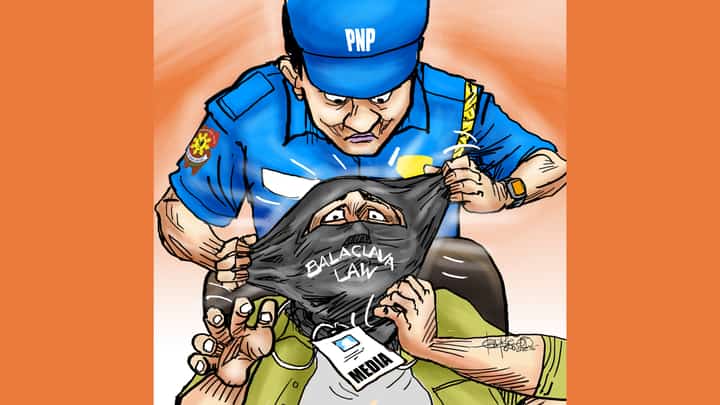
The Philippine National Police (PNP) insists nothing untoward happened in Ermita last Sunday, and its spokesperson, Brig. Gen. Randulf T. Tuaño, “clarified” that three media workers covering the second Trillion Peso March were not arrested for wearing protective gear like balaclavas, helmets and vests.
“We just want to clarify that they were not arrested — they were invited to the police station in Ermita,” Tuaño said in Filipino, as though the public had already forgotten what that phrase means in this country.
Here lies the first problem.
In the Philippines, an “invitation” by the police is rarely voluntary. It carries an undertone of compulsion — not explicitly illegal, but coercive nonetheless.
Everyone knows what follows when cops say, “Come with us.” A refusal is treated as an admission of guilt. Agreeing wastes your time, if you’re lucky. If you’re not, the usual ending is that the suspect “resisted arrest” or “fought back.”
The PNP can pretend those words mean something else, but the lived experience of Filipinos says otherwise. Our police are not approached for assistance; they are avoided. They are not symbols of protection; they are sources of anxiety. It is absurd for the PNP to act surprised when people interpret their “invitation” as intimidation.
Second, if this was truly about Manila’s Balaclava Ordinance, the enforcement was comically inefficient. If the police only wanted compliance, they could have simply asked the men to remove their balaclavas.
Instead, they were detained, questioned, and reminded of a law that was never intended to criminalize safety equipment. The ordinance targets anonymity in crime, not journalists preparing for potential physical hostility in a rally that had already seen violence.
Let’s be clear: the cops know this.
They know journalists had been beaten, pepper sprayed, blocked and shoved in past demonstrations — most recently on 21 September during the Mendiola dispersal of a breakout group from the first Trillion Peso March.
They know press workers have no illusions about on-ground risks. Protective gear is not fashion; it is survival. The PNP’s excuse that “legitimate journalists” do not treat protest sites as battle zones is laughable. Journalists treat assignments based on experience, not on police spin.
Third, the PNP’s logic collapses under its own weight. If the three men were not actually journalists, if they were agitators or criminals using PRESS insignias as cover, the PNP should have filed charges.
Let’s welcome the PNP to 2025 where citizen journalism exists.
Smartphones, livestreams, and independent platforms report diversified news. The PNP cannot insist that only journalists it recognizes are entitled to safety gear. The Constitution does not distinguish press freedom based on payroll source, accreditation ID, or editorial affiliation.
Neither does common sense.
Fourth, and most troubling, the Balaclava Law is being weaponized through selective enforcement. The ordinance was drafted to deter criminals from hiding their identity while loitering near establishments.
It was never meant to embarrass or police the press. The three men were not inside a bank or casing a shop. They were heading to cover a mass action, in broad daylight, at a location swarming with 17,000 police officers.
Only someone detached from reality would imagine them plotting a crime at the precise place where the state’s security apparatus was concentrated. Even hardened criminals know to pick better odds.
Press freedom becomes hollow if journalists must choose between covering danger unprotected or being detained for wearing protection.
Tuaño’s insistence that everything was done out of “prudence” is a fig leaf. Prudence is telling journalists, “Remove your balaclavas.” Harassment is “inviting” them to the precinct.
If the police want respect, they can start earning it by grasping the civic necessity of journalism, the constitutional value of dissent, and the obvious truth that wearing safety gear is not a crime.
Until then, journalists will continue to wear Kevlar — not because protest sites are war zones, but because the police behave as though they are.