Largest yet
This Diamond Jubilee year was one of the largest yet. The foundation recorded 2,359 entries across the competition’s divisions, evaluated by 57 judges, and culminating in 58 winning works written by 54 authors. Of this year’s winners, 36 were first-time awardees, while 18 were returning laureates. The age range reflected the breadth of literary life: from a 15-year-old young female writer to a 64-year-old male writer. As the foundation’s vice president, Criselda “Dang” Cecilio-Palanca, said in her Diamond Year remarks, the Palanca Awards endure because they continue to offer “a timeless fount of opportunity, positive expectation, and harmony amongst torchbearers of succeeding generations.”
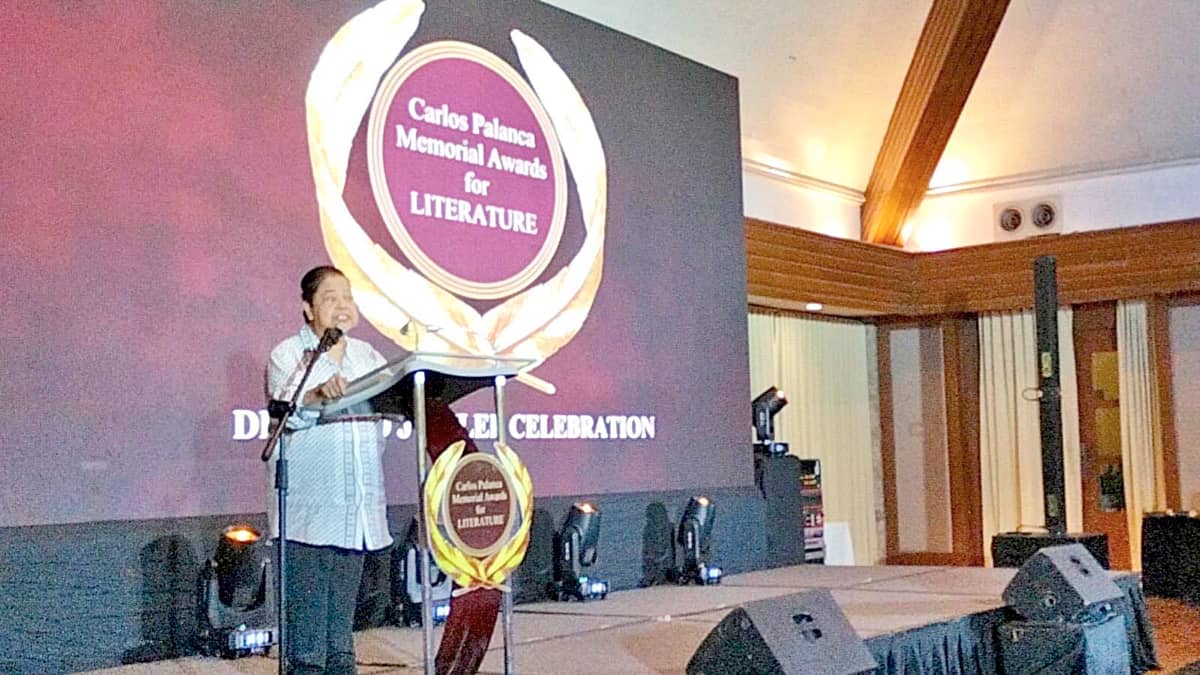
Her speech traced the origins of the awards — from the first cycle in 1951 to the present moment, where 75 years of literary tradition stand against a rapidly shifting world. She spoke of crises and opportunities, of how writers confront new terrains shaped by digital change, artificial intelligence, contention, and contradiction. She noted that the awards were temporarily halted for two years during the Covid-19 pandemic, so while the ceremony celebrated 75 years of history, this year was the 73rd year of the competition. She also emphasised how literature remains the constant thread in a landscape of noise, conflict, and reinvention. “Seventy-five years of a hallowed tradition can only spur the Filipino writer to be courageous,” she declared, “to chart inventive paths towards literary fulfilment and authenticity.”
The night’s most anticipated moment came with the keynote address delivered by this year’s Gawad Dangal ng Lahi awardee, Professor Emeritus Dr. Ruth Elynia D. Mabanglo, one of the most influential voices in Philippine poetry and drama. A poet, playwright, translator, educator, and advocate for women and Filipino identity, Dr. Mabanglo was the first woman inducted into the Palanca Hall of Fame in 1995.
In her speech, she delivered a thought-provoking line: “The square root of writing is loneliness.” She gazed back at her life with a mix of solemnity and gratitude, recounting a journey forged in hardship and uplifted by courage. She spoke of losing her job in 1972 during the declaration of martial law by the dictator former President Ferdinand Marcos Sr., the closure of newspapers including Taliba where she worked as a desk woman, and the misogyny she navigated as one of the very few women in a male-dominated newsroom. Yet all the trials led her to the page. She turned to poetry and drama, submitting works to the Palanca Awards to support herself. She would go on to win more than 20 awards, including five First Prizes that earned her a place in the Hall of Fame.
“Binabalot ng pangungulila ang aking gunita,” she said, describing the loneliness of her childhood, the isolation of her early adulthood, and the hunger to claw her way into the space of literature. But her story did not end in hardship. Her Palanca victories opened doors beyond what she imagined, including a pivotal appointment to the University of Hawai‘i at Mānoa, where she eventually became a professor emeritus and coordinator of the Filipino and Philippine Literature Program. Her work helped establish Filipino language and literature in American academia, allowing generations of Filipino students abroad to reconnect with their identity through scholarship and writing.
Her speech was not simply autobiographical. It was a testament to resilience, and to the belief that words carry weight, influence, and salvation. Her reflections illuminated the night’s theme: that literature endures because writers persist, even when beginnings are humble or painful. Furthermore, words do not just reflect a nation’s story; rather, they shape how we view ourselves and how we tell our stories.
Red paint
The evening also brought moments that cut sharply through the formality of the event, showing the fire that burns in the hearts of writers who want to make a change. When Rouchelle Dinglasan, 3rd Prize winner in the Dulang May Isang Yugto category, walked onstage, the room stirred. Her pregnant belly was painted red with the stark message, “IKULONG NA ‘YAN, MGA KURAKOT.” She led a familiar chant against corruption — an act of protest that electrified the ball and underscored the political urgency that has always pulsed in the heart of Philippine literature. It was a reminder that writing in this country is rarely apolitical. It is often born of witness, struggle, and the refusal to look away.
Bridge to the next
This year’s roster of judges — 57 in total — included DAILY TRIBUNE’s own Managing and Lifestyle Editor Dinah Sabal-Ventura, who served as a judge for the Kabataan Division. The participation of established authors, scholars, journalists, and artists ensured that each winning work underwent rigorous, thoughtful evaluation. Across the Filipino, English, Regional, and Kabataan Divisions, judges from universities, publishing houses, cultural institutions, and the arts community lent their expertise to uphold the standards that define the Palanca legacy.
Through the decades, the Palanca Awards have honoured 2,634 authors and 2,735 winning works. Thirty winners have been inducted into the Hall of Fame. Many names are now canonical. Others have contributed quietly but steadfastly to the evolving tapestry of Philippine literature.
This Diamond Jubilee was not merely a look back at the past 75 years. It is a bridge towards the next. As Ms. Palanca said in her speech, the future will demand imagination, flexibility, and courage from writers navigating the complexities of the 21st century. Yet that night, surrounded by judges, awardees, Hall-of-Famers, and emerging voices, it was incredibly apparent: Philippine literature is alive. Restless. Ready for what lies ahead.
And as Dr. Mabanglo reminded the audience, sometimes the act of writing begins in loneliness. But it leads to something larger — community, history, and legacy. It leads to nights like this, when stories reflect and shape the nation, and writers find their place amongst those who came before them.