
SCUTTLEBUTT


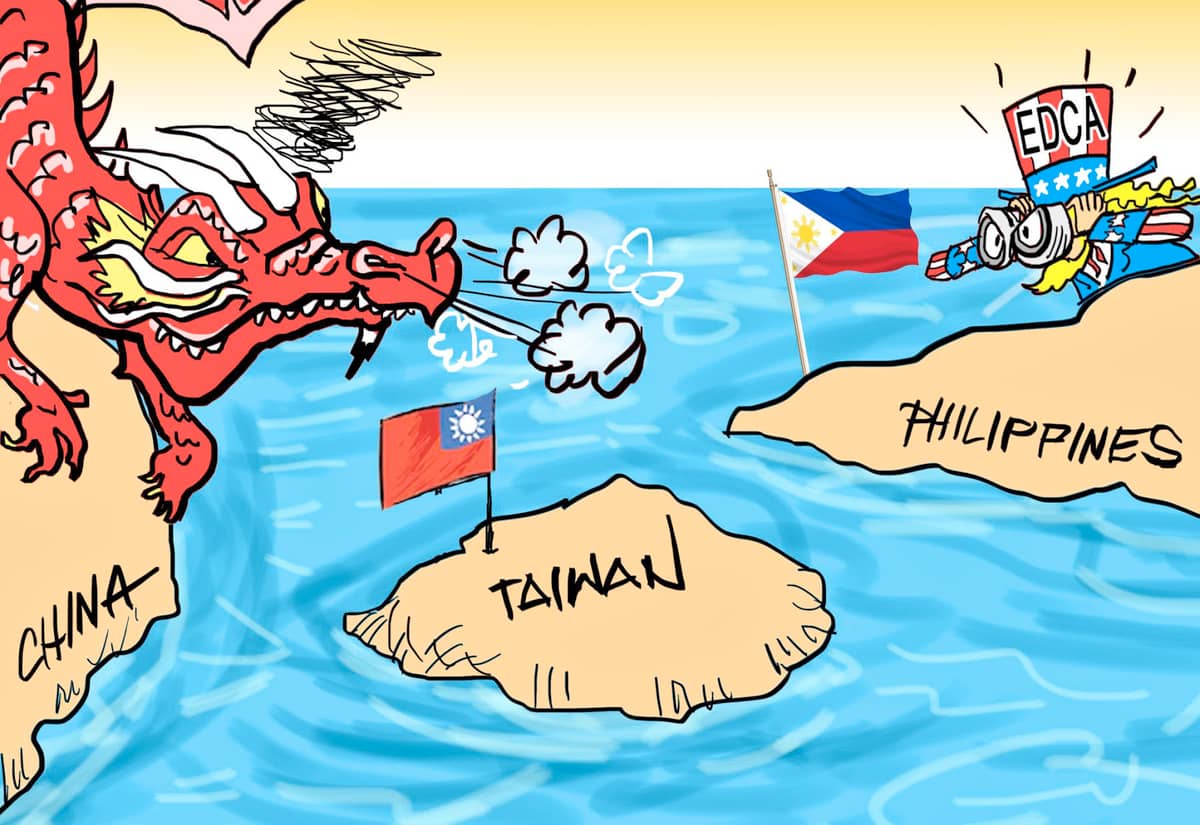
EDCA sites, Taiwan’s frontline
Strong proof that the Enhanced Defense Cooperation Agreement (EDCA) bases in the country are primarily intended for the deterrence of Chinese objectives on Taiwan is a US congressional commission’s proposal that Taipei help fund upgrades of the installations.
The US has access to nine bases under EDCA, with some located close to Taiwan. The US has been investing money in the bases, upgrading runways, hangars and warehouses.
The US-China Economic and Security Review Commission (USCC) said Taiwan could be brought in to help with the funding, because it would ultimately benefit the self-governed island’s own security.
Specifically, the commission recommended that the US Congress direct the State Department to utilize the foreign military sales (FMS) program to facilitate the funding, which means the transfer of expenses to Taiwan and to go around the diplomatic gauntlet with China.
Under the scheme, upgrades to the EDCA bases, such as those on Luzon and Palawan islands, would be “sold” to Taiwan as a non-weaponry support service. The US Defense Security Cooperation Agency would manage the contract with a US defense contractor, while the Philippines would be the beneficiary of the infrastructure.
Such investments would make sense for Taipei “because they are directly related to the US ability to defend Taiwan, if the political decision was made to do so,” USCC vice chairperson Randall Schriver said.
Utilizing FMS would be the right channel, Schriver said, because it would allow political cover for Taiwan, who may not want to be seen as directly spending to enhance a Philippine base.
Schriver, a former assistant secretary of defense for Indo-Pacific security affairs, added that the FMS would “help lift Taiwan’s defense spending and help Taiwan reach its target of spending as a percentage of GDP.”
The bases upgrade spending was one of 28 recommendations made this year by the commission, which was set up by Congress in 2000 to advise lawmakers on China policy issues.
Beijing is expected to respond forcefully to such a move.
“China is going to stomp heavily on any kind of collective action on Taiwan,” he said, pointing to the recent reaction from Beijing toward Japanese Prime Minister Sanae Takaichi’s statements about Japan’s potential involvement in a Taiwan contingency.
The question, said Schriver, was how much regional actors like Taiwan, the Philippines, and Japan were “willing to absorb that kind of Chinese wrath, because I think that’s what’s coming.”
The Philippines was singled out in the report as a Southeast Asian country that the US should focus its support on.
The commission is also prodding the US Congress to pass legislation to equip the Philippines to more effectively counter China’s aggression, including by providing the necessary resources to the US departments of State, Defense, and Homeland Security to support the Philippine Coast Guard on the front line.
The commission also proposed enhancing Philippine engagement with the Quad grouping of the US, Japan, India and Australia. The State Department should develop a “Quad Plus” dialogue with the Philippines and work together on countering China’s gray zone or ICAD — illegal, coercive, aggressive, and deceptive — activities, it said.
Philippine shipyards could provide maintenance, repair and overhaul services to US Navy ships and help with defense and commercial shipbuilding, the USCC said.
Under President Ferdinand Marcos Jr., the country has expanded the number of EDCA sites to nine, adding four new locations in February 2023 to the five original bases designated in 2016.
The five original sites are Basa Air Base in Pampanga, Fort Magsaysay in Nueva Ecija, Antonio Bautista Air Base in Palawan, Mactan-Benito Ebuen Air Base in Cebu, and Lumbia Air Base in Cagayan de Oro.
The four new sites are Naval Station Narciso del Rosario in Balabac, Palawan; Camp Melchor F. de la Cruz in Gamu, Isabela; Lal-lo Airport in Lal-lo, Cagayan; and Naval Base Camilo Osias in Santa Ana, Cagayan.