




EU, Philippines launch €22M digital economy program
Text size
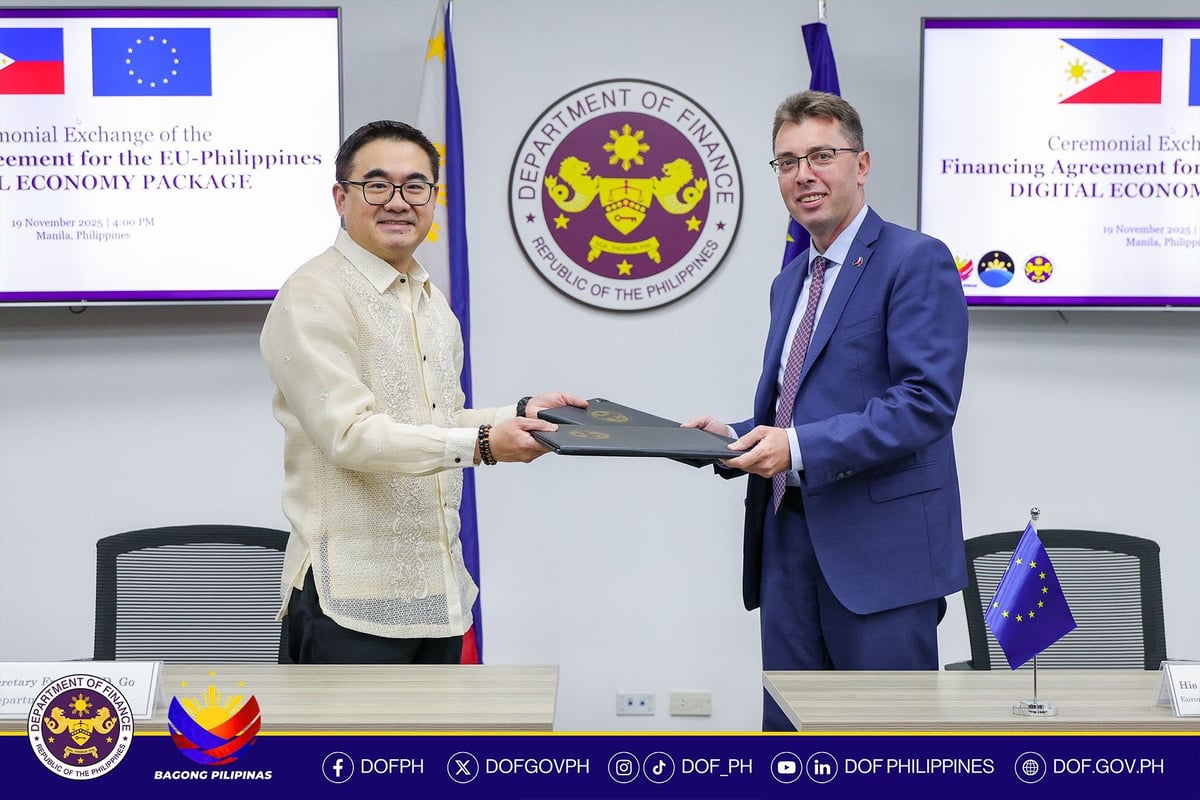
The European Union (EU) and the Philippines have formalized a new cooperation agreement worth around €22 million under the EU-Philippines Digital Economy Package, a major initiative that will support the country’s digital transition through investments and policy assistance in 5G development, cybersecurity, artificial intelligence (AI) for earth observation, and nationwide digital connectivity.
In a Friday, 21 November statement from the Department of Finance (DOF), the agency said the program forms part of Global Gateway, the EU’s global infrastructure strategy aimed at strengthening secure and sustainable digital, energy, transport, and research networks across partner economies. Both sides said the partnership aligns with shared economic objectives, particularly the use of advanced digital tools to support development and improve public services.
“This partnership marks a significant step forward in our commitment to support digital technology for societal advancement. The EU is delighted to work with the Philippines in creating innovative solutions that promote inclusive and sustainable digital transformation,” said EU Ambassador Massimo Santoro.
Newly appointed DOF Secretary Frederick D. Go noted the economic and disaster-response benefits of the agreement. “This project will provide the Philippines with a secure and reliable digital connectivity infrastructure by enabling high-speed and real-time access to Copernicus data. This will allow the government to better prepare for natural disasters, respond faster in times of crisis, and provide immediate relief to Filipino families. And we need this now more than ever,” he said.
The DOF added that a central component of the package is the expansion of the EU–Philippines Copernicus program, which applies satellite and earth-observation data to support government planning in areas such as disaster mitigation, environmental monitoring, agriculture, and infrastructure mapping. The new phase will integrate AI-powered analytics to strengthen policy decision-making and improve productivity in both public and private sectors.
The agreement will also strengthen collaboration between EU and Philippine universities through joint research and innovation initiatives, while providing policy support for the rollout of 5G and the development of applications reliant on ultra-fast connectivity. Cybersecurity development will be a key focus, particularly in safeguarding critical infrastructure.
The Digital Economy Package is backed by €20 million from the EU, with additional contributions of €2 million from Finland and €600,000 from France. Implementation will be led by the Philippine Space Agency, the Department of Science and Technology (DOST), the Department of Information and Communications Technology (DICT), and the Office of Civil Defense, working alongside European partners.
A traditional dish called zongzi is served during China’s Dragon Boat Festival, which falls in June. It is a rice…
Divina credited the firm’s achievements to its members, thanking them for their ‘hard work, dedication, teamwork, and…
‘Sec. Vince Dizon, please explain how this finding of your own team should not be flagged as a ghost project in Taguig.’
