
Phl ramps up pedestrian safety programs
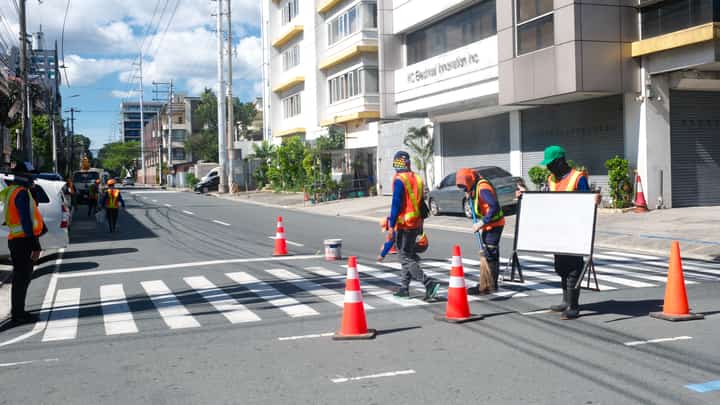
Workers from the Department of Public Works and Highways repaint a pedestrian crossing along Quezon Avenue. Various concerned agencies are already gearing up to enhance pedestrian safety along major thoroughfares in the metro.
DAILY TRIBUNE FILE PHOTO
Amid the government initiatives and increased public-private collaboration, pedestrian safety remains a critical concern in the Philippines, where road crashes continue to claim numerous lives — particularly among the most vulnerable users.
Road crashes are a pervasive issue, with the Philippine National Police Highway Patrol Group recording more than 19,000 incidents from January to August 2025. According to the International Road Assessment Programme (iRAP), traffic crashes claim approximately 30 lives and cause over 1,000 injuries daily across the country.
In Metro Manila, the figures highlight the danger faced by those on foot: pedestrians accounted for 27 percent of all road crash fatalities and 12 percent of all injuries in 2021.
To directly address these casualties, the government has launched several key initiatives. The Metro Manila Road Safety Action Plan (MMRSAP), launched in 2025 with support from the World Health Organization (WHO), is the region’s first comprehensive plan focused on reducing traffic injuries and fatalities in the capital.
The MMRSAP is a multi-sectoral initiative aiming to implement safer road user behaviors, safer vehicles and enhance post-crash response to substantially reduce road traffic deaths and injuries across the National Capital Region.
Also, the Department of Transportation (DoTr) has been instructed by the President to push for people-first designs, such as raised crossings and curb extensions, to improve safety infrastructure.
People-first designs stress the safety and accessibility of pedestrians and cyclists over vehicle speed. Key features include raised crossings — speed tables at crosswalks that visually and physically force vehicles to slow down — and curb extensions or sidewalk additions that shorten the crossing distance for pedestrians and make them more visible to drivers.
Regional efforts are also underway, including the new Quezon City Road Safety Program, a partnership with the public interest law group ImagineLaw focused on strengthening local road safety.
Additionally, the Metropolitan Manila Development Authority (MMDA) launched a children’s road safety park in Manila to instill safety discipline early, citing plans to build more parks or deploy mobile safety vehicles with private sector help.
These domestic efforts are bolstered by collaborations with international partners, with the 2025 Transportation Forum — co-organized by the European Chamber of Commerce of the Philippines (ECCP) and Team Sweden — brought together experts to explore solutions centered on safer infrastructure, smart and safer vehicles, and sustainable mass transport.
Discussions at the forum highlighted achieving the UN Target of having over 75 percent of travel on three-star or better roads by 2030, a goal iRAP estimates could save 3,744 lives annually.
Despite the systemic changes underway, experts and officials continue to urge individual pedestrians to prioritize their own safety. The risks of counterfeit and substandard roads mean pedestrians must remain vigilant.
Safety advice includes consistently looking both ways when crossing, even at a pedestrian lane with a green light, and ensuring all vehicles have stopped.
Pedestrians are also strongly advised to avoid distractions such as using phones or wearing headphones while walking on busy roads to maintain full awareness of their surroundings. Furthermore, care is stressed when boarding or alighting public transportation like buses and jeepneys, where sudden stops are common.
For citizens looking to contribute to policy, involvement in advocacy groups like the Make It Safer Movement is promoted as a way to support better pedestrian infrastructure and safety policies.
The focus, according to officials, remains on a coordinated effort to modernize the country’s transport landscape and create a safer environment for all road users.