
Many faces of Sierra Madre: On film, folklore and a vanishing mountain range

There are nearly half a dozen Filipino films that use Sierra Madre in their titles. One of the earliest is LVN Pictures’ 1948 production Sierra Madre, Bundok ng Hiwaga, starring Leopoldo Salcedo and Nela Alvarez, the great-grandmother of Sandro Muhlach.
In 1963, Fernando Poe Jr. and Jess Lapid Sr. also made a war film titled Sierra Madre. Set during World War II, Poe and Lapid battle Japanese forces in the mountain terrains of the Sierra Madre. The film also stars Cecilia Lopez, Liza Moreno and Rebecca — a mid-1960s sex symbol who used that screen name. Directed by Armando Herrera, the movie was even released in the United States, if memory serves. (War films still sold very well locally and abroad during that period.)
FERNANDO Poe Jr. in ‘Sierra Madre.’
PHOTOGRAPH COURTESY OF OCTOARTS FILMS
Rey Malonzo also starred in a film that carried the name: Tigre sa Sierra Madre. His co-stars were Pia Moran and George Estregan. The film was released in 1982, three years before Estregan — once a serious actor — shifted to pornographic roles. Malonzo, incidentally, also directed this movie.
One of Bong Revilla’s early films was Sa Dibdib ng Sierra Madre (1985), where he plays an idealistic young man disillusioned with the system and determined to create reforms, even if it means resorting to violence. Directed by Carlo J. Caparas, Revilla’s leading lady here was his real-life partner, Lani Mercado.
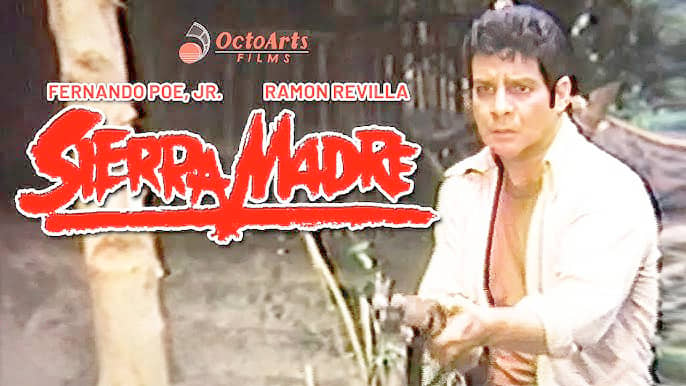
The most outstanding local film with Sierra Madre in its title was produced by Lea Productions in 1981 and is now in the OctoArts Films library. The movie is simply called Sierra Madre and again features Fernando Poe Jr., this time paired with Ramon Revilla Sr.
This 1981 film is particularly impressive as an action picture. It opens with a gripping scene of bandits ransacking a town and abducting its women. Diego Cagahastian’s screenplay is complex but effective. In the story, Poe plays a military officer who goes undercover to capture the leader of the bandits. Revilla’s role is complicated and takes an interesting turn toward the end.

‘Sa Dibdib ng Sierra Madre’ starring Bong Revilla.
PHOTOGRAPH COURTESY OF OLD PINOY MOVIES
The film, directed by Pablo Santiago, also has a few interesting trivia notes. Early in the movie, Santiago gives his second son with Cielito Legaspi, a small role. The teenage boy would be formally introduced by Viva Films the following year as Rowell Santiago. This was not Rowell’s first film, however; he had already appeared in bit parts in Bato sa Buhangin and Kumander Ulupong, both also directed by his father.
A year before Lea Productions released Sierra Madre, singer Coritha — who passed away only recently — recorded a song with the same title. The lyrics evoke homesickness and a longing for a place somewhere in the Sierra Madre.
When the film was about to premiere, Coritha denounced the FPJ movie, claiming it was riding on the popularity of her song. She reportedly asked the producers to change the title, but her request fell on deaf ears. What angered her further was Poe’s remark in an interview that he had never heard of her song. Coritha, incidentally, was the aunt of actor Paulo Avelino.
There truly is something inspirational about the Sierra Madre that sparks creativity. In Spanish, sierra has two meanings. One is “saw,” the cutting tool. The other — more relevant to Filipinos — is “a chain of mountains,” which aptly describes the Sierra Madre. The Spanish colonizers named this mountain range “Madre” because it is the “Mother of Mountains.”
Stretching from Cagayan Valley to Quezon Province, the Sierra Madre is undeniably imposing. It is visible even from the lowlands of Luzon.
Even before I learned to read, I already knew the legend of the Sierra Madre — ang alamat. I heard it countless times while sitting on my grandmother’s lap.
This is the tale I was told: Once upon a time, a beautiful woman named Sierra caught the eye of the god of the wind. But Sierra loved a mortal, which angered the god. As Sierra and her husband built a family, the god kept sending storms — perhaps hoping for a stormy marriage. When he failed to break them apart, he decided to kill the husband. In his dying moments, the husband asked Sierra to protect their children and future descendants from the wrath of the wind god. Sierra’s body lengthened to shield them. She became the Sierra Madre — protector of Luzon’s people. The end.
Fortunately, the Sierra Madre legend does not end as a mere fable. The mountain range continues to shield a vast portion of Luzon during typhoons. Just last weekend, it lessened the full force of Super Typhoon “Uwan” — much to the relief of Metro Manila and nearby provinces.
In the past, the Sierra Madre did more than block typhoons. It also enhanced the scenic beauty of what was then called the Greater Manila Area. The mountain range was part of the metropolis’ skyline.
Even in flat sections of Manila, like the less congested neighborhoods of Sampaloc and the lower areas of Sta. Mesa — the Sierra Madre was visible during the day. Its bluish silhouette added elegance to the cityscape. The view was even more spectacular in Quezon City, particularly from Katipunan, where it also provided beautiful sunrises.
Sadly, the sight of the Sierra Madre began to disappear with the rapid development of Metro Manila. Tall buildings gradually blocked the view. Today, it is visible mostly to condominium residents with units facing east.
I was fortunate to occupy the top floor of a condo building in Greenhills for 14 years. It offered views of seven provinces, each with its own distinct terrain.
From the kitchen, I could see Quezon Province and majestic Mount Banahaw. From the living room, Corregidor and Bataan with Mount Samat and its cross. On one side of the bedroom — the northern part — stood Mount Arayat.
But aside from the spectacular sunsets, nothing matched the splendor of the Sierra Madre on the eastern side of the bedroom. It was breathtaking during the day, and its nighttime silhouette was calming before sleep.
During those 14 years, I witnessed the gradual denudation of the Sierra Madre. Over time, the mountain range grew increasingly bald. Though I could not see the tools of destruction from my vantage point, I knew the cause: relentless logging, mining, and quarrying.
At night, more and more specks of light appeared across the mountains. While beautiful from afar, they also signaled the growing population along the slopes — especially near San Mateo, Rizal. Imagine how many trees were felled to make way for residential areas.
On hot summer evenings, forest fires would occasionally break out. These were often due to kaingin, the illegal but still widely practiced slash-and-burn method of farming. This is the Philippines, after all.
This is also the country where Slater Young was allowed to denude one side of a mountain in Cebu to build ultra-high-end residential units. It is only here that a city mayor — Nestor Archival, in this case — would defend irresponsible developers. His position weakened when photos of him with Slater circulated online, taken when the two met at city hall last August to discuss their “shared vision.”
Of course, the Slater Young project was not the sole cause of the massive flooding in Cebu during Typhoon Tino. But many believe it was a contributing factor. To be clear, Slater is not the only developer involved, but he has become the face of Monterrazas de Cebu, especially since he aggressively promoted it on social media.
Does Cebu City really need Monterrazas de Cebu? The city’s growing population does need more housing, but Monterrazas will cater only to the wealthy minority.
When Young began promoting the project online two years ago, there was already significant public opposition. The project was clearly harmful to the environment. But Young would not listen. He was proud of its design — as if nothing on earth could be more beautiful.
Beyond developer profits, Monterrazas de Cebu feels like a vanity project, particularly for Slater, whose showbiz career had fizzled out. He basked in its promise of prestige — even long before its completion.
In truth, the project reeked of arrogance — Slater’s arrogance. And ultimately, it became his Tower of Babel.