




What good would it do Rody now?
No court hearing for the Duterte patriarch, no invocation of the Constitution’s shield for citizens against foreign compulsion, just politics at play.

Text size
No court hearing for the Duterte patriarch, no invocation of the Constitution’s shield for citizens against foreign compulsion, just politics at play.
The law, they say, is blind. But in the Philippines, it squints, sometimes toward The Hague.
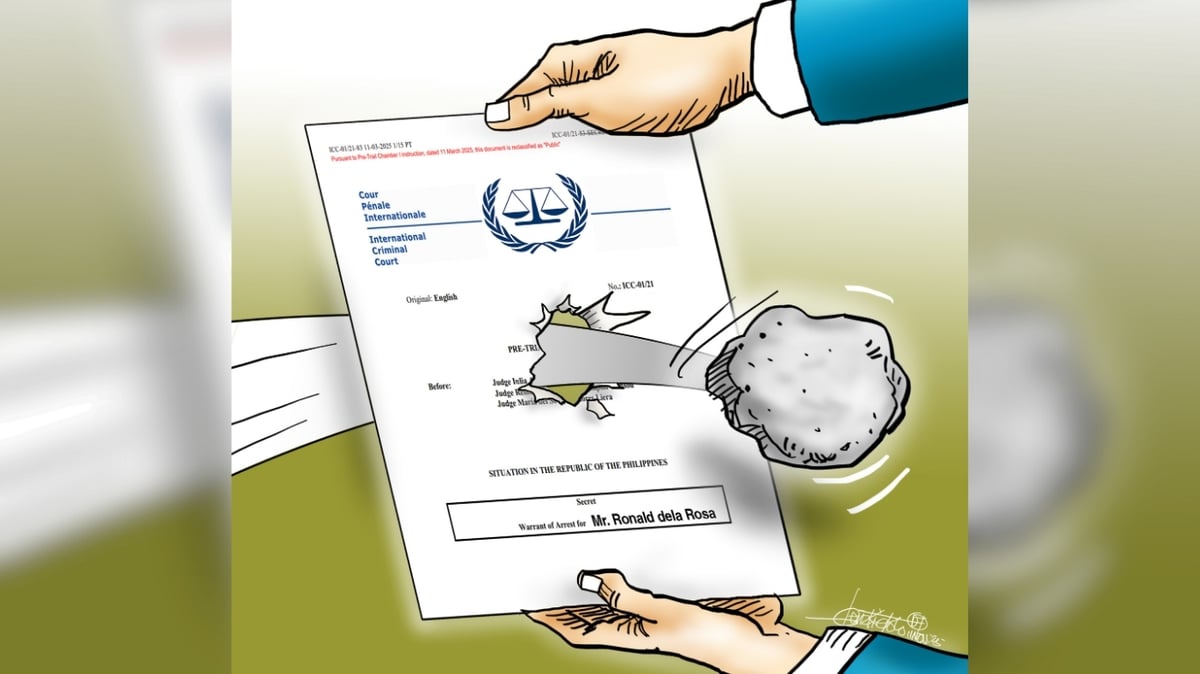
Executive Secretary Lucas Bersamin, a former Supreme Court justice, recently cited the Court’s new Rules on Extradition Proceedings to justify the government’s position that it cannot “just surrender” Sen. Bato dela Rosa to the International Criminal Court (ICC). His invocation of due process struck a chord because it echoed a principle the Court itself blurred in Pangilinan v. Cayetano (G.R. 238875, 16 March 2021), which upheld the country’s withdrawal from the ICC.
In Pangilinan, the Court ruled that treaty-making and unmaking fall within the President’s prerogative. It avoided the political storm and left unsaid what many expected it to clarify: that cooperation with the ICC after withdrawal is a matter of discretion, not duty.
In plain English, the Philippines has no legal obligation to surrender anyone to the ICC: not Dela Rosa, and certainly not former President Rodrigo Duterte. While the ICC insists that Article 127 of the Rome Statute preserves its jurisdiction over crimes committed while the Philippines was a member, jurisdiction and enforcement are different things.
A tribunal like the ICC may retain the former, but it cannot compel the latter in countries that have withdrawn. Indeed, the Philippines is no Israel or Russia, whose governments have ignored the ICC’s warrants against Benjamin Netanyahu and Vladimir Putin. Yet here in the Philippines, a government that should know better panders to a court it already left.
Under Presidential Decree 1069, the Philippine Extradition Law, no person may be sent abroad for prosecution without a verified petition and a judicial finding that the request meets the requirements of law and treaty. Extradition applies only when the requesting party is a foreign government.
On the other hand, Republic Act 9851, the Philippine Act on Crimes Against International Humanitarian Law, Genocide, and Other Crimes Against Humanity, outlines cooperation with international tribunals, such as the ICC, but that framework assumes membership. When the withdrawal took effect, that obligation ceased.
So Bersamin is right, at least in principle. The new extradition rules may not technically apply to the ICC, which is not a “requesting state,” but their intent should. They were written to protect the rights of anyone whose liberty the state is asked to surrender. To insist on due process in extradition while ignoring it in surrendering a citizen to the ICC would be hypocrisy disguised as international courtesy.
The irony is that we already did exactly that. Duterte, demonized and politically disowned, was in effect offered up to The Hague not for justice but for politics. He was no longer president, but he retained a power base the Marcos administration wanted neutralized. The ICC inquiry became a tool to weaken that bloc while the government trained its sights on the failed impeachment of his daughter, Vice President Sara Duterte, the presidential contender to beat in 2028.
No court hearing for the Duterte patriarch, no invocation of the Constitution’s shield for citizens against foreign compulsion, just politics at play. And that is the tragedy. Rodrigo Duterte, now an octogenarian, sits in a foreign jail not because of a Philippine court ruling but because his own government failed to enforce its own legal standards.
Duterte is proof that the state can fail or, worse, choose not to protect its citizens. The question is no longer about guilt or innocence but whether the Philippines still upholds the rule of law when it allows one of its own to be judged under another’s authority.
When the government chose expediency over constitutional duty, it abandoned not just Duterte but the very idea of equal protection. The moment it allowed a Filipino to be surrendered without a complete judicial process, it declared that the rights of citizens depend on political convenience.
Every Filipino, saint or sinner, must first be judged under the laws of his own land. The ICC may claim universal jurisdiction, but universality cannot erase fairness. For if politics can dictate surrender, then no Filipino, innocent or guilty, is safe from the whims of the powerful or the applause of the international gallery.
Even without the new Supreme Court rules on extradition, Presidential Decree 1069 is still in full effect. Yet the government subverted it so that the lamest general ever to head the Philippine National Police, Nicolas Torre, could hand Rodrigo Duterte over to the ICC. That was the death of due process right there.
Housing is probably the biggest issue affecting people the world over.
Malacañang on Monday called for a more thorough investigation into the questioned flood control projects in Taguig…
The defense on Monday backed the move by senator-judges to exclude a prosecution witness who testified on the firearms…
