
Nearly a million flee Uwan’s fury


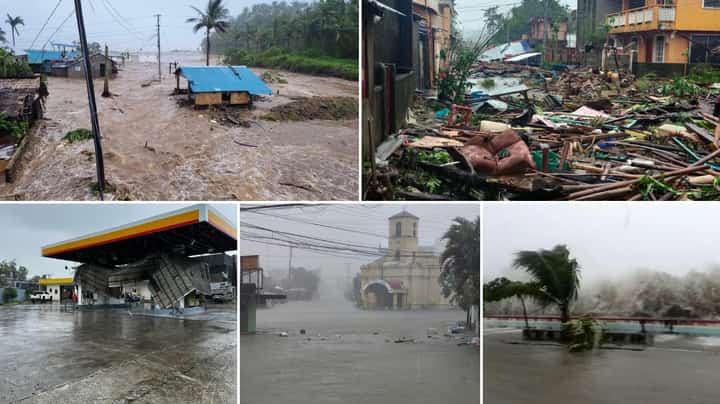
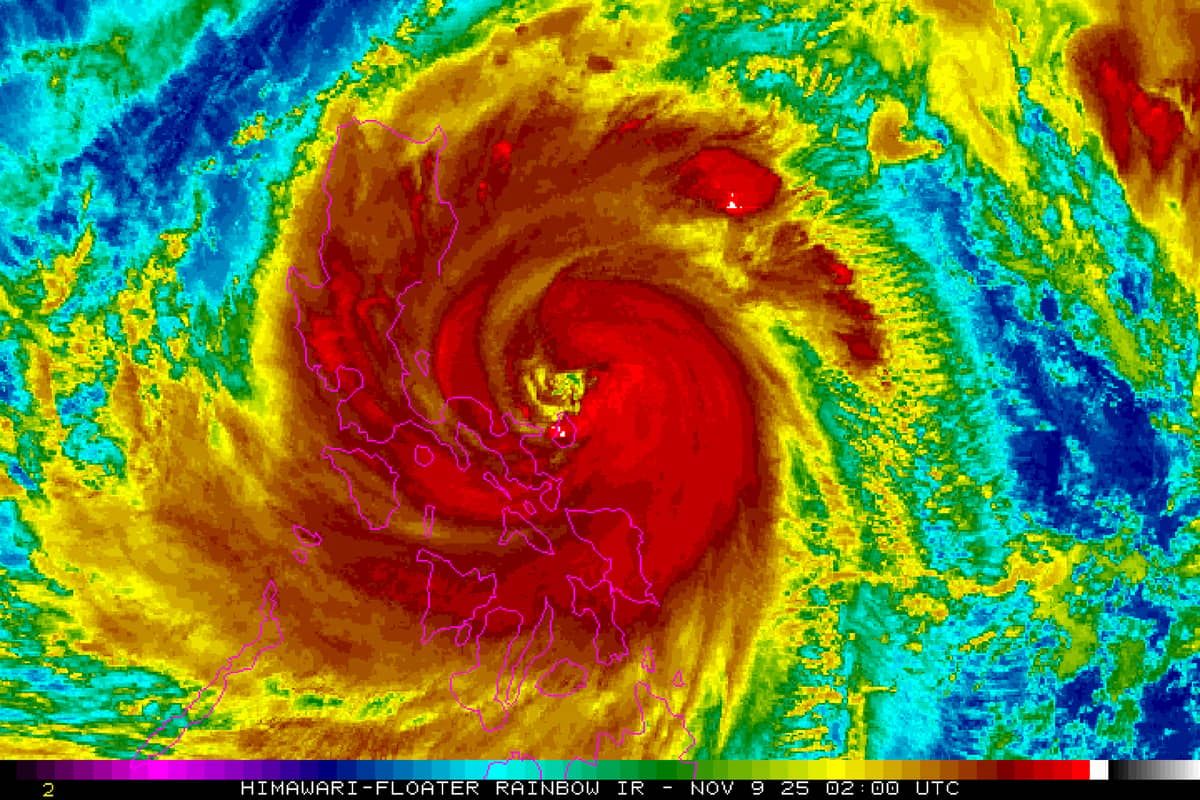
Catanduanes stands at the frontline of fury as super typhoon ‘Uwan’ devours the archipelago, its vast spiral of red and yellow swallowing the Philippine map whole (inset). The storm’s wrath has driven nearly a million to flee, some by forced evacuation.
Photographs courtesy of Bicol Connect FB
Nearly one-million people have been evacuated across the Philippines as super typhoon “Uwan” (international name: Fung-Wong) barreled across Luzon and the Visayas, bringing destructive winds, torrential rain and widespread flooding.
The Philippine Atmospheric, Geophysical and Astronomical Services Administration (PAGASA) said Sunday that Uwan was packing maximum sustained winds of 185 kilometers per hour near the center and gusts of up to 230 kph as it moved west-northwestward at 30 kph over the coastal waters of Camarines Norte.
With a radius spanning much of the archipelago, Uwan was expected to make landfall over the central portion of Aurora late Sunday or early Monday before crossing Northern Luzon and exiting via Lingayen Gulf.
PAGASA warned that the super typhoon could trigger life-threatening storm surges of over three meters in coastal areas across Luzon and the Visayas.
The Office of Civil Defense reported that 916,863 people were evacuated nationwide, with Catanduanes taking the first and heaviest blow as storm surges sent waves crashing over seawalls and floodwaters rose in low-lying towns.
“As we speak, they are feeling the impact of the typhoon, especially in Catanduanes, because the storm’s eye is closest there,” OCD deputy administrator Assistant Secretary Bernardo Rafaelito Alejandro IV said.
Power interruptions were reported in parts of the Bicol and Eastern Visayas regions, including Tacloban City, Palo, Bato and Babatngon in Leyte, as well as Northern Samar and Catanduanes. Communication lines were down in some towns, hampering response efforts.
Signal No. 5
In Albay, about 50,000 families were evacuated as authorities warned of possible lahar flows from the slopes of Mayon Volcano due to heavy rain. Another 5,000 people were moved to safety in Camarines Norte.
As of Sunday afternoon, PAGASA raised Tropical Cyclone Wind Signal No. 5 — the highest alert level — over parts of Quirino, Nueva Vizcaya, Nueva Ecija, Aurora, Polillo Islands, Camarines Norte, Camarines Sur and Catanduanes.
Signal No. 4 covered large portions of Northern and Central Luzon, while Signal No. 3 extended southward over Metro Manila, Cavite, Batangas and Quezon.
PAGASA cautioned that Uwan’s effects would be felt far from its center, warning of gusty to gale-force winds across Luzon and the Visayas, heavy rainfall exceeding 200 millimeters in many areas, and possible flash floods and landslides in mountainous terrain.
The OCD said the Bicol Region accounted for the bulk of evacuees — 660,721 individuals — followed by Eastern Visayas with 112,760 and Calabarzon with 74,388.
The Department of the Interior and Local Government is urging more than 17,000 at-risk barangays to act swiftly, monitor river systems and carry out preemptive evacuation, especially for the elderly, persons with disabilities, pregnant women and children.
Coastal barangays were told to suspend fishing and boating activities as storm surges above three meters are expected.
Defense Secretary Gilberto Teodoro Jr. warned that forced evacuations would be implemented in areas where residents can still be safely moved, stressing that non-compliance endangers rescuers.
The DILG and the Philippine National Police reminded local officials they are authorised under law to enforce mandatory evacuation after repeated warnings, but urged that enforcement be carried out “peacefully, respectfully, and with proper documentation.”
Dams release water
Five major dams in Luzon — Angat, Ipo, Ambuklao, Binga and Magat — opened spillway gates on Sunday morning to manage rising water levels. PAGASA said floodwaters were also rising along the Bicol River basin and in parts of Albay and Camarines Sur.
Malacañang suspended government work in nine regions on Monday, 10 November, and classes in 12 regions until Tuesday, 11 November, because of the typhoon’s impact. Agencies responsible for essential and emergency services were ordered to remain operational.
The Metropolitan Manila Development Authority suspended the number coding scheme for Monday, and the House of Representatives canceled its plenary session, citing public safety.
Uwan’s onslaught comes just days after typhoon “Tino” (Kalmaegi) devastated Cebu and Negros islands, killing at least 224 people and leaving 109 missing. Search and rescue operations in affected areas were suspended as “Uwan” approached.
Scientists have warned that storms are becoming more powerful due to climate change. Warmer oceans allow typhoons to intensify rapidly, while a warmer atmosphere holds more moisture, resulting in heavier rainfall and more destructive floods.