
‘Uwan’ on the horizon; Sierra Madre on edge

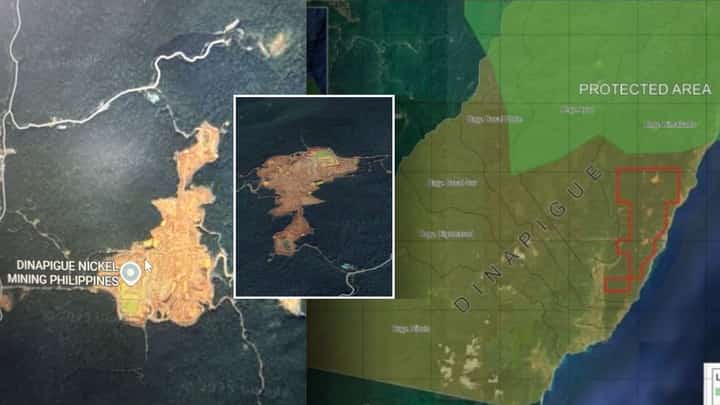
A newly surfaced set of satellite images has triggered public alarm over a massive patch of cleared forest on the slopes of the Sierra Madre in Dinapigue, Isabela — just as a rapidly intensifying tropical cyclone threatens to batter Luzon beginning Saturday.
Similar images, first circulated widely in late May and resurfacing on social media this week, show a wide bald stretch of mountainside that some environmentalists say could compromise one of Luzon’s most important natural defenses against typhoons. The site appears to match the nickel mining operations of Dinapigue Mining Corp. (DMC), a subsidiary of Nickel Asia Corp. (NAC).
DAILY TRIBUNE sought clarification from NAC after the images were widely shared on social media. In its initial response, the company said it could not verify the satellite images because of the high zoom level.
DAILY TRIBUNE then sent geotagged screenshots from Google Maps that showed the location of Dinapigue Nickel Mining Philippines matching the clearing in the viral post, but the NAC did not comment further.
DMC, however, said that “all our operations are conducted outside the boundaries of the Sierra Madre Natural Park and are carried out in full compliance with national and local regulations.”
The company said it holds all the mandated permits and environmental clearances issued by the Mines and Geosciences Bureau (MGB), the Department of Environment and Natural Resources (DENR), and local government units.
The mining permit —Mineral Production Sharing Agreement (MPSA) No. 258-2007-II — was first granted in 2007 and later acquired by DMC in 2015.
Commercial operations began only in 2021, after the company secured all the legal requirements, including the mandatory Final Mine Rehabilitation and Decommissioning Plan under the Philippine Mining Act of 1995.
Both MGB and DMC insisted the project is operating legally and pointed to their local hiring and community programs as proof of their commitment to responsible mining.
But some environmental scientists said the concern wasn’t just the legality but the geography.
The site sits on the steep flanks of the Sierra Madre, a mountain range long regarded as a natural storm shield that helps blunt the worst winds and rains from Pacific-born cyclones.
“The Sierra Madre reduces wind exposure and downstream rainfall for parts of northeastern Luzon. But when slopes are stripped of trees, the risk of flash floods and landslides increases dramatically,” said one researcher familiar with hazard mapping in Cagayan Valley.
The timing of the resurfaced images coincided with the approach of Severe Tropical Storm Fung-wong, which will be locally named “Uwan” once it enters the Philippine Area of Responsibility.
PAGASA said the weather system has rapidly intensified and may reach super-typhoon strength before nearing Luzon by Saturday. Violent winds, torrential rain, and storm surges are possible along the eastern seaboard, although the exact landfall location remains uncertain.
A social media post capturing the alarm over the clearing said in Filipino: “Based on the aerial view from Google Maps, the damage to Sierra Madre mountain in Dinapigue, Isabela is already extensive. In just a few years, the trees could be gone and the entire mountain range may be completely denuded.”
Local officials have confirmed the DMC site is legally permitted, but have not commented on whether they will reassess the environmental implications of the clearing in light of the looming cyclone and the larger risks associated with deforestation on steep terrain.
The controversy has reignited the debate over mining in remote resource areas. While such operations bring jobs and investments to hard-to-reach towns like Dinapigue, the environmental cost may surface during increasingly severe storms fueled by climate change.
First line of defense
The Sierra Madre mountains, stretching along eastern Luzon, are more than just a scenic backdrop —they’re the country’s first line of defense against powerful typhoons. Acting like a giant windbreaker, the mountain range slows down strong winds and heavy rains before they reach inland areas like Metro Manila and Central Luzon.
Its forests play a crucial role too. They hold the soil in place, absorb massive amounts of rain, and shield communities from flash floods and landslides.