
QCinema Industry 2025 expands Southeast Asian film links
This year’s edition is the most wide-reaching lineup yet. The 2025 program includes a new film market, a stronger focus on gender equality, and more attention to documentary films.

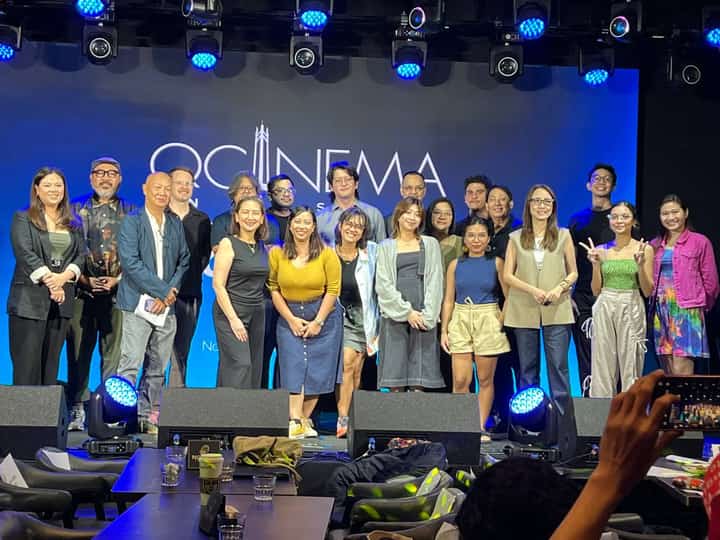
The QCinema Industry, the professional arm of the QCinema International Film Festival, returns this year with a bigger and more inclusive program for filmmakers from the Philippines and Southeast Asia.
In simple terms, QCinema Industry is a yearly gathering for people who make movies. It gives them a place to learn new skills, meet collaborators, and share their stories with a wider audience. It also supports Quezon City’s goal of becoming a major center for filmmaking in the region. On 1 November, this vision took a major step forward when Quezon City was officially named a UNESCO Creative City of Film—one of the first in Southeast Asia to receive this distinction.
This year’s edition presents QCinema’s most wide-reaching lineup yet. The 2025 program includes a new film market, a stronger focus on gender equality, and more attention to documentary films.
“Cinema has always been a space where stories meet purpose,” festival director Ed Lejano said. “Our goal is to build connections that help filmmakers and make Quezon City a home for Southeast Asian cinema.”
The project is organized by the Quezon City Film Commission, under the Office of the Mayor, and is led by Executive Director Liza Diño. QCinema Industry continues to grow as a center for film production, training, and creative policy. It also supports Quezon City’s effort to be recognized as a UNESCO Creative City of Film.
At the center of the event is the QCinema Project Market (QPM), which gathers new film projects from almost every Southeast Asian country. Filipino titles include Amateur, Daddy Cool, Dear Wormwood, Jaguar, KOMIXXX, Luzonensis and Floresiensis, Ozzy and Onie, Sentinel, The Void is Immense in Idle Hours, There Is, There Isn’t (Meron, Wala) and What’s Left of Us.
“QCinema Industry is a place of discovery,” said Diño. “We’re connecting filmmakers across the region to build a film culture that is both local and global.”
One of the year’s biggest developments is QCinema’s partnership with the Film Academy of the Philippines (FAP), now under the Office of the President. Led by Director General Paolo Villaluna, the partnership focuses on developing skills and improving working conditions for people in the film industry. The FAP also co-presents programs such as the Asian Next Wave Film Forum and Dokyu Days.
The launch of the QCinema Film Market (QFM) is another highlight. Modeled after major international film markets, QFM gathers 15 Quezon City-based production and post-production companies to meet global buyers and collaborators.
Women in film also take the spotlight in HER CITY: Women Shaping Sustainable Film Cities, co-presented by the French Embassy and France’s CNC. It features the first Southeast Asian Actresses Roundtable and the signing of the HER CITY Manifesto — a document promoting fair and inclusive practices for women in film.
Meanwhile, the Asian Next Wave Forum, curated by Manet Dayrit, turns into a three-day summit on creativity, sustainability, and innovation. Dokyu Days, organized with Daang Dokyu and the FAP, highlights documentaries as tools for truth-telling and social change.
Through its six programs — QPM, QFM, HER CITY, Asian Next Wave, Dokyu Days, and Critics Lab — QCinema Industry 2025 shows how stories, ideas, and people can come together to build a stronger film community.
“Every film begins with a single vision,” Lejano said. “But it takes a community to bring it to life.”
QCinema Industry 2025 runs from 17 to 23 November in Quezon City.