
'Smoke and Salvation'
'Smoke and Salvation' is a short story that won third place in the 2024 F. Sionil Jose Young Writers Awards in the English category.

Their plume of white smoke was a poor substitute for the missing clouds in the sky. Susie listened as Jay sang, his cheerful melody accompanying the smoke as it curled upwards like some mythical serpent beast. As the sunlight passed through the haze, she thought the ultraviolet rays were magnified ten-, a hundredfold. Her brown skin steamed reddish, burnt sienna, until she could almost imagine that the smell of cooked meat was her own. But no, it was the chicken, a pathetic carcass that Jay turned over their portable grill with wooden sticks. It was the last chicken from the three they had brought with them from home, which they had bound with ropes and hung from their backpacks as they travelled. This chicken was to be their next two meals, or perhaps three if they cut back on their portions. Inside their backpacks were an assortment of non-perishable food, which Susie reckoned could last them around a week and a half. As Jay cooked, she fished out her coin purse from her backpack and counted the money they had left.
“Sue,” Jay said, and Susie looked up from counting coins to see that their fire was getting smaller. She zipped up the wallet and put it away before getting an old magazine from her bag. Susie ripped out two pages, tore them into smaller pieces, and added them to the fire. Charcoal would have burned brighter and longer, but even that was hard to afford for the likes of them. They had to make do with scrap paper for fuel.
With the rest of the magazine, Susie fanned the flames as Jay kept turning the meat to make sure it was cooked on all sides. It was already 5:42 PM, but everything was still bright and airy. They could hear the steady crashing of the ocean against the cement border, and with the smell of freshly cooked meat and the bright blue of the sky, the two of them could pretend they were just on a beach enjoying the afternoon. What ruined the illusion was the sound of other people passing them by—those who were anxious to keep moving north to the Mountain Province while there was still daylight, and those who, like them, were preparing to camp on this deserted highway for the upcoming dusk. Groups of people crouched low on the asphalt, taking measly shelter from the sweltering heat under the shade of abandoned dilapidated cars. They talked in a gaggle of overlapping voices: some of them bartering and exchanging goods, some complaining about the heat, and some merely filling the air with idle chatter. A pair of skinny kids wearing nothing but underwear ran past Susie and Jay’s spot, laughing and chasing each other in childish glee. Susie wondered how they kept their high spirits when their stomachs bulged from malnutrition. She came to the conclusion that perhaps the kids were fuelled by goodwill and hope. She hoped that they’d keep that spark of life in them for much longer than she and Jay had.
The car that she and Jay leaned against and used as a makeshift wall seemed to be the oldest model on the highway. It had a grey steel body, with dark grey leather seats, and when it used to work, it ran on gasoline made from fossil fuels. It was a hulking beast of a vehicle compared to the other abandoned cars that were newer sleek designs. Its build and source of fuel betrayed a more uncivilised time when people weren’t so preoccupied with carbon emissions and organic materials. If Susie could guess, she estimated that this car was from the not-so-distant past of fifty years ago, but as Jay told her, so many advancements were being made that anything at least twenty years old was already primitive technology.
Jay finally finished cooking, and he took the chicken out of the fire. He placed it inside an empty plastic lunch box that he had rinsed out earlier by leaning over the highway border and dipping the lunchbox in the ocean water. As he cut the chicken into pieces, Susie held up the magazine so that they could see the cover, and she asked, “You think they have cars?”
The family on the cover of the magazine Susie held was one of those rich celebrity families. She and Jay weren’t quite sure what exactly they did. Perhaps they were actors, or models, or maybe just some random rich folk whose lavish lifestyle made them effective influencers. According to the magazine, the man was wearing a “100 per cent natural cotton” navy pinstripe suit with “ethically sourced” leather shoes. He was smiling at the camera, his white veneer teeth shining unnaturally, and his hands rested on the shoulders of a beautiful woman and a teenage boy. The wife was wearing a peach-coloured designer dress with matching pearl earrings and a brooch. It was written in the magazine that the clothing line she endorsed donated 30 per cent of all profits to nature-saving campaigns. The boy wore a white button-down shirt paired with straight black trousers, and the cover page boasted about his “influence” in encouraging the youth to recycle more.
Jay glanced at the magazine and rolled his eyes. He replied, “Maybe they do, Susie, or maybe they don’t. Maybe they have those top-of-the-line, solar-powered cars, or maybe they’re rich enough to afford tickets to the S.S. Salvation ships and have no need for cars anymore.”
Susie nodded thoughtfully. She wondered if this family was indeed rich enough for the floating communities, safe from the rising waters and constant floods. She had heard on the radio a while back a scandalous piece of news (at least, according to the lifestyle journalists): the famed Montemayor family wouldn’t have a place on the ships and instead chose to relocate to the mountain villages. They simply couldn’t afford the tickets, and their points from all their recycling and environmentally friendly shifts weren’t enough to get them on board. She and Jay had looked at each other in bewilderment when they heard the news. After all, if the rich Montemayors couldn’t afford tickets to the S.S. Salvations, then what hope did Jay and Susie have, with their attempts to earn points by merely recycling paper?
She and Jay cut the chicken into pieces. As they ate their portions, Susie asked, “You ever get angry that we’re not like them?”
Jay laughed bitterly. Susie could only watch sadly as her boyfriend’s eyebrows scrunched together in thinly-veiled resentment. She couldn’t help but think he looked more like his father when he was upset. She didn’t say this out loud, though, because Jay would be hurt at even the slightest comparison to his deadbeat dad. Jay said, “Of course, I’m angry, Sue. Everyone wants to be them. Everyone wants safety, and only money can do that. But what’s the point in constantly wishing we were born to better-off families? We just make do with what we have.”
Susie didn’t say anything anymore. She was silently berating herself for even asking a stupid, upsetting question. They dug into their early dinner, each just getting a chicken wing for this meal. As they ate, the fire started to die down. They were both relieved that at least one source of heat could be dealt with and removed. They were already sweating buckets, even with the ocean air threading through their hair, and they could only do so much water rationing without risking dehydration or overheating. Jay and Susie chewed the meat slowly, hoping to prolong the meal as much as they could. To their left, the father of the two skinny kids was slaughtering their second-to-the-last chicken. The other chicken was still tightly bound and hanging from his pack. To their right, a woman was prying open a can of corned beef to eat with a small pack of cheese crackers. As her nimble fingers worked on the can, her tongue peeked out from her mouth and her eyebrows scrunched up in concentration. Her frizzy hair was tied back with a rubber band. Susie suddenly remembered her nanay, and she felt tears prickling in her eyes. She subtly and quickly wiped them away, lest Jay see.
But Jay surprised her when he looked at the woman and said, “I wonder how our families are doing.”
It was rare for him to bring up their families, and when Susie did, he would often answer angrily or dismissively. Back in Las Piñas, Jay had left behind a drunkard father and an older and younger brother, while Susie had left behind her nanay. The night before they left, ugly words were thrown at them—some in pure disagreement at Jay and Susie’s choice to evacuate early before Las Piñas was completely flooded and underwater, while other words were below-the-belt jabs at the two young lovers’ relationship.
Susie considered Jay’s words. She wasn’t sure how to answer, because family still was a touchy subject for both of them. But when she looked at Jay, he looked uncharacteristically soft, and so she hesitantly said, “Maybe they’re on their way north, too.”
The softness on Jay’s face quickly disappeared with a scoff. Still, he looked more like a sad little boy than a hardened young man forced to grow up too quickly. Jay said, “Fat chance. They firmly believe that this rising water crisis isn’t real. ‘Pakana lang ng gobyerno para ibenta lupa natin,’ is what they always say.”
He glanced at Susie, and his face softened once more. He reached out to her and squeezed her hand comfortingly. “Pero it’s good to hope, no? Hope that they’re doing well, that they’re not dead or suffering.”
Susie could only nod sombrely. They finished the rest of their meal in silence. Then, they took turns sipping from their water jug. When they were done, Susie placed the lid over the plastic lunchbox and the chicken leftovers, while Jay took the bones and threw them into the water. The woman to their right looked at them both, shaking her head in disapproval. Jay only smiled roguishly at her. Then, he turned to Susie and said, “Good riddance, I say. If we had stayed with them, or perhaps forced them to come with us, they’d have dragged us down with them. They’re anchors, Sue. Mga pabigat. We’re better off without them.”
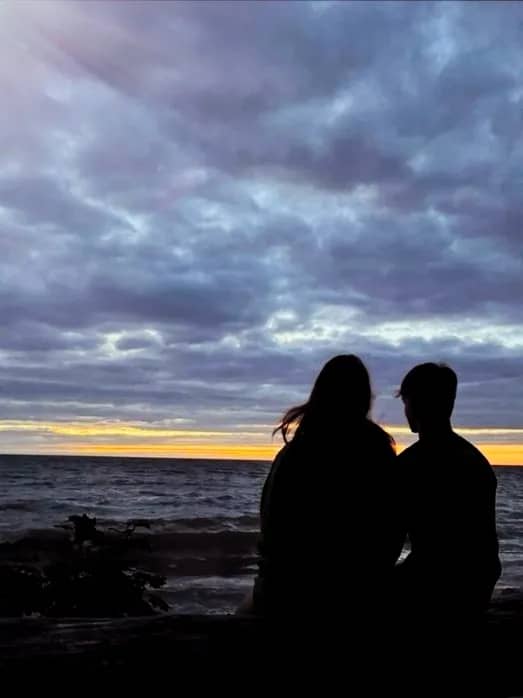
Photo by aria on Pinterest
He offered her his hand, and they climbed the cement border and leaned over, washing the grease off their fingers and lips with the cool ocean water. The water felt good on their overheated skin, and Susie saw that some of the other people had followed their lead, dipping their arms and legs into the ocean. With a teasing and challenging smile, Jay tilted his head toward the water. Susie understood what he meant, and together, they stood up and leapt into the ocean.
The other people on the highway who got wet from their splashes complained and made displeased sounds. Jay and Susie just looked at each other and laughed childishly. They swam, fully clothed, taking turns submerging their heads and rising back up to gasp for air. They stayed near the cement border, lest they drown or get carried away by the waves. Susie glanced behind her and saw that the two skinny kids were watching them enviously as their father kept shouting at them not to follow into the water. She shot the children an apologetic, sympathetic smile, and they ran away skittishly at her attention.
Jay floated lazily on his back, his face tilted to the sky and his eyes closed in relaxation. Susie dove into the water once more, but this time, with her hands, she followed the cement border down, down, and down, until she could reach the part where the highway was connected to strong cement beams that supported it. She opened her eyes underwater, ignoring the sting of salt, and could only see the pillars whose diameters might have been at least 300, 400 metres. She couldn’t see past the darkness, but she knew that deeper underwater were roads and buildings that people had lived in, well before her and Jay’s time. She longed to breathe underwater, so she could explore these underwater cities and make a home for herself and Jay in them. Perhaps she and Jay could eat seafood for their meals. They could have clothes made of algae and seaweed. They would not need fire and have no need to keep moving northeast. But all that was wishful thinking, and she swam back up to the surface.
Susie floated up to Jay, cupped water with her hands, and poured the water over his head. She massaged his scalp with her fingers, and her boyfriend hummed in satisfaction. She kissed his temple and asked, “What’s the plan when we get to north?”
“Probably camp just outside of those beautiful gated subdivisions with other poor folk,” Jay said. “Maybe we can make a house with wood from trees. I hear there’s a lot of trees there—that would be good.”
Susie hummed. She replied, “Don’t you think those pretty pes-hoes will be pissed? Us poor people cutting down the trees they so heroically planted and maintained with their campaigns and money?”
Jay opened his eyes and said with a laugh, “I’m counting on it. I can’t wait to see their angry faces. Then maybe they won’t be able to pretend that their so-called mighty efforts are not a waste and this rising water isn’t a problem anymore. Not when they’ll be forced to share their pretty mountain villages with ugly, poor folk like us banging on their gates for sanctuary. And you know what’s funnier? They’ll blame us for everything.”
She laughed at the absurdity, but with a heavy heart, Susie could not say that it wasn’t true. They were the scapegoats, she and Jay, and all the others like them on this deserted highway trying to escape their submerged barangays and provinces. They were killers of the world, with their plastic lunch boxes, their polyester clothes, their battery-powered instead of solar-powered radios. They were scum, just because they couldn’t afford biodegradable packaging and organic food.
Susie closed her eyes and put her arms around Jay’s shoulders. Despite everything, she was glad that it was the two of them, against the world. Jay reached up to massage her hands, and he resumed the song he had been singing while he was cooking a while ago. Susie inhaled the salty sea air, Jay’s familiar scent, and the smoke from the various cooking fires on the highway. For a moment, she could pretend they were in a tropical paradise, where there were fresh fruit, ripe and young and enough for more than just keeping their stomachs from rumbling.
It was a beautiful daydream.
The world was getting too thin, too small, and there was no place for them. Not inside the mountain villages, and certainly not on the S.S. Salvation ships.
As if her thoughts were magic, Susie heard a loud, bellowing horn, and she opened her eyes to see one of the S.S. Salvation ships in the distance. She looked back and saw that the people on the highway had spotted the ship, too, and they had started to crowd at the edge of the cement border, waving their hands and hollering. Amongst the ruckus, she and Jay could make out a few sentences here and there:
“Pasakayin niyo kami! Utang na loob, may mga bata!”
“Mga walang kwenta! Putang ina niyo, mga matapobre!”
She and Jay only watched dumbly as the ship sailed closer and closer, but clearly with no intent to get near enough to the highway. The ship’s white body gleamed magnificently in the sun, and it loomed bigger and mightier than Jay and Susie could have ever imagined. The pictures in the magazines and the papers could not do it justice. They guessed that it could house at least three subdivisions worth of people. Even from their distance, the two lovers could see people walking on the ship’s bow, dressed in bright, fine clothing, so different from the faded shirts on their backs that were too thin to protect against the sun. The ship emitted a huge white puff from its funnel. The smoke danced upwards, looking more like a cloud than the smoke from Susie and Jay’s pathetic fire ever could. Music was blasting on the ship from speakers, and as the ship approached slowly, it grew louder and louder, the vibrations permeating the air. The water also grew higher and wilder as the ship approached, until Susie and Jay could no longer hold their own and were forced to desperately swim back to the border.
But the waves were too fast, faster than Jay and Susie could swim to safety, and they were thrown around by the ocean. Their heads disappeared underwater. With all the strength of their thin, weak bodies, they struggled to keep afloat, swimming up and up and up, until they could break the surface. Susie and Jay sputtered out water from their mouths and noses, gasping for air.
Suddenly, they both crashed painfully into the cement border. Susie clawed her way up, ignoring the pain in her head and the stinging of multiple gashes on her limbs in order to survive. When she had managed to fall back into the solid asphalt of the highway, she landed on her palms and knees, shaking and sobbing.
People were already scrambling from their places and collecting their belongings. The water was rising higher, crashing against Susie’s back and splashing into the highway. People ran up the highway, heading north for dry land, salvaging what they could from the flood. Susie could briefly make out the father of the two skinny children carrying both his kids on his shoulders as his backpack hung from one shoulder, with the remaining chicken still hanging from it. The chicken he had slaughtered earlier was washed away by the flood, and he had no second thoughts about leaving the food behind just to get his kids to safety. Susie wondered if the rich people on the ship were watching the ruckus, watching them poor people fleeing like a pack of rabid, wild animals.
“Jay? Jay!” Susie yelled, frantically whipping her head back and forth, looking for her boyfriend. Their two backpacks were fully submerged in the mess, the fire long gone, and the plastic lunch box floating even as ocean water had managed to get inside. Susie crawled towards their belongings and hoisted them up on the hood of the abandoned grey car, safe from being washed away. Like the man with the kids, she paid no attention to their leftover food, and instead, she waded through the flood, screaming Jay’s name. “Jay! Where are you?!”
A cough resounded to her left, and she turned to see Jay climbing the border, wheezing and vomiting ocean water and the meal he had eaten earlier. Susie ran up to him on clumsy, deer-like legs, and she pulled him in before he could be swept away by the waves once more.
Jay’s forehead was bleeding, and there was a string of snot falling from his nostril. Susie wiped them away with her left hand, and with her right, she hit Jay’s back repeatedly to expel the rest of the water from his lungs. When he could finally breathe properly, Jay opened his red eyes and looked around the mess they were in. He said, “Try to save what the others left behind. We could use them.”
His urgency spurred them both to action. Susie chased after the still-floating lunch box. Jay saw an unopened cup of instant noodles floating in the water, left behind by someone who had already evacuated, and he took it, putting it along with their belongings on the hood of the car. He fished what he could from the mess: an abandoned jacket whose cloth was thicker than any of his or Susie’s clothes, a soggy pack of biscuits, some magazines, plastic bottles, and tumblers of drinking water.
When he turned to find Susie, Jay saw her walking slowly towards him, the plastic lunch box empty. She was shaking, and her eyes were red.
Susie whispered sombrely, “I tried. But the chicken had already been washed away… We don’t have any fresh food left.”
Her voice was quiet and shaky, and Jay was surprised to realise that she wasn’t just upset. She was afraid. He felt his face go red, hot tears stinging at his eyes and in danger of falling out. Jay clenched his fists in fury and raised them above his head, breathing sharply through his nose as he willed himself to calm down. He wanted to punch something—the car perhaps, or perhaps sweep their bags off the hood and throw them back into the flood. Once he had gotten a hold of himself, he opened his eyes just in time to see Susie flinch away from him. It was a minute action, lasting barely longer than a second, but he had caught it, and it caused his anger to sizzle out until it was replaced with sadness.
He fell onto his knees into the water, his head bowed. He would never hurt Susie. Never. But now she was scared. He was just like his father. He was just like Susie’s mother.
But then Susie fell onto her knees too, dropping the now empty lunch box into the flood and putting her arms around him. They clung to each other tightly, feeling each other’s warmth through their soaked clothes, and Susie babbled comfortingly in his ear, “Oh, Jay. Shh… It’s okay, Jay. I know you would never. You aren’t like them. It’s okay, you were just upset. It was the last chicken, after all, and you took so much care cooking it for us…”
She rubbed his back in circles. Amidst this mess, amidst her own discomfort and pain, she was still comforting him. The very thought of it, along with everything that has happened— leaving behind their horrible families, the deserted and now submerged highway, the glamorous ship still sailing in the distance and passing their pathetic camp—all of it caused a bubble of emotion to rise up Jay’s throat.
And suddenly, he was laughing.
Susie pulled away from him, confused, and the look on her face made Jay laugh even harder. They stood up, and they saw that the water was now up to their calves. A pair of boxers floated past them on the road. Their chicken was gone. Their backpacks were wet. Behind them, the S.S. Salvation kept cruising peacefully, blasting loud music on speakers, seemingly unaware or even uncaring that its sailing had destroyed whatever temporary relief Jay and Susie had. The smoke from the ship’s funnel kept dancing upwards into the sky.
Jay kept laughing.
Then, Susie started laughing too.
They doubled over like idiots, laughing maniacally, wheezing and clutching their stomachs. The sun started to set, leaving the blue sky with orange and red streaks. With a whoop, Jay jumped and pumped his fist into the air, as if he was a superhero. Susie hollered and kicked at the flood, splashing him in the face. They ran, chasing each other, twirling and spinning each other into circles. As if they weren’t survivors, refugees, two broken people on a highway at the end of the world. Instead, together they were simply Jay and Susie, recklessly in love, finding salvation in each other’s arms. They played in the water despite their hungry and panging stomachs. They ran and danced like kids fuelled by goodwill and hope, pretending to be on a beach in the middle of paradise, with the setting sun shining on their young faces.
They held each other, kissing and giggling, swaying and singing along to the distant music of that passing ship that they had no place in. They had nowhere to go, and for the first time, no desire to go anywhere.
It was just them. Just the two of them, dancing and swaying in the wind. Laughing and laughing, until tears pricked their eyes. Until the music from the ship had long since faded, and the only sound left was their cries.