
North Port passengers warned over new ‘orange tagging’ rule

Passengers at the North Port Passenger Terminal in Manila’s North Harbor are now required to wear an orange tag before boarding a vessel — a new rule questioned by port stakeholders and even the Philippine Ports Authority (PPA).
The measure, called the Passenger Terminal Monitoring System (PTMS), was implemented on 29 October and has caused confusion among travelers.
Information obtained by Daily Tribune revealed that PTMS personnel are collecting passengers’ personal information, including names, addresses, and contact numbers, and taking photos of their identification cards. A source warned that such data collection could compromise passenger privacy.
After the information is gathered, passengers receive an orange wrist tag with a QR code, which is scanned again upon disembarkation.
“Although the PTMS is just in its trial stage, we are not sure if the scheme was greenlighted by the PPA and the National Privacy Commission. Surprisingly, they operated last Wednesday without the approval of the Department of Transportation, the PPA, or even their so-called partner, 2Go,” the source said.
The source also identified a third-party IT company, UCC Tech, as being behind the system. The company reportedly approached Malacañang and the Department of Transportation (DoTr) to seek accreditation.
“We don’t even know whether they are already accredited by the DoTr or not. Biglang sumulpot lang sa North Port at nagsimula na ng kanilang trial stage,” the source added. (“They suddenly appeared at North Port and began their trial stage.”)
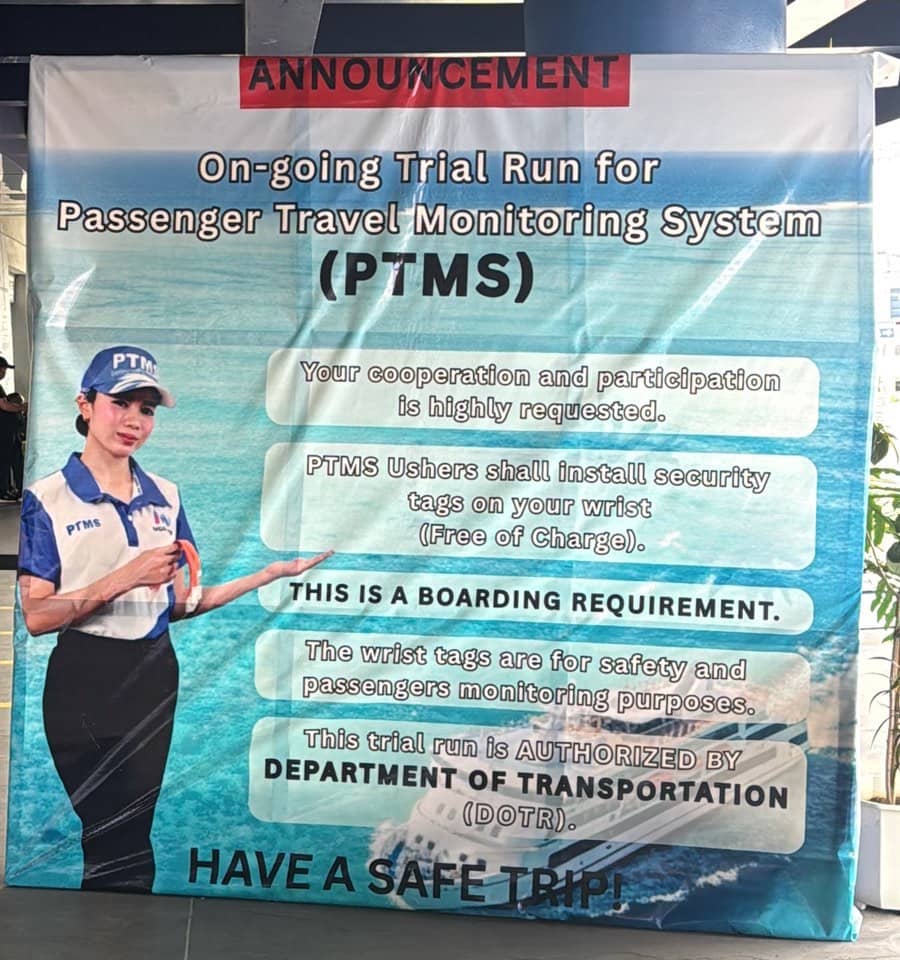
A tarpaulin displayed inside the terminal stated: “Ongoing trial run for Passenger Terminal Monitoring System. This is a boarding requirement,” claiming that the trial run was authorized by the Department of Transportation.
The PTMS is currently free of charge but will later collect P10 per passenger, adding another expense for commuters. The process also caused long queues entering the Passenger Terminal Building.
PPA General Manager Jay Daniel Santiago said they were surprised by the PTMS launch, which coincided with the influx of passengers traveling home for All Saints’ Day and All Souls’ Day on 01 and 02 November.
“Dahil sa kaguluhan nung trial run, hiniling namin sa DoTr na ipatigil muna yung trial run hanggang maisaayos ang proseso nang hindi nakakaabala sa mga pasahero at operasyon ng terminal,” said Santiago. (“Due to the confusion during the trial run, we requested the DoTr to halt the system until the process is properly organized without disrupting passengers and terminal operations.”)
Santiago said the request was immediately acted upon by DoTr Acting Secretary Giovanni Lopez, who ordered the suspension of the PTMS.