




Early warning systems everywhere more important than ever
The work of the WMO will be extremely vital in the next decade.

Text size
The work of the WMO will be extremely vital in the next decade.
For 75 years, the World Meteorological Organization (WMO) has been a barometer of truth. A credible and clear-eyed source of data and information about the planet we share. And a shining example of science supporting humanity.
Every day, your scientists, technologists and meteorologists embody your anniversary’s theme of “Science for Action.” Transforming observations into data. Data into understanding. And understanding into lifesaving action.
Without your rigorous modelling and forecasting, we would not know what lies ahead — or how to prepare for it. Without your long-term monitoring, we wouldn’t benefit from the warnings and guidance that protect communities and save millions of lives and billions of dollars each year. And without you, we would never have understood the emergence of the dangerous and existential threat of climate change.
But as the climate crisis accelerates, so too are the solutions to help communities adapt. Early-warning systems — the focus of your meeting today — are a prime example.
Early warnings are not an abstraction. They give farmers the power to protect their crops and livestock. Enable families to evacuate safely. And protect entire communities from devastation.
We know that disaster-related mortality is at least six times lower in countries with good early-warning systems in place. And just 24 hours’ notice before a hazardous event can reduce damage by up to 30 percent.
Early-warning systems work. And they’re finally getting the attention — and investment — they deserve. Over 60 percent of countries now report having multi-hazard early-warning systems in place. And least developed countries have nearly doubled their capacity since official reporting began.
Observation networks, regional collaboration and forecast capabilities are growing stronger every year. And breakthroughs in digital technology and artificial intelligence are modernizing data exchange and alerting. Your new report on Hazard Monitoring & Forecasting shows how much stronger forecast and warning systems have become.
But we have a long way to go. In 2022, I launched the United Nations Early Warnings for All initiative to ensure everyone, everywhere, is protected by an alert system by 2027. And I commend the WMO Secretary-General’s Call to Action that was endorsed earlier this week to act at the speed and scale required.
I must say I am impressed with the extraordinary commitments of the WMO and its partners on making sure that our projects, led by the WMO in relation to the early warning system, becomes a reality. And I would say it’s absolutely essential that it becomes a reality everywhere in 2027. And I fully understand the obstacles from the financial point of view and from the capacity to mobilize partners, resources and, sometimes, the political will of governments, but it is essential to have it in place.
It’s not difficult to forecast that the work of the WMO will be extremely vital in the next decade.
A few reports will be presented, one will be WMO on the emissions gap, but one thing is already clear: we will not be able to contain the global warming below 1.5 degrees in the next few years. The overshooting is now inevitable, which means that we are going to have a period, bigger or smaller, with higher or lower intensity, above 1.5 degrees in the years to come.
That means that the importance of early warning systems and the importance of the work of WMO will be vital, because the devastating impacts of these overshooting are to be expected. Now, that doesn’t mean that we are condemned to live with 1.5 degrees lost. No. If there is a paradigm shift and people assume seriously that we need to deal with the problem, it is possible to anticipate as much as possible to get to net zero and then to be consistently with negative net in the future in order for temperatures to again go down and the 1.5 still remains, according to all the scientists I met, possible before the end of the century, if there is a very serious package of measures that correspond indeed to a paradigm shift, but in which fortunately we have both the science and the economy at our service.
But one thing is sure, the next decade you will have a lot of work, a lot of extremely important work, to preserve as much as possible human lives, to preserve as much as possible communities and to preserve as much as possible the economies of countries, especially in the most vulnerable areas in the world.
And so, I have to say, WMO is becoming more important than ever and to have early warning systems fully in place everywhere in 2027 must be, for all of us, an absolute priority. The good news is that after listening to you, I trust that, independently of what the errors of humankind will lead in relation to climate change, you will be there in the first line of protection of the populations worldwide. We can trust on your competence, your professionalism and your very solid science-based approach and the use of the technologies that are today essential to make your work even more effective.
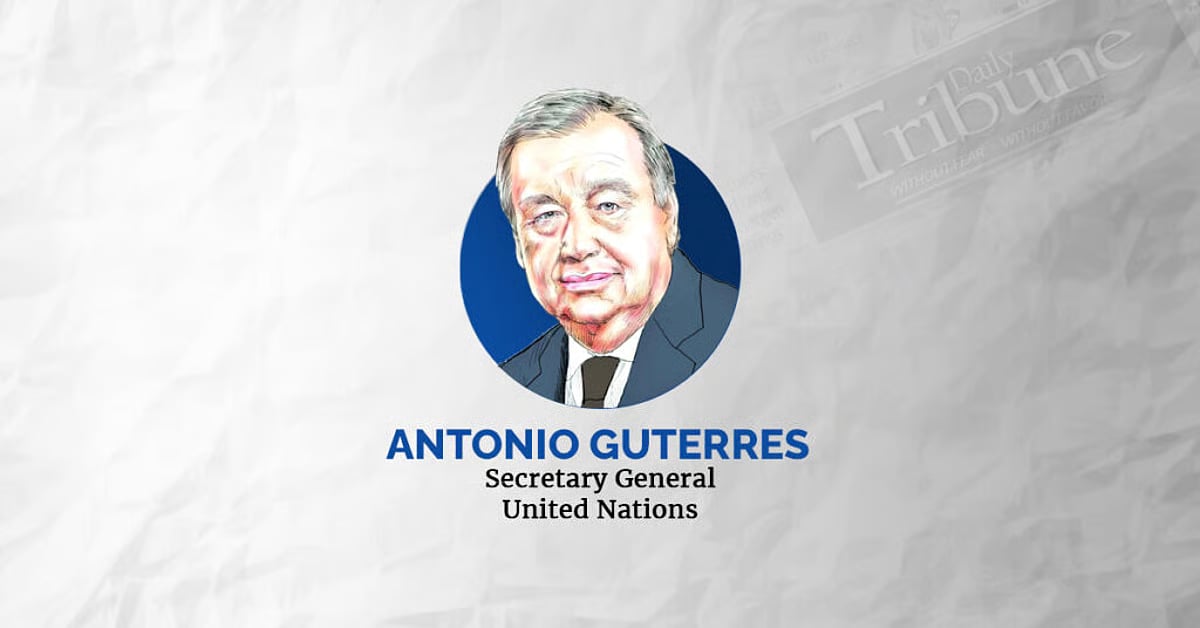
(Excerpts of United Nations Secretary-General Antonio Guterres’ remarks to the High-level Event on Early Warnings for All at the Extraordinary Session of the World Meteorological Congress on 22 October 2025.)
Three decades after the Marcopper mining disaster devastated Marinduque’s waterways, the province is again pressing the…
Housing is probably the biggest issue affecting people the world over.
Malacañang on Monday called for a more thorough investigation into the questioned flood control projects in Taguig…
The defense on Monday backed the move by senator-judges to exclude a prosecution witness who testified on the firearms…
