




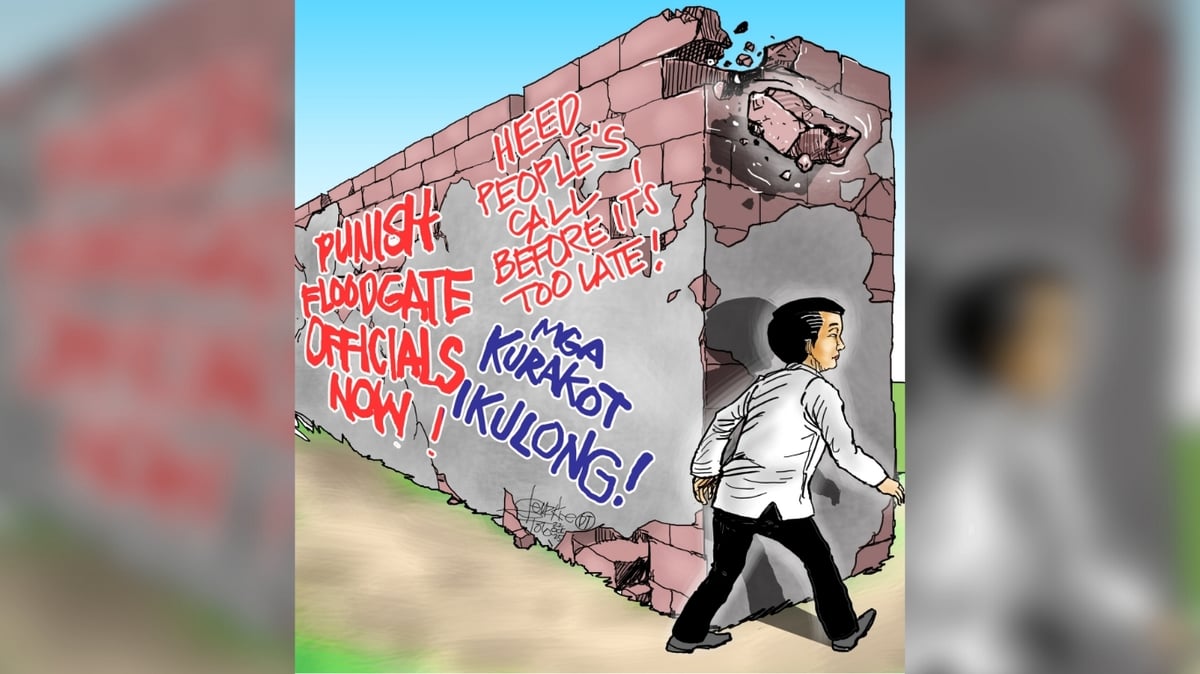
Writing on the wall
Business groups recently sent President Marcos Jr. a strong message through a joint resolution urging swift and decisive action on the massive corruption scandal.

Text size
Business groups recently sent President Marcos Jr. a strong message through a joint resolution urging swift and decisive action on the massive corruption scandal.
When the business sector speaks, the government must listen, as their raised voices on a particular issue often signal a tipping point, one that could lead to significant social unrest.
A captain of industry recalled that protests by traders signaled the beginning of the end of the extended rule of former President Ferdinand Marcos Sr.
Recently, business groups sent his son, President Ferdinand Marcos Jr., a strong message through a joint resolution urging swift and decisive action on the current massive corruption in flood control and infrastructure spending.
The message in gist: “We don’t want coverups. We don’t want railroading. We want those who are really responsible to be identified and punished.”
The statement also effectively questioned the capabilities of the Independent Commission for Infrastructure (ICI), saying it lacks teeth and should be free from political influence.
Established last September through Executive Order 94, the ICI is an ad hoc fact-finding body, but it can only recommend the prosecution of all those it finds responsible for the corruption in government public works projects.
A business sector figure reminisced: “Remember when the confetti rallies in Ayala, Makati started?”
He was recalling the days following the assassination of Senator Ninoy Aquino in 1983 when a small group of business leaders in Makati, known as the “Monday Group,” came up with a creative, low-risk form of protest to mobilize white-collar workers without attracting intervention from security forces.
Inspired by the Filipinos’ love of fiestas and pageantry, they settled on “confetti rallies” as a festive yet symbolic act of protest, a shower of yellow paper strips torn from the Yellow Pages, which were the business pages of the telephone directory.
The confetti rained down from office windows to signal solidarity and demand justice.
The first rally unfolded on 29 August along Ayala Avenue, the bustling financial artery of Makati, lined with high-rise buildings housing banks, corporate towers, and multinational firms.
Organizers secretly coordinated with building managers and employees: at a pre-arranged signal, often the explosion of a firecracker, workers would hurl confetti from the upper floors, abandon their desks en masse, and converge on the street to march and chant.
There was no police presence initially in this elite enclave, allowing the protests to swell spontaneously.
The rallies eroded the aura of invincibility of the Marcos Sr. regime and sparked economic boycotts and international pressure. This foreshadowed the 1986 People Power Revolt.
The last time that confetti rained down on Ayala Avenue was in 2009 as former President Cory Aquino’s funeral cortege passed by.
The confetti rallies were considered a masterstroke of civil disobedience, turning Makati’s glass towers into beacons of hope.
The flutter of yellow paper affected the government more than the violence that accompanied the more aggressive mass actions at the time. The idea also appealed to the office workers who later joined the mass movement.
Today, the ongoing protests against the corruption in flood control projects are a precursor to a reprise of the Ayala business center mass action.
According to the insider in the meetings of the executives, the protesting groups are cohesive, which is expected to produce results.“It’s the business community that’s rallying,” he said.
When traders talk, it would be a disaster for the administration not to listen.
