Daily Tribune
I respect the Ombudsman, I respect the DPWH, I respect the ICI in their mandate, and I am willing to cooperate as long as we get to the truth. Just the truth.
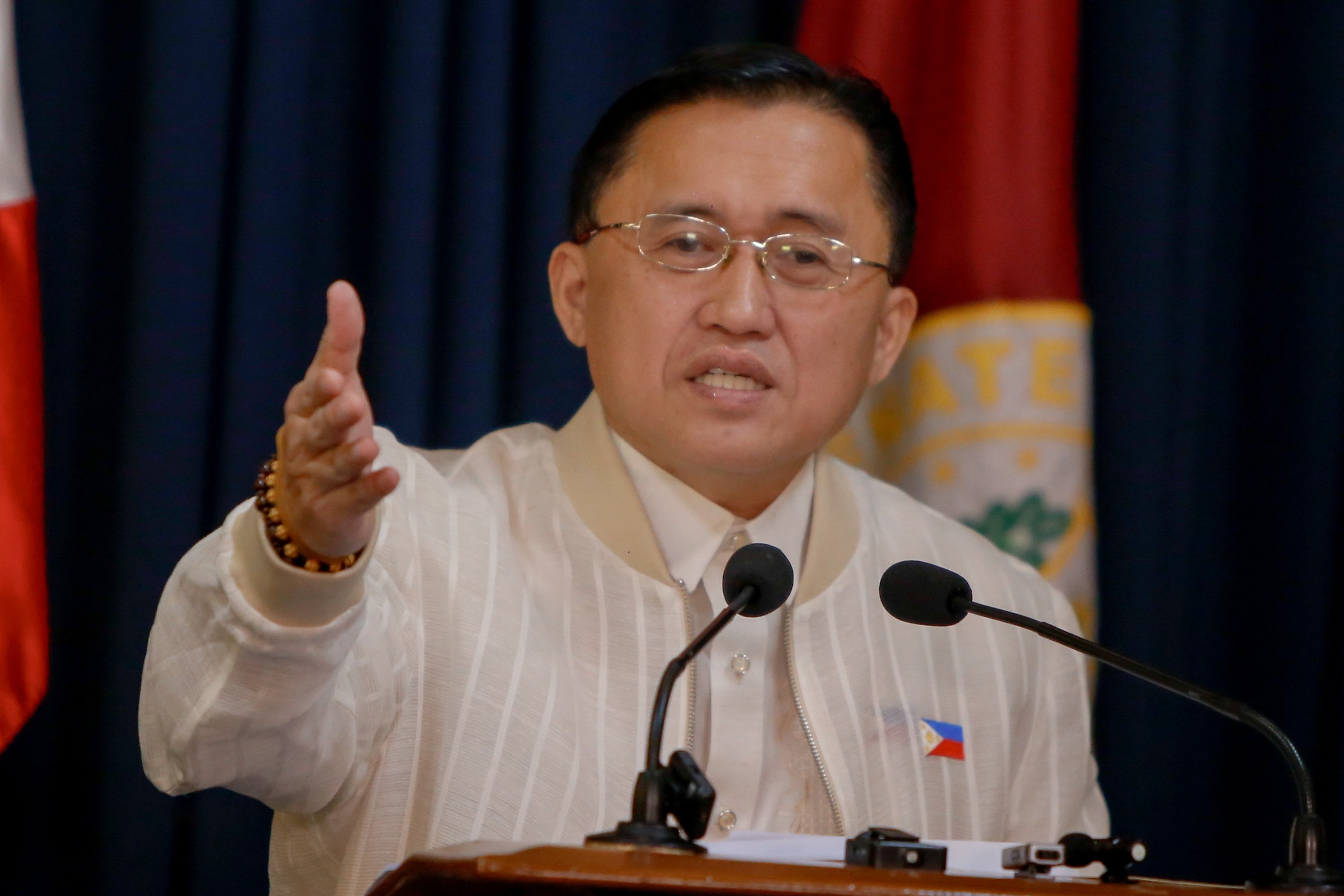
‘Let’s make them accountable’ Senator Christopher ‘Bong’ Go tells media on Thursday, 16 October.
PHOTOGRAPH BY ARAM LASCANO FOR DAILY TRIBUNE
Probing CLTG Builders and linking the contractor to Senator Christopher “Bong” Go was a political maneuver meant to distract the public from more pressing corruption cases, particularly those involving ghost projects and flood control anomalies, the legislator said yesterday.
In a briefing amid the scrutiny over his alleged connection to contractor couple Pacifico “Curlee” and Cezarah “Sarah” Discaya, Go said the probe into CLTG Builders is nothing more than an attempt to drag his name into a scandal that he claimed had already been addressed in a Senate hearing.
“I even opened it up during the hearing. I asked them,” Go said, referring to the Senate Blue Ribbon Committee inquiry on anomalous infrastructure projects.
“That was discussed openly. It was openly tackled during the Senate hearing,” Go recalled.
He questioned the motive behind revisiting the 2017 joint venture between the Discayas and CLTG in Davao, calling it “unfair” and an attempt to smear his name with a legitimate contract.
CLTG, it is claimed, stands for Christopher Lawrence Tesoro Go, the senator’s full name. CLTG Builders is being linked to Go’s family, particularly to his father.
Ombudsman Boying Remulla ruled out the possibility of providing a blanket immunity to big-time contractors Curlee and Sarah Discaya, citing their “evasiveness” in divulging their alleged connection with the CLTG Builders, a firm reportedly tied to Senator Bong Go.
Remulla suggested the couple has been shielding certain personalities, including Go, from being implicated in the flood control scheme, suggesting selective testimony that raises serious doubts about their credibility as potential state witnesses.
“They’re holding a lot [of information], very selective,” he said in Filipino in an interview. “It looks like Senator Go is being protected for a conflict of interest, [so] they refused to speak.”
The CLTG, according to Remulla, stands for “Christopher Lawrence Tesoro Go,” a Davao City-based construction firm either allegedly owned by the senator’s father or brother that entered a joint venture with the Discayas.
The Discayas ran nine firms, bagging over P30 billion in government contracts for flood control during the first half of the Marcos administration.
Their licenses, however, were revoked in early September after the couple admitted in a Senate hearing that their companies bid against each other.
“Let the facts speak for themselves. I have nothing to hide and nothing to fear because I am innocent. I am not involved in any anomaly,” Go said in a briefing on Thursday.
The senator also raised concerns that the ongoing probe into the flood control may be manipulated, suggesting a “cover-up.”
Remulla, however, warned that they would “go with the facts as we dig up everything,” saying the Ombudsman would not allow the Discayas’ evasive attitude.
The Discayas implicated at least 19 House members, including former Speaker Martin Romualdez and resigned lawmaker Elizaldy Co of Ako Bicol Partylist, accusing them of receiving 10 to 25 percent kickbacks for every flood control project awarded to their firms.
Nonetheless, the Ombudsman asserted that the awarding of contracts to CLTG clearly constitutes a conflict of interest on the part of Go, enough to stand on its own without the corroboration of the Discaya couple.
“That’s why we told them, ‘If you have a chance to get out of this, you should tell everything, and hide nothing.’ But they’re very evasive,” Remulla said.
Remulla, on the other hand, is confident that his office could build a strong case and prosecute the personalities involved in the flood control corruption scheme, whether or not the Discayas execute a “tell-all” testimony.
Go insisted he never influenced any government-related businesses in Davao City.
“It even reached Baguio, the NBI, Ilocos Norte. There are so many places that should be looked into — Mindoro, for example. Why would you go back to 2017 in Davao? It’s not a flood control project, it’s not a ghost project, it’s not even anomalous. So why bring it up? Just to drag my name into it,” he asked.
He also warned the public not to be misled.
“I said it’s unfair, it’s unfair to go back like that. That’s clearly an attempt to divert the issue. I hope it’s just unfair and nothing more,” he added.
“I respect the Ombudsman, I respect the DPWH, I respect the ICI in their mandate, and I am willing to cooperate as long as we get to the truth. Just the truth,” he asserted.
Go reiterated his adherence to propriety, insisting he never intervened in favor of any family member in government dealings.
‘I have not gained’
“I have not gained anything. I observe propriety — that’s my investment up to now,” he stressed.
Go held significant sway as former President Rodrigo Duterte’s longtime aide and trusted ally from 2016 up to the present as a senator.
The Discayas are under investigation by the Office of the Ombudsman and the Department of Justice (DoJ) for their involvement in allegedly anomalous public works projects, including joint ventures with CLTG in Davao City.
Despite concerns of a conflict of interest, Go insisted that neither he nor his family benefited from the contracts under investigation.
“Let me repeat, I was not yet born in this world my family already had several businesses,” he said.
“And for the record, they retired in 2019. These are the facts; it is the truth. They were retired in 2022, from 2019,” he said.
Go emphasized his willingness to cooperate with the authorities.
“I am willing to know the truth. You can file a case, even against my relatives if they are guilty,” he said.
Brutal truth hits Discayas
Meanwhile, the Discaya contractor couple has encountered a reality check, prompting their sudden turnaround from cooperating with the Independent Commission for Infrastructure’s (ICI) investigation into alleged irregularities in flood control projects, Ombudsman Jesus Crispin Remulla revealed.
The anti-graft official indicated the Discayas were given a “reality check” by the DoJ in their pursuit of turning state’s evidence.
“My colleagues at the DoJ told them it was likely they would be imprisoned, given the number of crimes involved,” Remulla said.
The only possible course of action left for the couple is to enter into a plea bargain, unless they decide to tell the whole truth and not shield other individuals.
“We need to be talking to truth tellers. It should be truth tellers who will ask for government protection and special consideration,” he added.
In September, the Discayas applied to the DoJ to become state witnesses in the ongoing flood control projects investigation.
Their application was rejected, however, and, according to Remulla, their only chance of approval is if they agreed to a full restitution of the funds they allegedly took in the flood control projects scam.
The Ombudsman noted, however, that a full restitution “has never happened in the entire history of the Philippines.”
The dim prospect of their being allowed to turn state’s evidence convinced the Discayas to stop cooperating with the ICI probe.
Following the couple’s withdrawal from the probe, Remulla said the Discayas are not the only witnesses cooperating with the commission.
WPP not a bargaining chip
On Thursday, Prosecutor General Richard Anthony Fadullon cautioned the Discayas against using the Witness Protection Program as leverage to set conditions or dictate the terms of their cooperation with the government’s corruption probe.
Fadullon said the DoJ respected the couple’s decision to pause their coordination with the ICI but noted the move could affect their eligibility for protection.
“They are applying for witness protection coverage, and we have procedures to determine if they are qualified,” said Fadullon, adding, “It is not for anybody to dictate to us how to conduct our evaluation or impose conditions.”
The DoJ, Fadullon said, was surprised to learn through the couple’s lawyer that they would no longer cooperate with the ICI, although there has been no formal communication of withdrawal.
“As far as the department is concerned, there has been no indication that they are refusing to continue talking to us,” he said.
The DoJ official pointed out the WPP provides protection, not immunity, from prosecution.
“The protection is because of the danger to their lives, but that protection cannot be equated with immunity,” he said. “If what they’re expecting is blanket immunity, that’s out of the question. Each project could constitute one separate case.”
He said the DoJ’s evaluation process involves cross-checking the veracity of an applicant’s statements — including names, transactions, and the movement of money — before recommending protection.
“You cannot just run around mentioning people’s names without supporting documents or evidence,” Fadullon said.
Case buildup continues
The prosecutor general confirmed the DoJ is continuing to build up corruption cases related to ghost flood control projects independent of any prospective state witnesses.
“Even as we speak, we are gathering evidence on different projects reported to us,” he said.
“We have already referred cases to the Office of the Ombudsman this week involving flood control projects, and those can stand on documentary evidence alone,” he added.
He said that while insider testimony could strengthen the government’s case, “you cannot rely solely on one person’s testimony,” noting that witnesses could later retract their statements.
Fadullon said the DoJ is evaluating an affidavit submitted by the Discayas.
He said cooperation with investigating bodies such as the ICI remains crucial in determining their credibility and eventual qualification for the WPP.
“If they choose not to cooperate, that could be a reason to deny their application — because there would be nothing to evaluate in the first place,” he explained.
Fadullon appealed to potential witnesses to be forthright in their testimonies if they genuinely wish to help the government uncover corruption in public works.
“Our appeal is simple: if you come to us, tell us everything,” he said. “If you hide information or selectively remember, then it’s better not to speak at all. Partial truths will not be credible to us or to the court.”
Open SALNs
Meanwhile, Remulla reminded public officials they are obligated to disclose their Statement of Assets, Liabilities, and Net Worth (SALN) when requested, as required under the rules of disclosure.
According to Remulla, SALNs will allow the ICI and the Office of the Ombudsman to conduct lifestyle checks on government officials to identify potential discrepancies and signs of corruption.