
VST-ECS chief urges lawmakers to craft Data Sovereignty Law
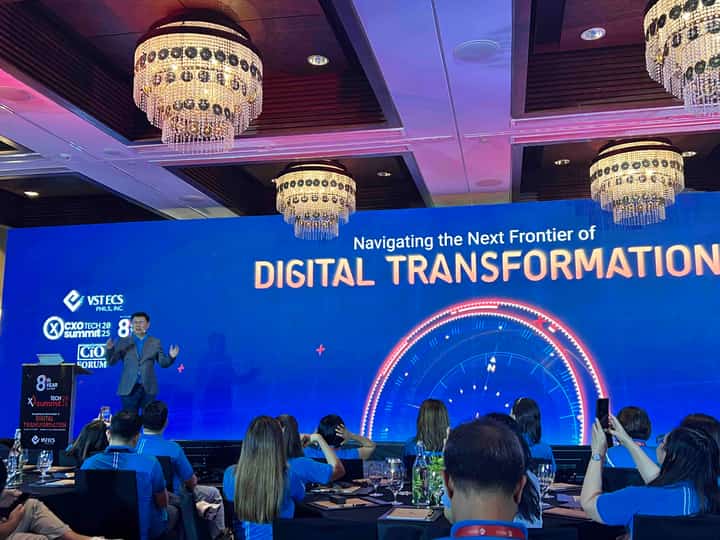
The top official of the country’s market leader in local ICT distribution, VST-ECS, has called on lawmakers to formulate a bill establishing Data Sovereignty—a measure already adopted by ASEAN counterparts such as Thailand and Vietnam.
During the VST-ECS CXO Summit 2025 at Shangri-La Boracay in Malay, Aklan, VST-ECS President and CEO Jimmy Go admitted that the Philippines lags behind its neighbors because it lacks such a law.
“I think we are going there, but we are a bit behind other countries because we don’t have a Data Sovereignty Law. And I hope that the Philippines will at least craft that law to attract more hyperscalers and data center players here in the country,” Go said in an exclusive interview with the Daily Tribune.
Data sovereignty refers to the concept that data is subject to the laws and regulations of the geography where its owners are located. These rules require organizations that collect and process data to manage and protect it in accordance with the user’s country or state of residency.
The Philippines currently has the Data Privacy Act of 2012 (Republic Act No. 10173), which protects personal information in government and private information systems. However, Go noted that other ASEAN nations have gone further by adopting policies that enhance national control over data.
Data from PS-Engage, authored by Mackenzie Gunther, shows that Indonesia passed Law No. 71 of 2019 or the Implementation of Electronic Systems and Transactions, which gives its Ministry of Communication and Informatics authority over data localization, electronic systems governance, and monitoring.
‘On the right track’
Go said the country is moving in the right direction in embracing digitization, particularly in social media and e-governance.
“It is just a matter of time (for us to fully embrace digitization) because we don’t have the budget, as we don’t have the Data Sovereignty Law, but we are going there. It is very important in everybody’s business to have a competitive advantage, or else you will be left behind,” he said.
Go noted that while many government transactions are now conducted electronically, digital transformation is only the first step.
“AI helps us in digital transformation, reduces our costs, improves our efficiency, and builds our business solutions and internal applications, which is the most important thing,” he stated.
According to the Philippine Statistics Authority, the country’s digital economy reached ₱2.25 trillion in 2024, accounting for 8.5 percent of GDP, a 7.6 percent increase from ₱2.09 trillion in 2023.
AI moving faster
In his keynote address at the CXO Summit 2025, themed “Navigating the Next Frontier of Digital Transformation” and attended by major global tech brands including Huawei, Cisco, Fortinet, HPE Aruba, Lenovo, Rubrik, and VMware, Go said technology is evolving faster than ever before.
“With the accelerating pace of technology, digital transformation is unfolding in ways we’ve never seen before. What once took years now happens in months—or even weeks. The velocity of change is staggering,” he said. “This brings us to a critical inflection point. The frontier has shifted in unprecedented ways. The map we once relied on is being redrawn by one powerful, undeniable force: Artificial Intelligence.”
Go said businesses are entering the era of Agentic AI—autonomous systems capable of making decisions, executing strategies, and collaborating like digital teammates.
“This is the dawn of the Augmented Enterprise: a strategic integration of technology designed to amplify human capabilities,” Go said. “What was once theoretical is now gaining traction across industries. Yet for all its promise, AI is only as powerful as the data it consumes. It is driven by one relentless force: AI’s insatiable appetite for data.”
Go emphasized that AI thrives on high-quality, relevant, and timely information, and without it, even the most advanced systems are ineffective.
“These are just some of the questions every organization must ask: Are we collecting the right data? Are we using it wisely? Do we have the right tools to collect them? Are our data sources diverse enough to reflect the complexity of our business? Is our data infrastructure scalable and secure? Are we eliminating silos that prevent data from flowing across departments?” he said.
Go concluded by urging companies to act now and explore how AI can serve their unique business goals.
“Whether it’s reducing operational costs, improving customer experience, streamlining supply chains, or accelerating innovation—AI offers tangible, measurable impact,” the VST-ECS official said.