
Geologist: Expect ‘the big one’ coming
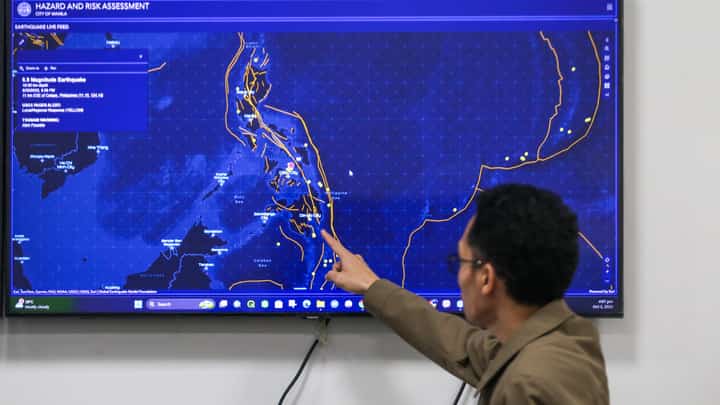
Metro on tenterhooks Christian John Evangelista, chief of research and planning of the Manila Disaster Risk Reduction and Management Office, traces the fault lines and trenches running beneath the archipelago on 2 October 2025 — days after a 6.9-magnitude quake rattled Bogo City, Cebu, and reminded the nation of its fragile ground.
PHOTOGRAPH BY TOTO LOZANO FOR DAILY TRIBUNE
Dr. Mahar Lagmay, geologist and director of the University of the Philippines Nationwide Operational Assessment of Hazards (NOAH), emphasized the importance of preparedness for possible upcoming earthquakes.
In an interview on Sunday, he highlighted the Philippines’ geographical location within the Pacific Ring of Fire, where numerous fault lines are situated. He urged the public, especially those in Metro Manila, to remain vigilant and prepared.
“Let us expect ‘The Big One’ coming,” he said.
Explaining the Cebu quake that occurred on 30 September, Lagmay said it originated from a fault between Leyte and Cebu, where a rupture took place.
“There is a break on land, inland, near Bogo City,” he explained.
Lagmay also discussed the concept of stress transfer — the shifting of pressure within the Earth’s crust from one fault to another after an earthquake — which can sometimes trigger nearby quakes.
In relation to the Cebu and Davao Oriental earthquakes on 10 October, he clarified that the two events were not connected, as they occurred too far apart.
“The fault where it originated is different. In that case, they’re not connected, the source of the earthquake rupture is different,” he said.
Lagmay added that the Philippines lies between the Philippine Sea Plate and the Eurasian Plate, which are constantly colliding.
“Massive rocks push against each other, causing stress to accumulate in this part of the world. And when that stress builds up, it’s sometimes released, resulting in an earthquake,” he explained.