
Metro Manila Subway, PNR to face 4-year delay amid funding cuts, ‘insertions'
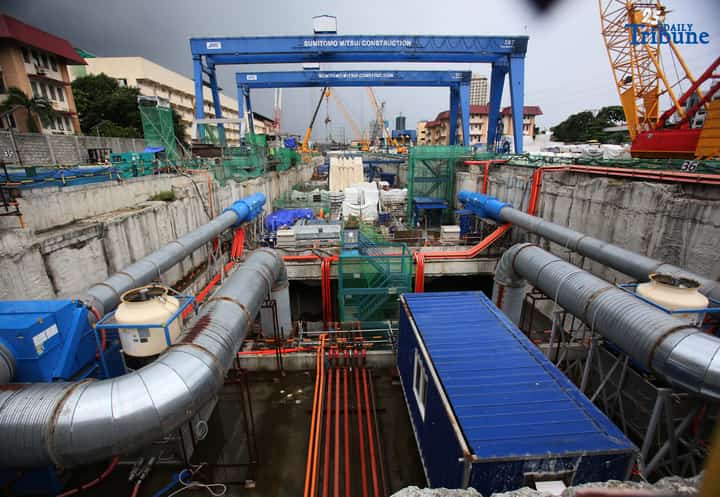
Ongoing construction at the Camp Aguinaldo Station of the Metro Manila Subway Project in Quezon City. Newly appointed Acting Transportation Secretary Giovanni Lopez said Wednesday that the P488.5-billion project is targeted for completion by 2032. He added that the entire subway line will be under construction by November, with remaining segments to be awarded to contractors before year-end.
Photograph by Analy Labor for DAILY TRIBUNE
The funding for the Metro Manila Subway and the expanded Philippine National Railways (PNR), supposedly completed before 2030, was among those hit when flagship programs were defunded in the previous budgets, which a minority solon blamed on the “negligence” and “collusion” of Malacañang with Congress.
House Senior Deputy Minority Leader Edgar Erice disclosed in an interview on Wednesday that the budgets for over 15 big-ticket projects of the Marcos administration were slashed in the 2023, 2024, and 2025 General Appropriations Act (GAA) to make room for the “insertions” of lawmakers, which already ballooned to P1.45 trillion.
“P1.45 trillion, unprecedented, largest in the history of Congress. In three years, P1.45 trillion in amendments and insertions, which are only the same,” Erice said partly in Filipino.
“Worse, the important flagship projects, which were foreign-assisted projects, were defunded and [redirected] to projects not studied by the agencies concerned,” he added.
The Metro Manila Subway and the expanded PNR, also known as the North-South Commuter Railway (NSCR), are estimated to cost P488.5 billion and P873.6 billion, respectively, totaling P1.4 trillion.
Japan will fund the bulk of the projects’ cost through a loan, though the Philippines had an equity contribution.
Erice, however, said the government’s stake was removed from the said budgets and reallocated to those that lacked proper evaluation and planning endorsed by lawmakers in the previous 19th Congress.
Due to a lack of funding, the completion of the Metro Manila Subway and the NSCR will be delayed for four years—from 2028 to 2032 and 2029 to 2034, respectively.
As a result, the government will incur a whopping P300 billion in financial repercussions to shoulder commitment fees, penalties, materials, and labor, among others.
Erice asserted that this should have been averted had the Department of Budget and Management properly vetted the GAB passed by Congress before President Marcos Jr. signed it into law.
The Caloocan lawmaker said it is puzzling why the DBM did not question such massive insertions, which he classified as “red flags,” suggesting complicity between the executive and Congress.
“I’m just wondering, [in] 2023, 2024 the executive department already knew that Congress was doing that. Why did this still slip through in 2025? I think there was also negligence on the part of the DBCC or the DBM,” he stressed. “Why didn't they advise the President? He could have vetoed it.”
Erice also attributed these so-called irregularities to the power imbalance in Congress, saying the opposition could do so little in the budget alignment because the supermajority dominates the chamber.
The 2025 GAA, derided as the “most corrupt” budget ever passed by Congress, had an initial allocation of P6.352 trillion before it was slashed to P6.326 trillion after Marcos vetoed P194 billion worth of line items deemed inconsistent with his administration's priority programs. Of the vetoed items, P16.7 billion was intended for flood control projects.
This year’s budget was also heavily criticized for allegedly featuring bloated unprogrammed appropriations, reaching nearly P2 trillion since 2023.
Opposition lawmakers branded the UA as a conduit for corruption and pushed to scrap it from the 2026 budget, with an allocation of P250 billion.
Unprogrammed appropriations are “standby funds” that can be tapped when the government collects more revenue than expected, or when grants and foreign funds are available. Traditionally, the UA is invoked for emergencies or when infrastructure projects, social aid programs, among others, are required.
In 2023 and 2024, a staggering P141 billion in UA was reportedly tapped to bankroll flood-control projects, which are at the center of an investigation into allegations of corruption involving members of Congress, DPWH officials, and private contractors.