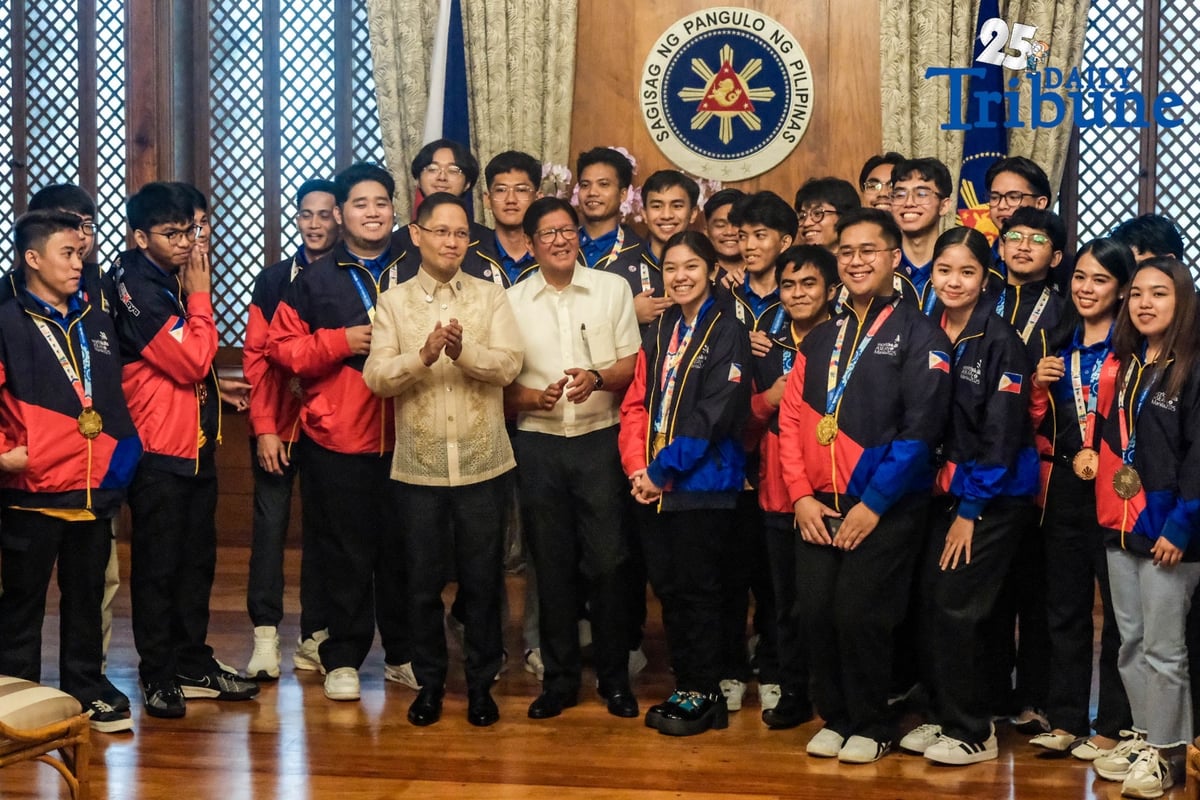
President Ferdinand Marcos Jr. praised the exceptional achievements of young Filipino talents who represented the country in the 14th WorldSkills ASEAN 2025, hosted by the Philippines.
During a courtesy visit at Malacañang Palace on Tuesday, Marcos lauded the dedication, skill, and performance of the winners.
“We did very well, and we're all very proud of you because there is more to this than just a contest or just a competition between different countries in ASEAN. It also shows the quality of the training that we have given our workers,” Marcos said.
The Philippines brought home 10 gold medals, 7 silver medals, 8 bronze medals, and 5 Medallions for Excellence.
In recognition of their achievement, Marcos awarded the winners with cash incentives through the Office of the President — P100,000 for gold medalists, P80,000 for silver medalists, P60,000 for bronze medalists, and P50,000 for Medallion for Excellence recipients.
It has been 29 years since the Philippines last hosted WorldSkills. Marcos commended the Technical Education and Skills Development Authority (TESDA) for successfully preparing the national delegation.
“Considering that we are working so hard to retrain, reskill, upskill all our workers, this is going to be very, very important. But I said if we are going to host it, we should do well. Huwag naman tayo mapahiya... I think that you have achieved our purpose,” Marcos said.
The President said the delegation’s success serves as an inspiration to Filipino youth and as proof of the quality of technical and vocational education in the country.
“This, here, as what you’ve done have yielded a successful result, we only show that the Filipino worker is a good worker. [And] we can say, this is proof that we are,” he said. “You have made our reputation better, you have once again proved to the world the value of the Filipino worker,” he added.
The 14th WorldSkills ASEAN, themed “ASEAN: Skilled for the Future,” gathered over 1,000 delegates from 10 ASEAN member states, including Timor-Leste’s first participation. Nearly 300 young professionals competed across 32 skill areas—from traditional trades in construction and manufacturing to high-tech fields such as CoBot Systems Integration, Industry 4.0, Cybersecurity, Internet of Things, Autonomous Mobile Robotics, and 3D Digital Game Art.