
The power of transitions in ‘Walang Aray’: Story, style and sound
Back onstage for another run, PETA’s ‘Walang Aray’ bridges tradition and transition, transforming a classic into a modern hit that celebrates both creativity and diversity.


Robust laughter and resounding applause have been rocking the PETA Theater Center in Quezon City as the Philippine Educational Theater Association (PETA) — long known for championing original, socially resonant works — brings back its runaway hit Walang Aray (Without Pain) for another run. The production opens PETA’s fifty-eighth theater season, which carries the theme “Love and Power.”
The musical has grown crisper in rendition, evergreen and ever evolving with new cast members. It breaks ground in inclusivity and proves, once again, that laughter can be revolutionary.
Revisiting the sarsuwela
Walang Aray is an adaptation of the classic sarsuwela Walang Sugat (No Wounds) by Severino Reyes, author of the beloved Mga Kuwento ni Lola Basyang who is deemed the “Father of the Tagalog Sarsuwela.” The sarsuwela is the Filipino adaptation of the Spanish zarzuela, brought to the archipelago in late 19th century by touring troupes from Spain. It became very popular in the first two decades of the 20th century. Following performance conventions and plot formulas, it was light and didactic, and usually told stories of star-crossed lovers. Before long, Filipino writers began creating original zarzuelas, and Walang Sugat, first staged on 14 June 1902 at the Teatro Libertad in Manila, is one of the earliest sarsuwelas written in Tagalog.
Walang Sugat became so popular that it helped established the sarsuwela as the dominant form of entertainment in Manila. However, the sarsuwela’s popularity declined during the American period until it faded into nostalgia. In recent years, restaging and original works have emerged sporadically. Walang Sugat, which was last staged in 2010 by Tanghalang Ateneo, is among the few classic sarsuwelas that are reimagined and reinvented. Written by playwright Rody Vera, Walang Aray is at once parody and homage. The result is a delirious spectacle that feels both rooted in history and unmistakably of the present moment.
The musical was originally written as a screenplay in 2007, commissioned by filmmaker and advertising director Jun Reyes, the great-grandson of Severino Reyes, for a film to be produced by his creative content agency Indie.Go Media. Walang Sugat has actually been adapted into a movie three times — in 1913, 1939 and 1957. However, this latest project did not push through due to prohibitive production costs.
More than 10 years later, in 2018, Vera presented Walang Aray to PETA to be transformed and produced as a musical incorporating existing pop songs. Then artistic director Maribel Legarda, however, suggested the use of original music instead.
Walang Aray was first staged in a PETA Lab show in 2018 and 2019 under the direction of Ian Segarra, with original music and musical direction by Vince Lim.
The musical’s first full run took place from 17 February to 14 May 2023, spanning 41 shows, serving as PETA’s inaugural production when it returned to live performances in 2023, after a two-year hiatus brought about by lockdowns and restrictions imposed to curb the spread of the Covid-19 pandemic.
The original cast included KD Estrada, Alexa Ilacad, Gio Gahol, and Marynor Madamesila in the lead roles. Due to insistent public demand, a second limited run, with 17 shows, was mounted from 6 to 22 October 2023, featuring Gahol, Madamesila, Shaira Opsimar and Jon Abella as leads.
Story and style
Walang Aray retains the core plot of Walang Sugat. It follows the story of secret lovers Julia, a rising star of the zarzuela stage, and Tenyong, a freedom-loving youth. Their affair is known only to their loyal confidants, Monica and Lucas, who also become lovers.
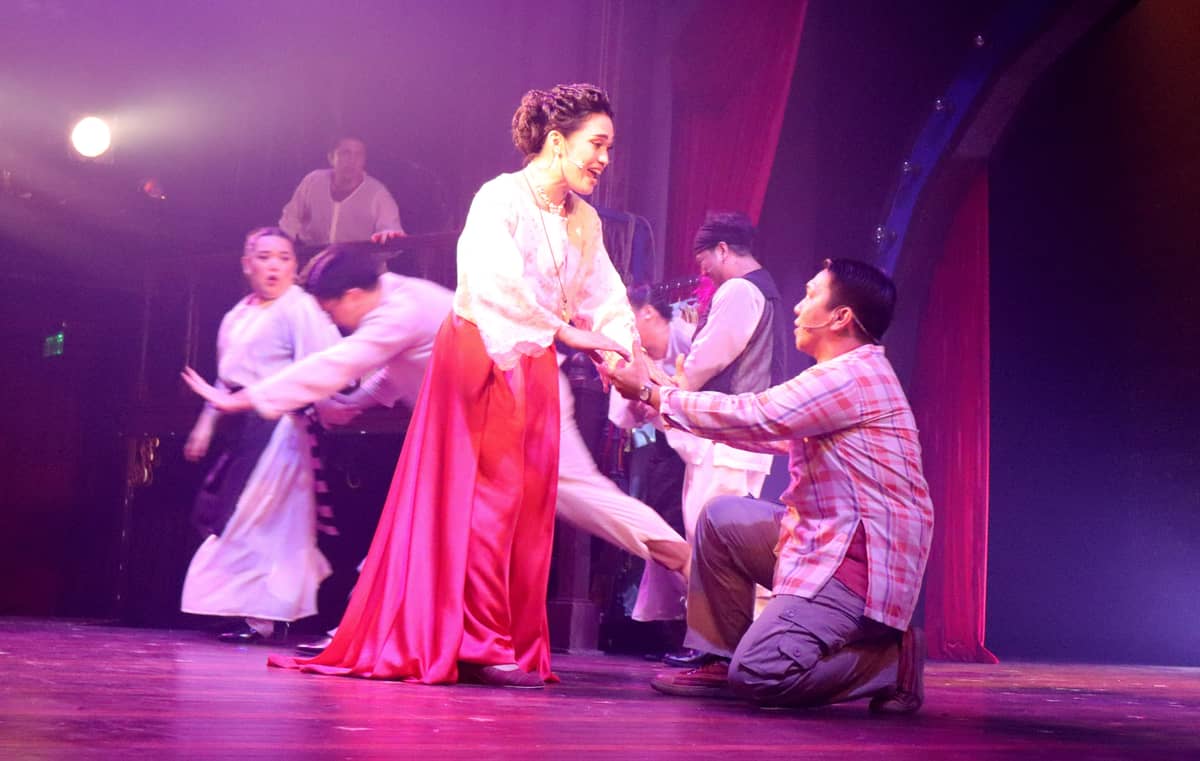
Secret lovers Julia (Lance Reblando) and Tenyong (Gio Gahol).
When Tenyong’s parents die because of the cruelty of Spanish friars led by the ruthless Padre Alfaro, the grieving Tenyong joins the revolutionary movement Katipunan, leaving Julia behind, who vows to wait for his return. But Julia’s ambitious mother, Juana, has plans for her daughter to marry Miguel, the dandy and vain son of the wealthy Don Tadeo, and orchestrates a match that would secure Julia’s marriage into wealth and privilege.
On the day of the wedding, a wounded and moribund Tenyong crashes the ceremony and makes a dying wish: to marry Julia, even if only for the fleeting moments. After the ceremony, he reveals the ruse.
The musical was a hit not only with audiences but also with critics and award-giving bodies. It dominated the 2024 Gawad Buhay Awards, winning eight major awards, including Outstanding Musical, Outstanding Ensemble Performance for a Musical, Outstanding Stage Direction for a Musical (for Segarra), Outstanding Book of a Musical (for Vera), Outstanding Original Score (for Lim and Vera), and Outstanding Choreography (for Gio Gahol). Walang Aray also bagged the major awards in the female performance categories, with Neomi Gonzales winning the Female Featured Performance in a Musical Award and Shaira Opsimar taking home the Female Lead Performance in a Musical.
For this third mounting, which runs from 29 August to 12 October, Segarra, now joined by associate director Norbs Portales, is attempting another take on the material.
“This rerun gave us the chance to revisit the material with fresh eyes. We refined scenes, clarified messages, and even integrated new elements — including two new songs, additional lines, visual design elements, and revised moments that deepened both the humor and the heart of the show….So, while the spirit of Walang Aray remains the same, this run offers a rich balance of comedy and the underlying message of resistance, courage and love,” he explained.
This latest take feels zippier and tighter, but remains seemingly spontaneous, almost teetering on mayhem, as it revels in melodrama and old conventions and at the same time gleefully dismantles and turned them into comic fodder. It uses a range of comic devices, such as satire, caricature, anachronism, and slapstick, resonating with Filipino audiences, and often breaks the fourth wall, recognizing well the artifice of it all but convincing enough to draw you in.
Beneath the nonstop humor runs a current of social commentary. The hypocrisy of friars, the oppression of colonial rulers, the objectification of women, the follies of the privileged — all are lampooned with broad strokes. Yet the show does not feel heavy-handed. Its political bite is softened by its comic surface, its satire delivered with a wink rather than a lecture. Walang Aray proves that comedy indeed ameliorates the stings of history and present social reality it deftly alludes to.
Another notable aspect of the play is the music that traverses genres — from pop and ballad to novelty — all stitched together with hummable hooks.
During this run, the official cast recording has been made available via the audio streaming and media service provider Spotify, made possible through a partnership with Soundesign Manila, a full-service audio production house.
“We are proud that the outstanding music and witty storytelling of Walang Aray can now be appreciated by as many theater fans who have long clamored for the music to be available for streaming,” said Leloi Arcete, PETA’s head of PR and Corporate Affairs and executive producer of the Walang Aray Cast Recording. “Our partnership with an organization as reputable as Soundesign Manila elevated the recording beyond expectation.”
Raul Blay, Soundesign Manila’s president and founder, enthused, “At Soundesign Manila, we believe in the transformative power of music and sound. Walang Aray’s cast recording was a way for us to support the arts and the art of doing original music for theater.”
The recording features tracks composed by Lim, such as “Pangako ‘Yan,” “Luv U 4 Ever,” “Tipo Kong Lalaki,” “Walang Aray Finale,” “Huwag Mo Akong Saktan,” “Front Act,” and a newly released song, and “Tumindig at Lumaban” mashed up with the rousing Act 1 ender, “Bayan Ko.”
Bold casting
Another factor that makes this staging different from the previous ones is the infusion of new cast members working together with original players.
“With new actors stepping into the roles, the characters have naturally evolved. Their own interpretations, improvisations, and instincts have shaped the way the story unfolds onstage,” Segarra explained.
“Working with the new and original cast in the rehearsal room has been both challenging and incredibly rewarding. They brought fresh interpretations to beloved characters and the chemistry that unfolds on stage is both surprising and electric. Watching the show transform through their choices has been one of the greatest joys of this process. Ang (the) cast members po ng (of) Walang Aray are very, very, very generous actors,” he averred.
One of the new cast members is singer, movie and television actor and pop icon Jolina Magdangal, who is making her debut in live theater playing Juana. The character can be shrill, domineering, and ultimately annoying, but her portrayal is so hilarious that Juana becomes eventually endearing — the smirks, choke, and horrified gawk delivered with her own kind exaggeration.
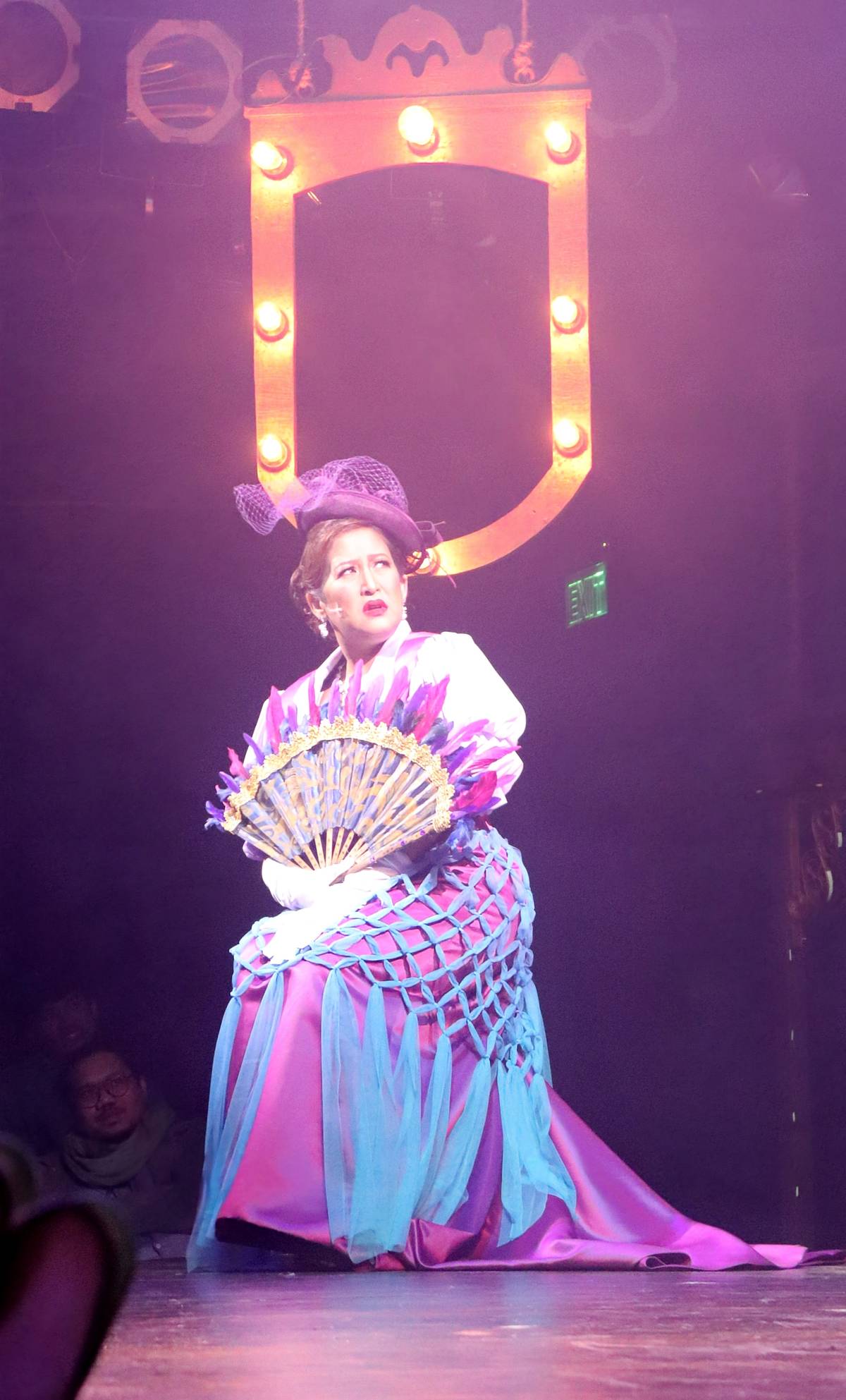
Jolina Magdangal shines as Juana.