
Unemployment rises to 4.1% in April
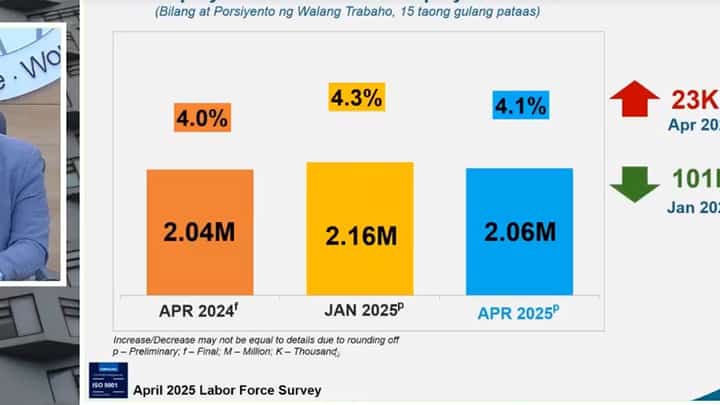
Unemployment rate in April rose to 4.1 percent from 4 percent in the same month in 2024, National Statistician and Civil Registrar General Claire Dennis Mapa said Friday.
Philippine Statistics Authority
The unemployment rate in April slightly rose to 4.1 percent from 4 percent in the same month last year, with the largest decrease in manufacturing workers, the Philippine Statistics Authority (PSA) said Friday.
Preliminary data from the government agency showed that jobless Filipinos increased to 2.06 million from 2.04 million year-on-year.
The manufacturing sector posted the highest number of job losses at 410,000.
National Statistician and Civil Registrar General Claire Dennis Mapa linked the decline to slower export activity in semiconductors and other electronic products.
"The first sub-sector affected by external market conditions was semiconductors and other electronic components, with 76,000 fewer workers," he said during a media briefing.
The data comes amid threats of new tariffs under U.S. President Donald Trump’s proposed policies, which economists say could dampen global expansion plans and limit export opportunities.
Export sales of electronic products in April dropped to $3.41 billion from $3.6 billion in the same month last year, based on preliminary data.
Mapa said manufacturing employment in plastics, food products, and garments also declined, with worker losses ranging from 42,000 to 51,000.
However, from January to April, the agriculture sector saw the biggest overall employment drop at 324,000.
This decline was partly due to increased use of mechanized farming methods, according to data from the Department of Agriculture.
"Some farmers also shifted to the construction industry, while others were discouraged by the lower retail prices of rice," Mapa added.
The PSA also noted that 129,000 Filipinos reported they were still waiting for job application results, while 42,000 were waiting to be rehired.
Consequently, the employment rate slightly dipped to 95.9 percent from 96 percent in April 2024.
Mapa attributed the decrease to a growing number of jobseekers, which rose to 50.74 million from 50.4 million.
"We saw a higher labor force participation rate due to the country's growing population. Some applicants were absorbed, while others were not," he said.
Most Filipinos found jobs in administrative and support services, as well as in public administration and defense.
Meanwhile, the underemployment rate remained steady at 14.6 percent, with the number of underemployed Filipinos — those looking for longer hours or better jobs — rising slightly from 7.04 million to 7.09 million.
“Despite the slight uptick in unemployment, the Philippine labor market continues to demonstrate resilience amid global headwinds,” said Department of Economy, Planning, and Development (DEPDev) Officer-in-Charge and Undersecretary for Policy and Planning Rosemarie Edillon.
“We remain on track to meet our target unemployment range of 4.4 to 4.7 percent under the Philippine Development Plan 2023–2028,” she added.
To ensure stronger employment data, the government is implementing programs to improve job security for high school and college graduates. These include the Technical-Vocational-Livelihood (TVL) track in senior high school and the Government Internship Program.
“Under the Enterprise-Based Education and Training Framework, the government, in partnership with the private sector, will co-develop programs that focus on digital, technical, and soft skills,” Edillon said.