




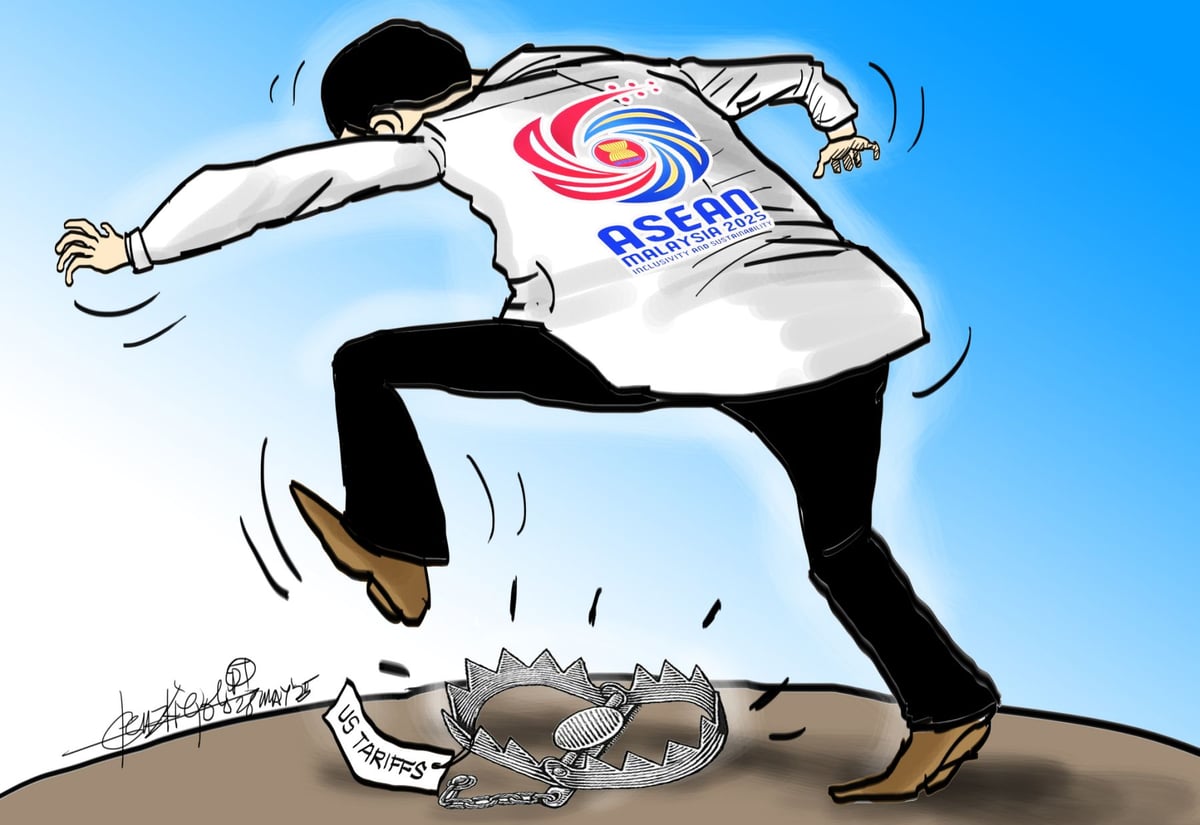
KL summit begins as tariffs spook ASEAN
The holding of a trilateral summit was a clear indication that ASEAN was now ready to forge trade deals with new markets beyond America.

Text size
The holding of a trilateral summit was a clear indication that ASEAN was now ready to forge trade deals with new markets beyond America.
The 46th Association of Southeast Asian Nations (ASEAN) Summit kicked off on Monday, 26 May, in Kuala Lumpur with deep concerns expressed by this year’s summit host, Malaysian Prime Minister Anwar Ibrahim, over current critical global developments.
Anwar was particularly referring to the global trading system that is under further strain on account of the unilateral tariffs imposed by US President Donald Trump with duties ranging from 10 percent to 49 percent hitting ASEAN member countries come July.
The Malaysian PM said he had sent Trump a communication, asking that the US President “organize a US-ASEAN meeting” where ASEAN leaders could negotiate down the high tariffs, as a region, in addition to bilateral talks that have already been started by some of the ASEAN member countries with Washington.
ASEAN leaders are anxious over the unilateral tariffs which they say pose “complex and multidimensional challenges to ASEAN’s economic growth, stability and integration.”
Earlier, following the announcement of the new tariffs by Trump, ASEAN trade ministers met virtually and agreed not to retaliate, adopting instead a prudent stance to avert an escalation of trade tensions. As it is, if left un-negotiated, the blows wrought on these countries’ economies will cause severe pain.
Among those that would be most affected by the new tariffs are Cambodia (49 percent), Laos (48 percent), Vietnam (46 percent), Myanmar (44 percent), Thailand (36 percent), Indonesia (32 percent), Brunei (24 percent) and Malaysia (24 percent). Singapore and the Philippines are both in the bottom rung with 17 percent and 10 percent tariffs, respectively, imposed on their export goods to the US.
The regional bloc, particularly after Trump’s tariffs announcement in April, have commenced pursuing new trade deals in earnest with non-US partners while intensifying intra-ASEAN trade and business cooperation.
Prior to the official start of the two-day summit in Kuala Lumpur, ASEAN economic ministers had agreed to work on reducing trade barriers and to increase intra-trade and business cooperation between their countries. They also finalized talks with China on an upgraded free trade deal.
This was followed on Tuesday with ASEAN holding its first summit with China and its second with the Gulf Cooperation Council (GCC), a political and economic alliance of six member states in the Persian Gulf region, namely, Saudi Arabia, Qatar, Bahrain, Kuwait, Oman and the United Arab Emirates.
China is represented at the summit by Premier Li Qiang, while the GCC representatives include the Crown Prince of Kuwait, Sheikh Sabah Khaled Al-Hamad Al-Sabah, Kuwaiti Foreign Minister Abdullah Ali-Al-Yahya, Omani Undersecretary for Political Affairs at the Foreign Ministry, Sheikh Khalifa Ali al Harth and GCC Secretary General Jasem Mohamed AlBudaiwi, among others.
The holding of a trilateral summit was a clear indication that ASEAN was now ready to forge trade deals with new markets beyond America.
On Monday, the ASEAN leaders launched the Kuala Lumpur Declaration which contains a blueprint for regional development to 2045.
At the declaration’s launch, Anwar regretted the sight of an “unsettled” international order, with ties between nations “fraying under the pressure of geopolitical tensions, economic fragmentation, climate change, and technological disruption.”
Added to that heap is the current trade turmoil which experts say would most likely have a lasting effect on ASEAN.
One such expert is geopolitical and public policy consultant Adib Zalkapli of Viewfinder Global Affairs who said that Trump’s so-called “Liberation Day” tariffs have pushed the regional bloc to review its role and approach in protecting member countries’ interests.
Will such an approach translate to deepening ties with China? With the likelihood of the US presence waning in the region, Beijing’s shadow over ASEAN looms even larger.
This situation has added complexity to problems plaguing ASEAN member countries like the Philippines whose current relationship with China is fraught with tension.
The Philippines, under the leadership of President Ferdinand R. Marcos Jr., is seen as a staunch American ally, with its interests aligned closely with those of the US.
Whose side will the country now take? America’s? Or China’s? Will President Marcos be able to steer the country through this critical obstacle-laden period?
We certainly hope that he is able to discern his options well and makes the right decisions, for his sake and ours, and in the country’s best interests.
Three decades after the Marcopper mining disaster devastated Marinduque’s waterways, the province is again pressing the…
Housing is probably the biggest issue affecting people the world over.
Malacañang on Monday called for a more thorough investigation into the questioned flood control projects in Taguig…
The defense on Monday backed the move by senator-judges to exclude a prosecution witness who testified on the firearms…
