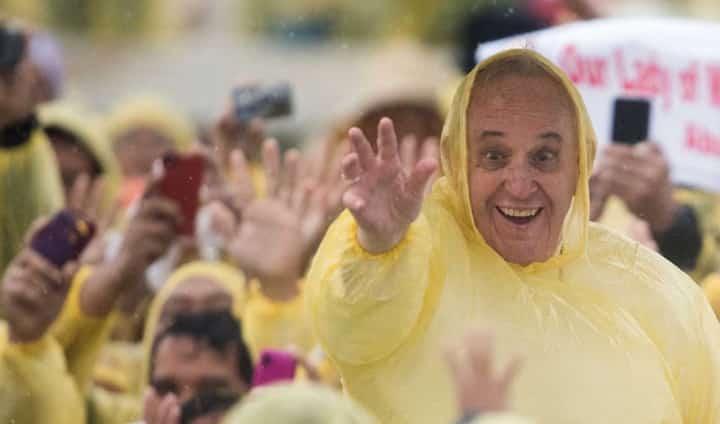
In January 2015, the Philippines opened its arms to a shepherd of hope and humility. Pope Francis — loved around the world for his simplicity and deep compassion for the poor — made a historic visit to the country from 15 to 19 January. It was a five-day journey that touched hearts, uplifted spirits and left a lasting imprint on the nation.
It wasn’t the first papal visit to the Philippines but it was, without a doubt, the most unforgettable.
Pope Francis became the third pontiff to visit the predominantly Catholic nation, following Pope Paul VI in 1970 and Pope John Paul II in 1981 and 1995. Pope Francis’s visit marked many historic firsts — it was the first papal visit in the 21st century and the new millennium. It had been long anticipated, after the visit of Pope John Paul II for the 2003 World Meeting of Families was postponed due to the latter’s declining health.
Visit born of love, marked by mercy
The theme of the 2015 papal visit — “Mercy and Compassion” (Habag at Malasakit) — reflected Pope Francis’s vision of a Church that goes to the peripheries, embracing the wounded and the forgotten. From the moment he arrived, Pope Francis was embraced not just as a global religious leader, but as “Lolo Kiko” — a nickname that captured the deep affection and warmth Filipinos felt for him.
The seeds of his visit were planted early. Shortly after his election in 2013, Manila Archbishop Luis Antonio Cardinal Tagle extended a personal invitation — one that would lead to one of the most unforgettable papal visits in Philippine history.
Just over a year later, on 7 July, 2014, the Catholic Bishops’ Conference of the Philippines made it official through a pastoral letter, declaring its theme, “A Nation of Mercy and Compassion.”
In the eye of a storm
One of the most poignant moments of the visit took place in Tacloban and Palo, Leyte — communities that bore the brunt of super typhoon “Yolanda” in 2013 and typhoon “Ruby” in 2014. Standing amid the rain and wind reminiscent of the storms that devastated the region, Pope Francis donned a simple yellow raincoat and addressed the survivors with a heart full of empathy.
The seeds of his visit were planted early. Shortly after his election in 2013, Manila Archbishop Luis Antonio Cardinal Tagle extended a personal invitation — one that would lead to one of the most unforgettable papal visits in Philippine history.
“I am here to be with you,” he said, visibly emotional. “Jesus is never far from those who suffer.”
His words were not just heard — they were felt, resonating deeply in a country so often at the mercy of natural disasters.
Global gathering of faith
Back in Manila, the capital turned into a massive pilgrimage site. Streets were closed, banners lined the roads, and millions of Filipinos filled the sidewalks, hoping to catch a fleeting glimpse of the Pope.
To ensure everyone’s safety, the Philippine government and the Church launched an extraordinary security operation — mobilizing over 37,000 personnel, including soldiers, reservists, police, and even UN peacekeepers who had just returned from missions overseas.
Snipers kept watch from rooftops as Roxas Boulevard was transformed into a powerful symbol of faith, hope, and tight security.
Yet, in the sea of security, it was the song of faith that rose above all.
Filipina singer Jamie Rivera performed “We Are All God’s Children,” the official theme song of the visit. It became the anthem of the Filipino faithful — echoing a powerful message of humility, compassion, and unity, especially for the poor and the vulnerable.
A Mass for the ages
The highlight of Pope Francis’ visit came on 18 January 2015, during his final Papal Mass at the Luneta or Rizal Park. Despite the rain and strong wind, an estimated 6 to 7 million people filled the historic grounds, breaking the record set on World Youth Day in 1995.
It was the largest papal gathering in history, a testament to the depth of faith and the immense love the Filipino people held for their Lolo Kiko.
In his homily, Pope Francis urged the crowd to protect their families and children, to reject the cultural corrosion of consumerism and indifference, and to always seek God’s mercy. “Let us not be afraid to make permanent commitments, to bring up a new generation of Christians,” he intoned.
Lasting legacy
Pope Francis’s 2015 visit was more than just a pastoral journey — it was a moment of national renewal. It reminded Filipinos of the power of faith in times of hardship, the strength of unity in times of loss, and the healing that comes from a Church that listens and embraces.
Ten years after, even as the world mourns the passing of Pope Francis in April 2025, the memories of his visit to the Philippines live on. In yellow raincoats, in the chorus of millions singing “We Are All God’s Children,” in the tears shed in Tacloban, and the roar of welcome on Manila’s streets — his spirit remains.