Sub-drones in Phl waters likely Chinese-made — Navy

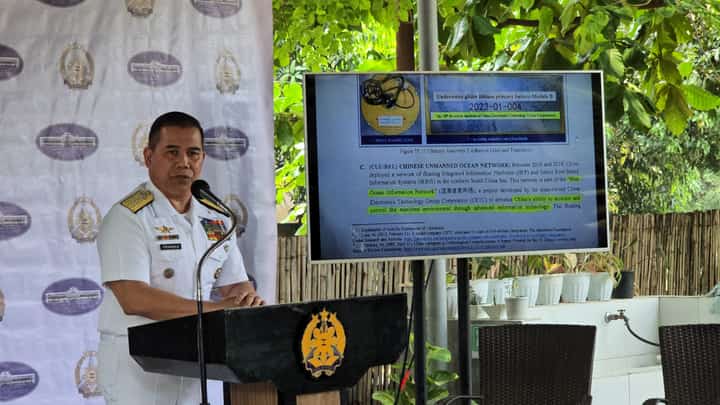
Philippine Navy spokesperson for West Philippine Sea Rear Admiral Roy Vincent Trinidad presenting the forensic analysis of five submersible drones discovered within Philippine waters during a press conference in Camp Aguinaldo, Quezon City on Tuesday, 15 April 2025. (Photo by Lade Kabagani)
Some of the submersible drones discovered within Philippine waters were most likely Chinese-made, the Philippine Navy spokesperson for the West Philippine Sea (WPS) said Tuesday.
Five underwater drones were recovered by Filipino fishermen and turned over to the Philippine Navy. The first was recovered in Pasuquin, Ilocos Norte in July 2022, followed by the recovery of debris from a second wave glider off the Zambales coast in September 2022. The third, the most intact submarine drone, was discovered in Cagayan in August 2022.
The fourth drone was found in Initao, Misamis Oriental in October 2023, while the fifth was discovered in San Pascual, Masbate in December the same year.
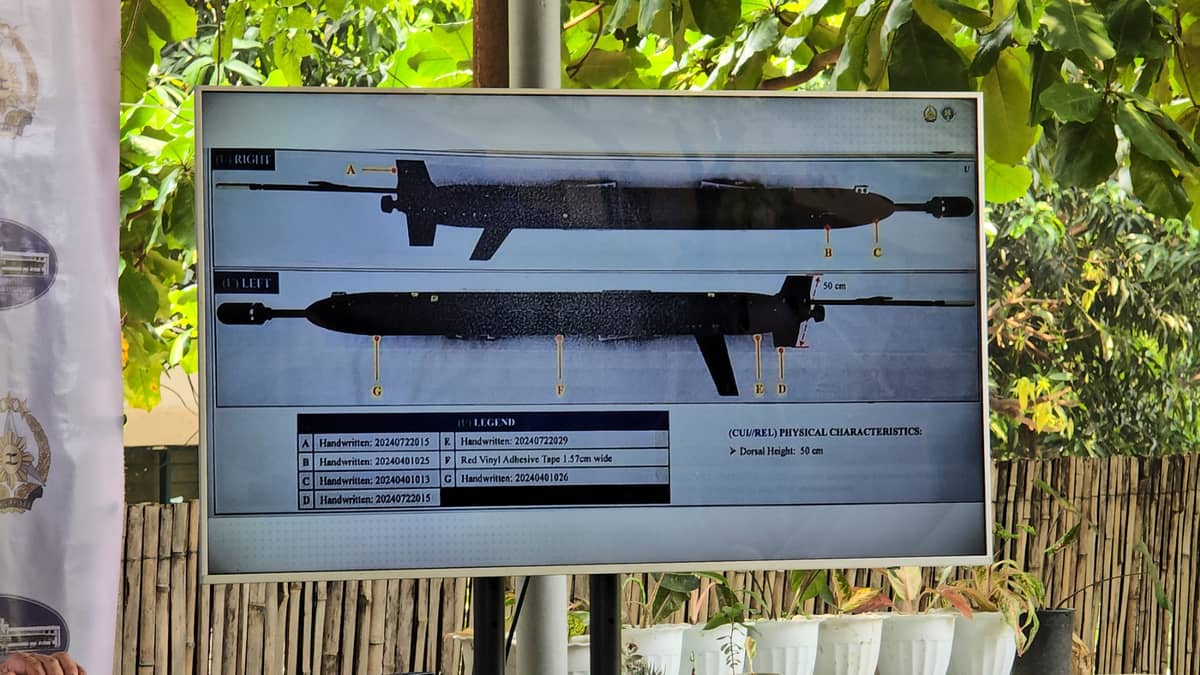
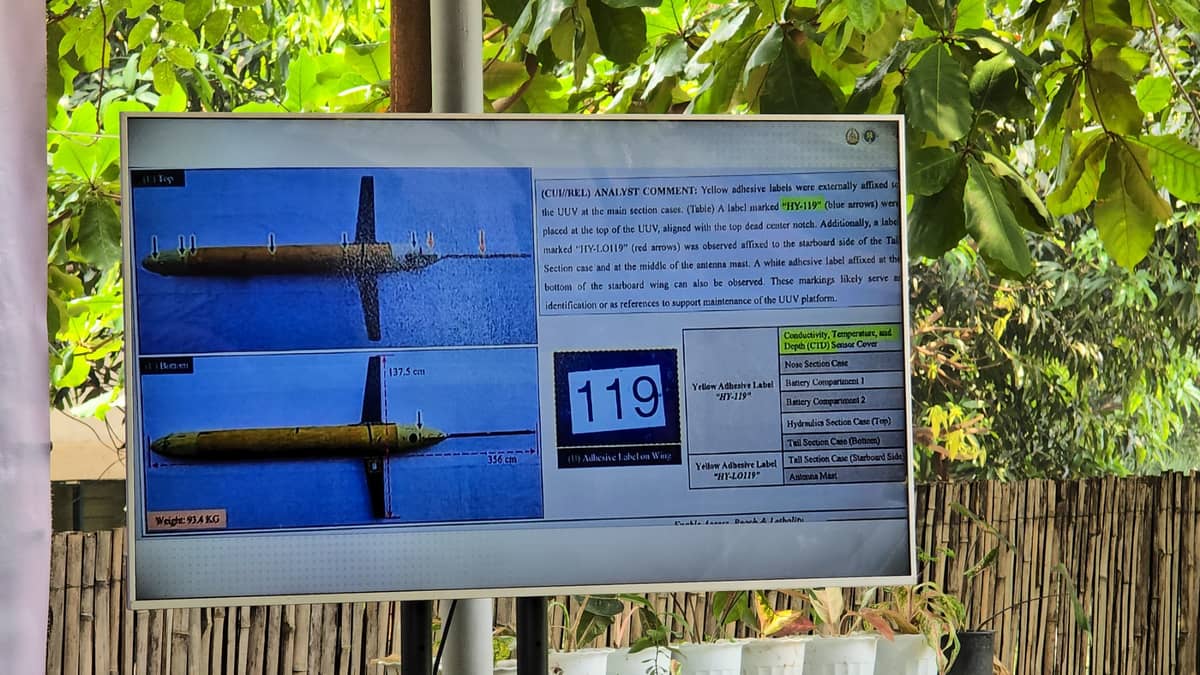
In a press conference at Camp Aguinaldo, Navy spokesperson for the WPS Rear Admiral Roy Vincent Trinidad revealed that forensic analysis of three out of five recovered underwater drones showed Chinese markings.
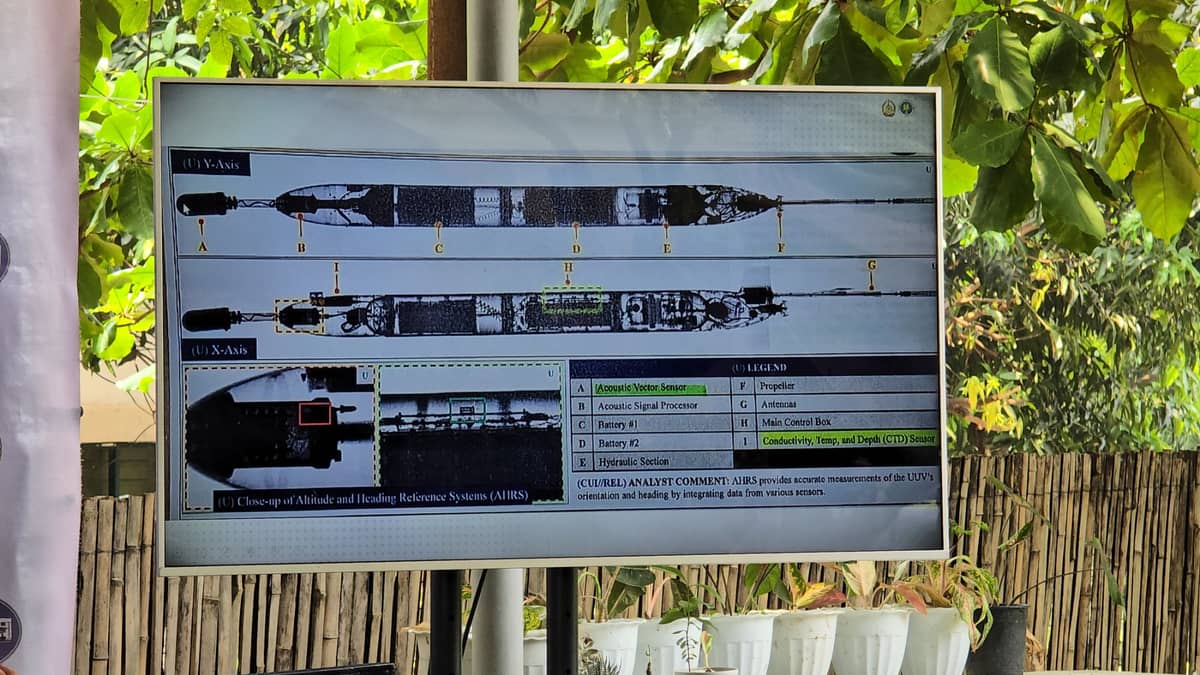
He explained that the investigation included both Level 1 and Level 2 — forensic examinations of external and internal components.
“Forensics level one focuses on the physical description—the weight dimension, the colors, any markings on the outside of the drone. The color was black. There were CTD sensors or conductivity, temperature, and depth sensors,” he explained.
“They had AVS [acoustic vector sensors.] Some of the components were available off the shelf. Some of the components had markings from China,” he added.
Trinidad said other drones also had “defaced markings to probably prevent reverse engineering or to hide the identity of the source.”
Citing the forensic analysis, Trinidad said the third drone was equipped with CTD sensors bearing external Chinese markings, while its internal components had either been sanitized or defaced.
It also had an iridium transceiver with serial number HWA Create Corporation, a company that focuses on defense, civil, government, and industrial solutions, and has a China Telecom SIM card.
Trinidad said the HWA Create headquarters is located in Beijing, China.
“The information gathered focuses on bathymetric data. It also collects information on sound propagation underwater. All of this information has been used commercially for scientific research, for academic purposes,” he said.
Trinidad also noted that the internal forensic examination revealed the third drone has dual-use capabilities, including potential applications for military purposes.
Security implications
Meanwhile, the fourth drone did not have an AVS but contained CTD sensors. Its battery assembly had markings from the 18th Research Institute of China Electronics Technology Group (CETG) Corporation.
According to Trinidad, CETG is a state-owned enterprise involved in civil-military integration of information technology and is responsible for the Blue Ocean Information Network (BOIN), which the Chinese Communist Party reportedly uses in the South China Sea to study underwater terrain.
He said the BOIN has multi-use and dual-use purposes, with the capability to store, process, and transmit data via satellite communications.
“These could also be used for military purposes. The report that we have mentioned that there is a 55 to 80 percent likelihood that these underwater gliders or drones were made in China,” he said.
Trinidad warned that BOIN’s purpose could have security implications, as it involves the generation of dual-use information.
“This allows China to monitor the maritime environment through advanced information technology,” he said.
Chinese markings
Furthermore, Trinidad said the forensic report on the fifth drone recovered in Masbate included only a Level 1 exploitation, which documented its physical characteristics such as color, weight, dimensions, and any visible markings.
He also pointed out that not all the recovered drones bore Chinese markings.
“Why 55-80 percent? It's because of the components inside. Not all of them have markings that these were made in China. Others are available commercially off the shelf. These can receive, process, store, and transmit data through satellite communications to a station on land, to a mothership, or to other drones,” he said.
“We are not categorizing where they came from, but there is a 55-80 percent likelihood for the report,” he added.
Trinidad said the Armed Forces of the Philippines (AFP) will continue to carry out its mandate, especially given that they are now facing non-traditional threats.
“For the Philippine Navy, the AFP, we will keep performing our mandates, lalo naming pag-iigtingin yung pagbabantay sa ating karagatan knowing that there are now capabilities which are non-traditional so we have to be on the lookout for this,” he said.
Tracing drone components
In a separate online forum, National Maritime Council spokesperson Undersecretary Alexander Lopez also addressed the discovery of submarine drones with Chinese markings.
“Despite the Chinese markings, we cannot speculate, but these drones can be used for nonmilitary or military purposes — it’s a multi-purpose. Why are they here or why were they used here? Again, for military and non-military purposes,” he said, expressing concern that it could be part of an "intelligence gathering" effort by adversaries in the WPS.
“That’s for intelligence gathering whether it’s military or non-military. it’s for intelligence gathering. Basically, that’s how far they would like to venture into our maritime territory,” he said.
In the same forum, National Security Council Deputy Director and Spokesperson Jonathan Malaya said the government regarded the potential Chinese deployment of submersible drones in Philippine waters as “alarming.”
“We always consider these types of activities by Chinese agents as alarming because the forensic investigation done on the drones that were found in strategic locations in the country — in particular, those that were found off Masbate very near San Juanico Strait and some which were found in the Strait in Surigao were found to be conclusively of Chinese origin,” he said.
Malaya also expressed concern that some components of these drones were traced back to Chinese state organizations.
“So evidently, I think now we can conclusively say that these are Chinese underwater drones. And these are alarming,” he said.
Underwater warfare
Trinidad said the discovered Chinese-made drones were likely used for mapping the underwater terrain of the country.
“Collecting information, like what I mentioned — bathymetric data. All of these are used across different fields to include underwater warfare,” he said.
Before undertaking any activity, Trinidad stressed that it's crucial to understand the terrain—whether on the surface, in the air, or beneath it.
Therefore, gathering information about the underwater terrain is a vital step in undersea warfare, he added.
“In today's generation of warfare, information is key. He who holds information will have an advantage. Any potential adversary who would like to harm our country would need to know the information. Not only on land, on air but more importantly, since we are an archipelago, underwater information,” he said.
In a separate message to reporters, Malaya said the forensic examination on the submersible drones allowed the Philippine government to conclusively determine that these are of Chinese origin.
“They are also in all likelihood deployed by China to map the Philippine underwater terrain. This is alarming because of its implications to national security,” he said.
“This only shows that we need to be more vigilant and we need to undertake more maritime patrols in more parts of the country to stop these types of activities,” Malaya added.
The Chinese Embassy in Manila has yet to respond to the Philippine government’s disclosure regarding the discovery of Chinese-made submersible drones in Philippine waters.