
Tariff blitz stokes global bloodbath
Shares were sold down for the second straight day, with the S&P 500 falling back into correction territory for its worst one-day loss since 2020.
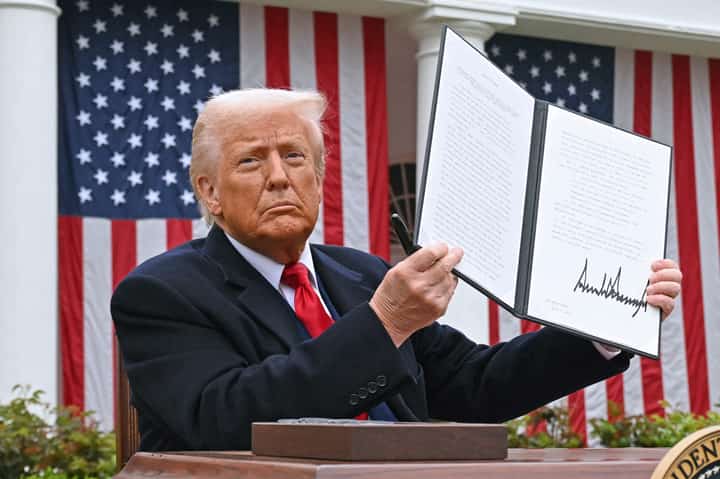
‘Declaration of economic independence’ US President Donald Trump imposes reciprocal tariffs from 10 percent upwards on nations worldwide in an executive order that aims to ‘Make America Wealthy Again.’ Trump geared up to unveil sweeping new ‘Liberation Day’ tariffs in a move that threatens to ignite a devastating global trade war. Key US trading partners including the European Union and Britain said they were preparing their responses to Trump's escalation, as nervous markets fell in Europe and America.
SAUL LOEB /AGENCE FRANCE-PRESSE
Equities widened losses in Asia and Europe on Friday, extending a global rout inflicted by Donald Trump’s tariff blitz that has inflamed a trade war and ramped up recession and inflation fears.
On Thursday, the US president’s harsher-than-expected “Liberation Day” levies sent shockwaves through markets. Wall Street suffered its worst day since the early days of the Covid-19 pandemic, and the dollar tanked against major peers.
Shares were sold down for the second straight day, with the S&P 500 falling back into correction territory for its worst one-day loss since 2020.
The drop followed former President Donald Trump’s announcement of new tariffs, raising fears of a global trade war and recession, according to Regina Capital Development Corp. managing director Luis Limlingan.
The Philippine Stock Exchange index (PSEi) fell 61.54 points to 6,084.19 after trading from 6,053.74 to 6,111.11. Trade volume reached 58,265, valued at P5.137 billion.
Jomar Lacson, head of macroeconomics and sustainability research at ATR Asset Management, said the reciprocal tariff is calculated as a proxy for trade barriers; hence, it is difficult to estimate the impact across multiple tariff lines.
“The design of the reciprocal tariff is to have a zero trade deficit with the US,” according to the economist.
“We don’t contribute a significant amount to the US trade deficit. Technically, the negative effect is much less severe than our neighbors. Most of the negative impact will come from the shock to the global supply chain, which the Philippines contributes. There is not much globally, but it can still be felt relative to local GDP. There will be bruising but no broken bones,” Lacson said.
Investors reacted to the US tariff measures, including a 17 percent export duty. Sentiment weakened on concerns over global trade disruptions.
Oil prices decreased as eight major OPEC+ producers agreed to raise output by 411,000 barrels daily, speeding up previously planned increases.
As stocks fell off a cliff on Thursday, the 78-year-old Republican insisted they will “boom” as the economy recalibrates.
Trump says he wanted to free the United States from reliance on foreign manufacturers in a massive economic restructuring that he likened to a medical procedure.
“It’s what is expected,” he said. “The patient was very sick. The economy had a lot of problems. It went through an operation. It’s going to be a booming economy. It’s going to be amazing.”
And White House Press Secretary Karoline Leavitt warned on CNN: “The president made it clear yesterday this is not a negotiation.”
Trump later said he would negotiate “as long as they are giving something good.”
One in two chance
But fears are growing that governments will retaliate in kind, further harming global trade and battering the world economy.
Some have already warned they will act, while others have said they will take time to take stock of the impact of the measures.
China demanded the tariffs be immediately canceled and vowed countermeasures, while France and Germany warned that the European Union could target US tech firms.
French President Emmanuel Macron called for suspending investment in the United States until the “brutal” new tariffs had been “clarified.”
Japanese Prime Minister Shigeru Ishiba said Friday the 24 percent levies his country faced were a “national crisis.”
Jim Zelter, president of Apollo Global Management, warned that the chances of a US recession had risen to at least one in two.
He added that the levies could put the Federal Reserve in a bind as it had to weigh hiking interest rates to fight a possible inflation spike or cut them to support the economy.
Jobs data under watch
Investors will keep a close eye on US jobs data due later Friday for a fresh insight into the world’s top economy, while Fed boss Jerome Powell is also lined up to give a speech.
“If I were here six months ago, I would have said a recession in 2025 or 2026 was one-in-five, and now that’s certainly one-in-two, if not higher,” Zelter told Bloomberg Television.
Traders are now eyeing a 50 percent chance the Fed will cut rates four times this year.
Asian investors continued to offload shares amid concerns about the possibility of more market-negative headlines over the weekend.
Tokyo shed 2.8 percent, with car giants taking the heat once more. Toyota lost more than four percent, while Nissan and Honda each sank more than five percent. Tech titan Sony and tech investor SoftBank were also sharply lower again.
Sydney tumbled more than two percent, along with Singapore and Bangkok, while Seoul, Wellington, Mumbai and Manila were also deep in the red.
Hanoi, which plunged more than seven percent Thursday owing to the near 50 percent tariff imposed on Vietnam, fell another 4.6 percent.
London, Paris and Frankfurt started on the back foot.