
Thoughts to live by: Feast of the Holy Family of Jesus, Mary, and Joseph
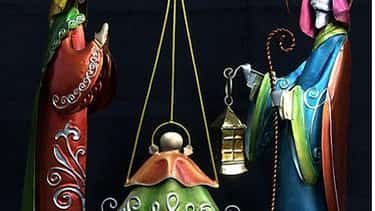
Sunday, 29 December, Fifth Day within the Octave of Christmas, Feast of the Holy Family of Jesus, Mary, and Joseph:
Liturgy of the Word — 1 Sm. 1:20-22, 24-28; Ps. 84:2-3, 5-6, 9-10; 1 Jn. 3:1-2, 21-24; Lk. 2:41-52.
Some Notes on the Feast of the Holy Family —
1. The Feast falls on the first Sunday after Christmas. It was formally instituted in 1921 by Pope Benedict XV, and was originally celebrated after Epiphany. In 1969, it was moved to the Sunday after Christmas, bringing it within the Christmas season. Although there are major feast days dedicated to each member of the Holy Family — Jesus, Mary, and Joseph — the Feast of the Holy Family commemorates their life together. The celebration focuses on religious family life. In eastern Christianity, the Coptic Church has celebrated the feast for the Holy Family from early times, because of the flight of the Holy Family to Egypt. But in the West, the feast of the Holy Family as a group did not arise until the 17th century, with St. François de Laval, the 1st Bishop of New France (Canada).
2. The Gospels speak little of the Holy Family in the years before Jesus’ public ministry. Matthew and Luke narrate the episodes of this period of Christ’s life, namely, his circumcision and later Presentation, the flight to Egypt, the return to Nazareth, and the Finding in the Temple. Luke narrates that Mary and Joseph brought Jesus with them on the annual pilgrimage to Jerusalem. The Holy Family was apparently observant of Jewish religious laws and practices.
3. The primary purpose of the feast is to present the Holy Family of Nazareth as a model for Christian families. The Catechism of the Catholic Church states, “The hidden life at Nazareth allows everyone to enter into fellowship with Jesus by the most ordinary events of daily life” (CCC, 533). Pope Paul VI said that Nazareth teaches us “the meaning of family life, its harmony of love, its simplicity and austere beauty, its sacred and inviolable character.”
Today, these lessons are more than necessary, when family values and structures around the world are crumbling under the influence of the sexual revolution. Parents juggle careers, children navigate the distractions of digital technology, and family conversation is disappearing. Hence, Pope Francis reminds us that families, even if imperfect, “should always be places where love, forgiveness, and joy thrive.”
Families are, and will always be, sacred spaces where God’s grace can turn hardship into hope. They are sanctuaries of life and love, and reflect God’s love for mothers, fathers, and children.
4. 1st Reading, 1 Sm. 1:20-22, 24-28 — The birth of Samuel. Elkanah had two wives, Hannah and Penninah. Unlike Penninah, Hannah had no children. Penninah scorned her for being barren. The family would regularly go to the sacred shrine of Shiloh and offer sacrifices to the Lord. Hannah would cry her heart to the Lord for a child. She vowed to offer a male-child to the Lord. The priest, Eli, overheard her prayer and told her, “May the Lord grant your request.” And the Lord, indeed, granted her request. She gave birth to her son, Samuel. When Samuel was weaned, she fulfilled her vow and offered Samuel to the Lord.
5. Resp. Ps. 84:2-3, 5-6, 9-10 — “How lovely your dwelling, O Lord of hosts! My soul yearns and pines for the courts of the Lord. My heart and flesh cry out for the living God” (vv. 2-3). “Blessed are those who dwell in your house! They never cease to praise you. Blessed the man who finds refuge in you, in their hearts are pilgrim roads” (vv. 5-6). “Lord God of hosts, hear my prayer…. look upon the face of your anointed” (vv. 9-10).
The last two verses could well be Hannah’s plea for a son; the blessed and “lovely” dwelling place of God could allude to the dwelling place of the Holy Family in Nazareth.
6. 2nd Reading, 1 Jn. 3:1-2, 21-24 — “See what love the Father has bestowed on us that we may be called the children of God…. Beloved, we are God’s children now” (vv. 1-2). “We have confidence” in him, “and receive from him whatever we ask, because we keep his commandments and do what pleases him. And his commandment is this: we should believe in the name of his Son, Jesus Christ, and love one another just as he commanded us. Those who keep his commandments remain in him, and he in them, and the way we know that he remains in us is from the Spirit that he gave us” (vv. 21-24). The greatest gift of God’s love for us is the gift of his Son — the Christmas theme. Jesus has made us true children of God. It is imperative then to live virtuous lives in imitation of Jesus.
7. Gospel, Lk. 2:41-52 — The Boy Jesus in the Temple. At 12 years old, Jesus and his parents, Mary and Joseph, go up to Jerusalem for the feast of Passover. But on their return, Jesus remains in Jerusalem. Mary and Joseph, look around for a day among their relatives and acquaintances to find him. Not finding him, they return to Jerusalem. After three days, they find him in the temple listening to the teachers and asking them questions (vv. 41-46) “And all who heard him were astounded at his understanding and his answers” (v. 47). His parents are astonished and tell him that they had been looking for him “with great anxiety” (v. 48). He replies, “Why were you looking for me? Did you not know that I must be in my Father’s house?” (v. 49). But they do not understand what he said to them. He returns to Nazareth with them, “and was obedient to them.” Mary “kept all these things in her heart” (vv. 50-51). “And Jesus advanced in wisdom and age and favor before God and man” (v. 52).
8. Here we see the home of the Holy Family as a sanctuary of love, where Mary and Joseph teach Jesus the virtues of love and obedience, They teach him by example to follow the religious devotions and practices of the Old Law. He intimates to Mary and Joseph that the God who dwells in the Temple is his own Father and he is God’s own Son.
9. Prayer — O God, you give us the shining example of the Holy Family. Graciously grant that we may imitate Jesus, Mary, and Joseph in practicing the virtues of family life and the bonds of charity, so that we may delight one day in the rewards of eternal life. This we pray, through Christ our Lord. Amen. (Collect of today’s Mass).
Prayers, best wishes, God bless!