




Moderate your greed
“ Moving crucial projects from programmed to unprogrammed is not only questionable but also undermines the government’s commitment to inclusive development and fiscal prudence.

Text size
“ Moving crucial projects from programmed to unprogrammed is not only questionable but also undermines the government’s commitment to inclusive development and fiscal prudence.
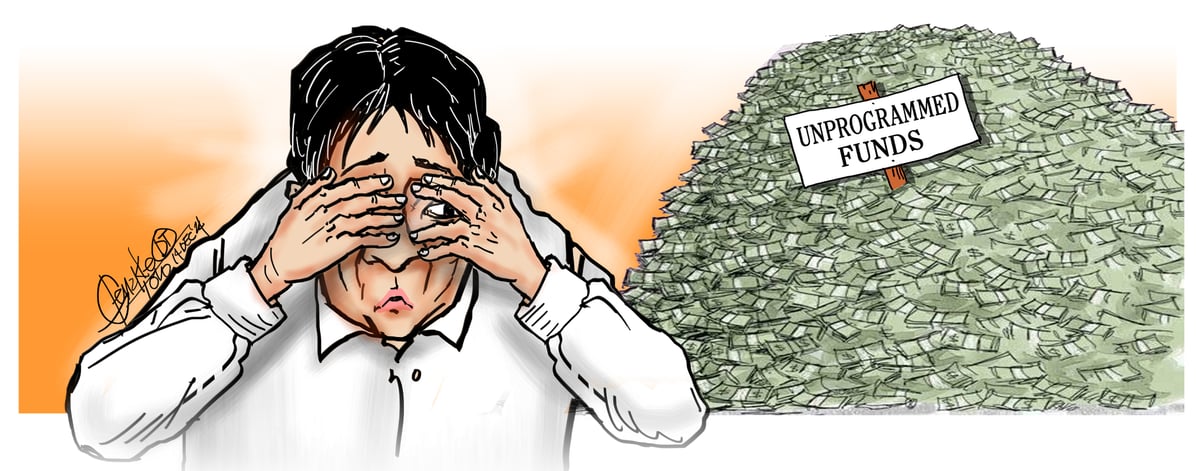
In an election year, the unprogrammed funds, mostly eleventh-hour insertions in the 2025 national budget, reached P532 billion, bloating the budget to an unprecedented P6.532 trillion.
A huge chunk of the amount went to the Department of Public Works and Highways (DPWH) with P95 billion. The DPWH, which everyone and their monkey’s uncle know, is the usual source of a political war chest.
There is a sprinkling of legitimate undertakings such as the DA’s Cold Storage Expansion Project and funding for the Department of Trade and Industry’s Comprehensive Automotive Resurgence Strategy but the increased allocations were mostly additions made during the bicameral conference committee of Congress.
Unprogrammed appropriations are funds that in theory can only be used when revenue collection exceeds targets, and when additional grants or foreign funds are generated.
A provision in the 2024 budget, however, allowed the Department of Finance to sweep the budget for “excess funds” of state firms, which resulted in the P89.9-billion reallocation from the Philippine Health Insurance Corp. (PhilHealth) that created a public uproar.
The PhilHealth funds were among the money raised to fill P200 billion in unprogrammed funds which budget watchdogs noted were actually part of the 2024 budget but were bumped off to allow insertions by members of Congress.
Thus, the disgusting situation had the insertions guaranteed with ready allocations while legitimate projects had to wait for Finance Secretary Ralph Recto to conjure up new money.
Former Finance Secretary Margarito “Gary” Teves said unprogrammed funds should not be necessary since priority social and infrastructure projects should already be included in programmed appropriations.
In 2023 and 2024, unprogrammed appropriations were at P807.2 billion and P731.4 billion, or 15 percent and 13 percent, respectively, of the government budget.
“This is more than double the 5-percent average from 2010-2022,” said Teves.
He said moving crucial projects from programmed to unprogrammed is not only questionable but also undermines the government’s commitment to inclusive development and fiscal prudence.
The implementation of social and infrastructure projects such as upgrading health facilities, the training of health professionals, and payment of benefits might be delayed without a definite funding source.
Teves said that a way to instill prudence in the budget is for President Ferdinand Marcos Jr. to convene the Legislative-Executive Development Advisory Council (LEDAC) to identify “priority programs that should strictly remain programmed and budget items that will be placed under the unprogrammed.”
The final version of the budget saw subsidies for PhilHealth removed after the Supreme Court halted the transfer of the remaining P30 billion in “excess funds” to the Treasury.
In the House version of the budget, PhilHealth was allotted a P74.4-billion subsidy. This was reduced by the Senate in its version to P64.4 billion.
In the reconciled version in the bicam, the subsidy to the health insurance agency was deleted because the state insurer was found to still have P600 billion in “reserve funds.”
Such an amount is anomalous considering that PhilHealth cannot fully implement the Universal Healthcare Act which it is mandated to supervise.
According to a senator in the bicameral committee, the P600 billion in reserve funds was “just deposited in a bank and its income is less than the rate of inflation. So the government is still at a loss.”
Sen. JV Ejercito, who sponsored the UHC law, said there could be questions of legality in the move to totally remove PhilHealth’s government subsidy since this is required under the law.
Ejercito also expressed concern about the budget cuts suffered by other agencies in the reconciled version of the budget.
An added caveat that Ejercito failed to mention is that items clearly meant as pork barrel substitutes have definite funding.
As a famous line of an economic manager in advising those plundering the public coffers would have it: officials should exercise moderation in their greed.
Housing is probably the biggest issue affecting people the world over.
Malacañang on Monday called for a more thorough investigation into the questioned flood control projects in Taguig…
The defense on Monday backed the move by senator-judges to exclude a prosecution witness who testified on the firearms…
