
Verde Island Passage designation as World Heritage Site apt
The ecological significance of the VIP cannot be overstated, serving as it does as the habitat of over 1,700 marine species, including 60 percent of the world’s shore fish species and some 300 coral species.
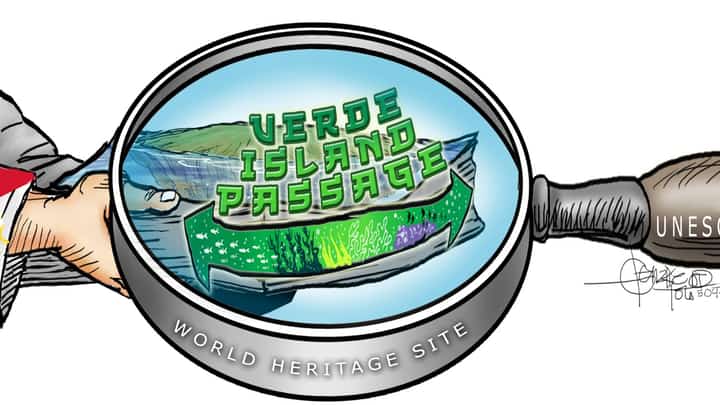
The campaign for the designation of the Verde Island Passage as a World Heritage Site should be strongly supported by all Filipinos, both in the government and the private sector.
A study in 2005 by the Smithsonian Institute and Kent Carpenter, a professor in Ichthyology and Marine Conservation Biology at Old Dominion University in Norfolk, Virginia, said the Verde Island Passage (VIP), situated in a strait separating the islands of Luzon and Mindoro, contains a high concentration of marine species per unit area, meriting the distinction of being the “center of the center” of the world’s marine shorefish diversity with 1,735 overlapping marine species — in other words the highest concentration of marine life in the world.
No wonder marine biologists all over the world refer to the VIP as the “Amazon of the Ocean.”
The critical VIP encompasses Batangas, Marinduque, Romblon, and Oriental and Occidental Mindoro provinces. Its strategic location places it at the heart of the Coral Triangle, a vast expanse renowned as the global epicenter of marine diversity, which includes such countries as Indonesia, Malaysia, Papua New Guinea, the Solomon Islands and Timor-Leste.
The campaign to designate the VIP as a World Heritage Site was launched on 27 September 2024 with Carpenter in attendance.
Carpenter is also manager of the Marine Biodiversity Unit of the International Union for Conservation of Nature (IUCN), an international organization working in the field of nature conservation and sustainable use of natural resources.
Founded in 1948 with headquarters in Gland, Switzerland, the IUCN is the global authority on the status of the natural world and the measures needed to safeguard it.
Carpenter points out that the VIP is home to half of the total marine species in the Indo-Pacific region, and other than its rich biodiversity, it also provides a lifeline for two million people who rely on it for fishing and tourism.
According to the Center for Energy, Ecology and Development (CEED), the strait generates some P12 billion in yearly gains from fishing alone, on which rely residents of Batangas, Marinduque, Romblon and Oriental and Occidental Mindoro.
Despite the tremendous significance of the VIP’s ecology and economy, it is facing increasing threats from various activities, including those caused by the shipping industry, energy expansion, fossil fuel extraction and climate change, all of which, says CEED’s OIC deputy for oceans and climate, Martha Vergara, “put pressure on the fragile ecosystem of the VIP.”
Those activities, along with the 2023 Mindoro oil spill, have caused damage estimated at over P41 billion.
The ecological significance of the VIP cannot be overstated, serving as it does as the habitat of over 1,700 marine species, including 60 percent of the world’s shore fish species and some 300 coral species.
This concentration of marine life puts emphasis on the urgent need for its conservation and protection to maintain the ecological balance not only within the Philippines but beyond, on a global scale.
Designating the VIP as a World Heritage Site will not only affirm its global significance but also encourage much domestic and international support for its protection.
But first, the VIP has to be backed by and have the country’s nomination before it can be considered a World Heritage Site by the United Nations Educational, Scientific and Cultural Organization (UNESCO).
Before a decision can be made on a site submitted for consideration, the UNESCO World Heritage Committee has to assess if the site can demonstrate that it represents the most outstanding of the world’s natural and or/cultural heritage.
The assessment will be guided by various criteria and once a site passes evaluation and is submitted for nomination, it will be up to the intergovernmental World Heritage Committee which meets once a year to decide if it is worthy of inscription on the World Heritage List.
Inclusion in the list elevates the location’s status internationally, attracting global attention and prestige. The expected benefits are bountiful, be these in terms of increased tourism, funding and grants, conservation support, enhanced site protection, international focus, and national pride and identity.
Already, there are six World Heritage Sites in the country: the Tubbataha Reefs Natural Park, the Historic City of Vigan, the Mount Hamiguitan Range Wildlife Sanctuary, the Puerto Princesa Subterranean River National Park, the Baroque churches in the country and the Rice Terraces in the Cordilleras. The Verde Island Passage is, and should be, a more than worthy fitting addition to that exalted list.