
World fears Israel-Hezbollah 'spiral of violence'
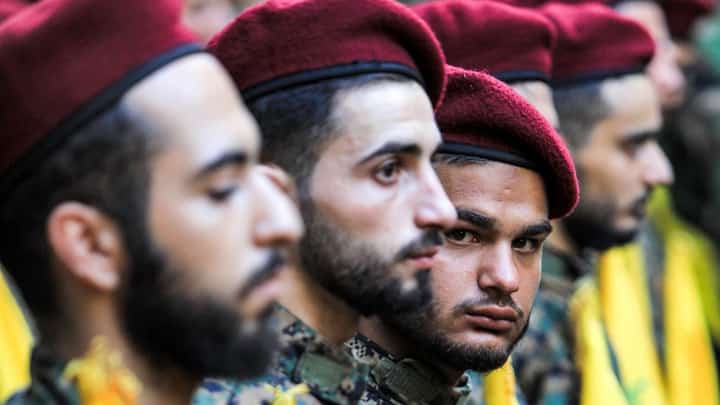
Fighters of the Lebanese Shiite movement Hezbollah attend the funeral of the group's top military commander Ibrahim Aqil in Beirut's southern suburbs on 22 September 2024.
AFP
World leaders on Tuesday sounded the alarm over fears of a wider war after Lebanon suffered its deadliest day in two decades in Israeli air strikes on Hezbollah strongholds.
After nearly a year of cross-border fire since the Gaza war erupted, Israeli bombardment on Monday killed 558 people in Lebanon, including 50 children, according to the country's health ministry.
The toll -- the highest since Israel and Iran-backed Hezbollah went to war in mid-2006 -- raised fears of an all-out conflict engulfing the Middle East.
'Tens of thousands' flee: UN
UN Secretary-General Antonio Guterres was "gravely alarmed by the escalating situation... and the large number of civilian casualties, including children and women," his spokesman Stephane Dujarric said.
"Tens of thousands of people were forced from their homes yesterday and overnight, and the numbers continue to grow," United Nations refugee agency spokesman Matthew Saltmarsh said in Geneva.
'Spiral of violence': US
Israel's closest ally the United States urged against any Israeli ground invasion targeting Hezbollah.
"We obviously do not believe that a ground invasion of Lebanon is going to contribute to reducing tensions in the region, to preventing an escalatory spiral of violence," a senior US official said Monday on condition of anonymity.
'Full-fledged war': EU
"We are almost in a full-fledged war," EU foreign affairs chief Josep Borrell said on Monday.
"We're seeing more military strikes, more damage, more collateral damage, more victims... Everybody has to put all their capacity to stop this," the bloc's top diplomat added.
'Another Gaza': Iran
"We must not allow Lebanon to become another Gaza at the hands of Israel," Iran's President Masoud Pezeshkian told CNN in response to a question if Tehran would use its influence with Hezbollah to urge restraint.
"Hebzollah cannot stand alone against a country that is being defended and supported and supplied by Western countries, by European countries and the United States," the president added.
'Attacks against civilians': China
China's top diplomat Wang Yi said: "We pay close attention to developments in the region, especially the recent explosion of communications equipment in Lebanon, and firmly oppose indiscriminate attacks against civilians."
Later on Tuesday, foreign ministry spokesman Lin Jian said Beijing was "deeply shocked by the relevant military actions that have caused a large number of casualties", in response to a question about Israel's strikes.
'Israeli escalation': Jordan
Jordan's King Abdullah II called on the international community to take action to stop the "danger of Israeli escalation" in Lebanon and "protect innocent civilians... before the region is dragged into a comprehensive regional war".
In a phone call with the Lebanese caretaker Prime Minister Najib Mikati, the king said that "stopping the escalation in the region begins with an immediate end to the war on Gaza," according to a palace statement.
'Brink of the abyss': Qatar
In a statement Tuesday Qatar, "condemned in the strongest terms the Israeli aggression on Lebanon".
A key mediator in talks on reaching a Gaza truce, Qatar added the escalation "puts the region on the brink of the abyss and exposes it to more tensions".
'Complete destabilization': Russia
Russia called the strikes "an event that is potentially very dangerous," risking the expansion of the conflict and "complete destabilisation of the region", Kremlin spokesman Dmitry Peskov told journalists.
"Of course that causes us extreme concern and worry," Peskov added.