
Kulaman limestone burial jars repatriated and gifted to the National Museum
The Kulaman jars show jar burial tradition that is unlike others in the Philippines. While other burial jars are fashioned out of clay, these are carved from blocks of limestone abundant in southern Mindanao, and are the only movable limestone ossuary among mostly clay jars

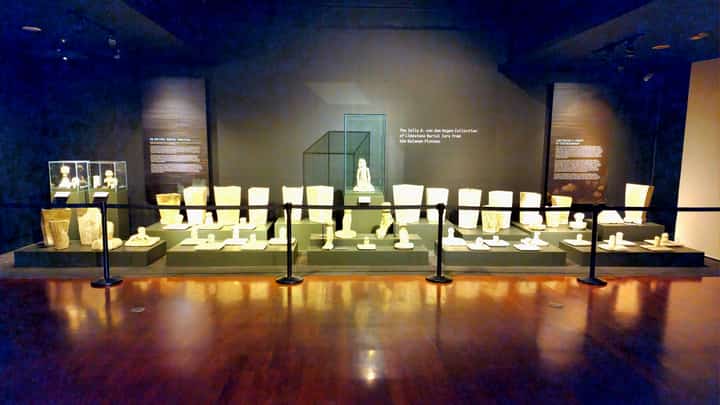
The National Museum of the Philippines (NMP) on 7 May led the turnover ceremony for the Sally A. von dem Hagen Collection of limestone burial jars from the Kulaman Plateau in what was then part of the province of Cotabato, a “successful culmination of its extensive repatriation efforts that began several years ago.”
This collection of 52 pieces were bought in the early 1970s by the late American businesswoman Sally A. von dem Hagen, then living in Manila, from a group of Dulangan Manobo who accidentally discovered the pieces while on a hunting trip. These artifacts were offered to her as she was a known collector.
According to NMP, “Mrs. Von dem Hagen, recognizing the profound cultural significance of these objects, agreed to acquire as many as possible and, over time, established relationships among members of the Manobo community in the area of what is today part of the province of Sultan Kudarat. Having grown fond of her collection, she brought the Kulaman pieces with her when she departed the Philippines for the United States in 1979.”
The collection is then donated to NMP by her children Peter, Stephanie, and Antoinette “in recognition of their late mother’s lifelong custodianship of these objects of Philippine antiquity, spanning over four decades.”
In a video message during the turnover ceremony, Peter said his late mother “will be delighted to know that the jars are back in the Philippines, in a place where they can be viewed and appreciated.”
The artifacts were under the temporary safekeeping of the Filipino-American Service Group Inc., anthropological archaeologist Dr. Stephen B. Acabado, and the Cotsen Institute of Archaeology at University of California Los Angeles, which held an exhibition at the FASGI Bayanihan Center until NMP director-general Jeremy Barns was able to arrange for their shipment early this year. They arrived in Manila on 25 March with NMP’s Archaeology Division supervising the unboxing, inspection, and curation. A team from the University of the Philippines Manila led by anthropology professor Dr. Ma. Teresa G. de Guzman conducted a brief blessing ritual to welcome the artifacts.
“I would like to stress the point that the Philippine government through the National Museum and the National Commission for Culture and the Arts, and other agencies responsible for cultural properties are indeed serious about facilitating the repatriation of items such as these. And this is made possible through our partnerships with, for instance, the Department of Foreign Affairs, and our various friends abroad. Our friends, typically Filipinos in academic institutions, and community leaders,” Barns said during the turnover ceremony. “In this case, this couldn’t also be possible without the support of community leaders such as those who run the NGOs like the Filipino American Service Group, Inc... other community leaders in LA, many of which are active, and of course, Stephen and his colleagues, his students at UCLA who helped us frame this in the appropriate manner, spotlighting issues such as ethics and provenance and collection.”
Barns also said that they are “really glad that the opportunity was taken to collect this collection and its significance with the Filipino American community in LA.”
“There are serious issues there that Stephen highlighted, and he is quite right that the work we do in the National Museum is aimed at Filipinos everywhere. Of course, our native audience is here at home but we never forget about Filipinos, wherever we are... We are trying to figure out how migrants and the next generation of Filipinos can increase their awareness of their heritage and identity,” he remarked.
“I would really like to thank Stephen and our friends in the US. He is quite right that repatriation is the first step….[W]e wanted to highlight this particular repatriation, and it’s a fairly large one, and there was a lot of work, and negotiations, expenses and logistics that was involved and wouldn’t be made possible without strong partnerships, and in the end also the generosity of the Von dem Hagen family, led by Peter. You could see from his message how of great sentimental value these limestone burial jars are to their family. And we do acknowledge their donation, and we’re very happy that we were able to bring them home, that we agree that they are an important collection of sacred objects from that part of Mindanao in Sultan Kudarat,” Barns said.
.jpg?w=1200&auto=format&q=70)
Chief of NMP’s Archaeology Division Dr. Mary Jane Louise A. Bolunia, NMP director-general Jeremy Barns and Dr. Stephen B. Acabado.
Photograph courtesy of National Museum of the Philippines
On the burial jars
According to Dr. Mary Jane Louise A. Bolunia, chief of the NMP’s Archaeology Division, the Kulaman jars show jar burial tradition that is unlike others in the Philippines. While other burial jars are fashioned out of clay, these are carved from blocks of limestone abundant in southern Mindanao, and are the only movable limestone ossuary among mostly clay jars. They are, however, still part of the burial practice that was widespread in the Philippines and Southeast Asia during the Metal Age, about 2,800 to 1,000 years ago.
Anthropologist Dr. Marcelino Maceda of the University of San Carlos in Cebu and his team conducted the first investigations of these jars in 1962, exploring two caves on the Kulaman Plateau and discovering jars containing human remains and bracelets as well as pottery, stone tools, and ornaments. Radiocarbon analysis of associated human bones determined an absolute date of 585 +/- 85 CE or approximately 1,450 years before present for the Kulaman site.
Usually round or quadrangular in shape, the Kulaman jars are decorated with vertical fluting or geometric designs and accompanied by lids that “are diverse with variations ranging from simple gabled roofs to elaborate anthropomorphic styles with arms and even genitalia,” the exhibition note said.
It further said that the stone carving technology from the mid-first millennium CE “demonstrates remarkable craftsmanship and ingenuity, possibly using round and flat-bladed chisels, crediting their makers with superb skills.”
A jar cover with anthropomorphic figure.
Photograph courtesy of Roel Hoang Manipon
limestone burial jar with its lid that is non-anthropomorphic.
Another example of anthropomorphic jar cover.
The burial jars are different from other jars being carved out of limestone
More work to be done
The people who have created these jars have not been established, including the connection to the communities currently living in the plateau. Thus, more work and studies must be done.
“Dr. Bolunia highlighted what we know about the jars, their significance, sacred purpose and we can only guess what their full significance and meaning are and it will take further research in the field and in the communities. Now, we probably have the largest assemblage of these objects. It’s time now to go back to the sites where they originated, which have long been kind of risky for researchers. But I think the time has come where we’re able to reconnect with the community and take up where the earlier research in the ‘60s and ‘70s left off. At the moment, we can’t directly connect this assemblage of artifacts with the indigenous peoples in the area. We want to look at that. We want to see if there’s a strong connection, if there is anything we can learn, if there’s anything we can help them with in learning themselves about these kinds of artifacts. And we really want to open them up for appreciation, study, and awareness,” Barns said.
He assured that NMP “will be pursuing a research agenda tied up with concerned stakeholders, facilitating interactions with source communities and so on and so forth.”
He also said several events are planned for the collection, including bringing it to its new museum that is about to open in Davao City, putting them “within much easier reach of Mindanaoans everywhere, but especially those from Region XII.”
“We hope to have a wide, large conversation that also does deploy sensitive issues, as Stephen was talking about how they came to leave their area, maybe how views on them have changed over the decades since they were first extracted, starting in the 1960s. Then we also want to make sure that various collections at home and abroad of these jars, that people realize how special they are. And maybe we can also use this occasion to send a strong message to collections and museums around the world that we are very concerned for these and other items of heritage, and maybe encourage more offers of donation in order to have them repatriated. So the National Museum is at the center of this work. We place high importance on bringing these objects home and love their home, making them available for study and making them topic for appropriate conversations that will lead to good outcomes, holding support of [the] community, best practices regarding heritage and community concerns,” Barns emphasized.
Now integral to the National Archaeological Collection, the Kulaman burial jars are currently on exhibit at NMP’s National Museum of Anthropology.