
Is volleyball stealing PBA’s thunder?
“Is basketball destined to fade into obscurity as volleyball rises to prominence? Not necessarily.

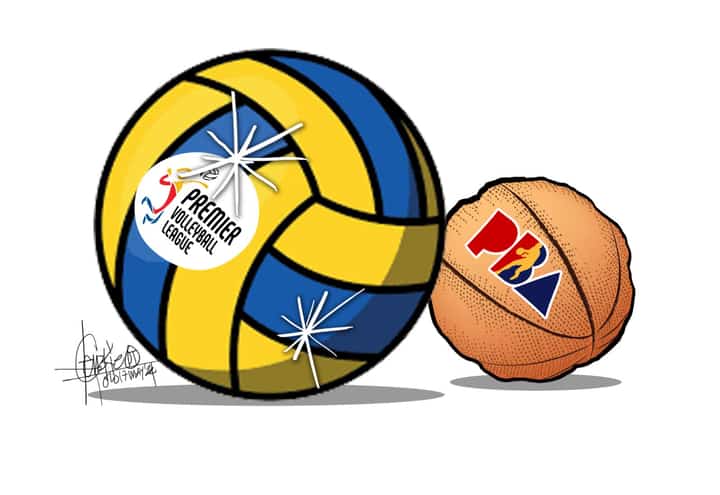
In the colorful world of Philippine sports, basketball has long reigned as the undisputed king. Due to its popularity, it was once called the national pastime.
For decades, the Philippine Basketball Association (PBA) has been the crown jewel in the country’s sporting landscape, drawing crowds by the thousands and captivating audiences with its fast-paced action and fierce rivalries.
But as the years passed, a new contender has emerged, threatening to steal the spotlight from the beloved PBA. It’s that game of spikes called volleyball.
Just recently, the Philippine Volleyball League held its title showdown between Cream Line and Choco Mucho before a packed audience at the Araneta Coliseum, showing its growing popularity among Filipino sports buffs.
Once relegated to the sidelines as a casual pastime, volleyball has risen to prominence as one of the country’s most popular spectator sports. And as its popularity continues to soar, the PBA is finding itself grappling with declining gate attendance and waning public interest.
So, what’s behind this seismic shift in the Philippine sports scene? To understand the rise of volleyball and the decline of the PBA, let’s examine the factors at play.
One of the most glaring issues facing the PBA today is the lack of parity within the league. Gone are the days when each team had a fighting chance at the championship.
Now, it seems that only a few elite teams, namely, San Miguel, Ginebra, Magnolia and TNT, consistently dominate the competition. The first three are from the San Miguel conglomerate and the last is one of three teams from the MVP or Manny V. Pangilinan group, the other two being Meralco and NLEX.
Of course, there are also independent teams such as Rain or Shine, Blackwater, Terrafirma, Northport, Phoenix and Converge but they hardly figure in the race to the finals. This lack of competition has led to a sense of predictability, with fans growing weary of seeing the same teams hoisting the trophy year after year.
But it’s not just the dominance of a few teams that’s driving fans away — it’s also the quality of the games itself. With the rise of international basketball leagues and their influx of foreign talent, the PBA has struggled to keep pace, leading to a decline in the level of play. Fans are increasingly turning to other sports, like volleyball, for their fix of high-energy action and fierce competition.
Add to this the exodus of future Filipino stars attracted by the higher pay in regional leagues like those in Japan, South Korea and Taiwan.
And then there’s the issue of accessibility. While basketball has long held sway in the Philippines, with street courts and barangay leagues, volleyball has the advantage of being more inclusive and accessible to a wider audience.
With its simple rules and minimal equipment requirements, volleyball can be played just about anywhere — from the sandy shores of a beach to the dusty streets of the barangay. This grassroots appeal has helped fuel the sport’s popularity, drawing fans from all walks of life.
But perhaps volleyball’s biggest draw is its star power. With the rise of leagues like the Premier Volleyball League (PVL) and the Philippine Superliga (PSL), volleyball has produced a new generation of superstars who capture the imagination of fans nationwide.
From the electrifying spikes of Alyssa Valdez and Sisi Rondina to the towering presence of Jaja Santiago (who unfortunately for us is now in Japan awaiting naturalization for its national team), these athletes have become household names, drawing crowds and commanding attention wherever they go.
So, what does all this mean for the future of Philippine sports? Is basketball destined to fade into obscurity as volleyball rises to prominence? Not necessarily. While the PBA may be facing challenges, it still holds a special place in the hearts of Filipino fans, and with the right adjustments it could reclaim its position as the country’s premier sporting league.
But one thing is clear: the rise of volleyball is a testament to the ever-changing nature of Philippine sports, and the need for leagues like the PBA to adapt and evolve in order to stay relevant.
Whether it’s through increased competition, improved quality of play, or greater accessibility, the PBA must find ways to capture once again the imagination of fans and reinvigorate interest in the sport.
In the end, the decline of the PBA and the rise of volleyball are not just about sports — they’re about culture, identity, and the ever-shifting dynamics of Philippine society.
As fans, we may have our allegiances and our favorite teams, but ultimately, we’re all united by our love of the game — whether it’s played on the hardwood or across a net.