




U.S. university suspends protesters
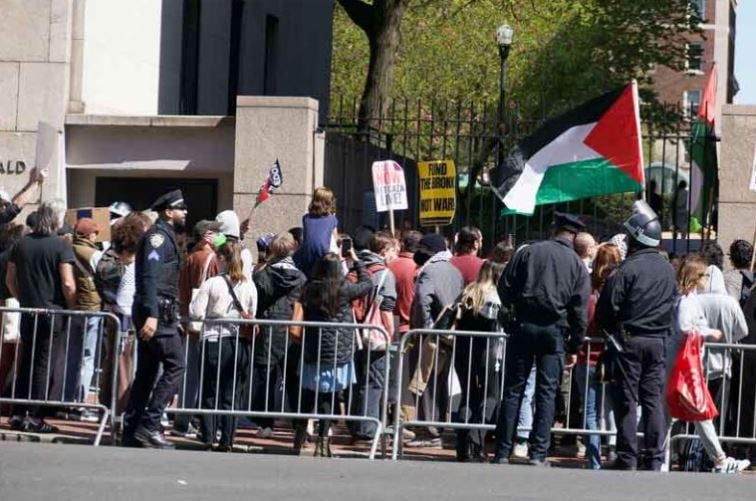
Protesters demand the divestment of Columbia University from Israeli donors
Text size
Protesters demand the divestment of Columbia University from Israeli donors
NEW YORK, United States (AFP) — Columbia University, the epicenter of pro-Palestinian protests that have upended college campuses across the United States, began suspending student demonstrators on Monday after they defied an ultimatum to disperse.
Overnight protesters occupied a campus building, barricading themselves inside while several others formed a human chain outside, according to a video posted on social media.
“Columbia community members took back Hamilton Hall just after midnight,” said the student group Columbia University Apartheid Divest in a statement.
“Taking over a building is small a risk compared to the daily resistance of Palestinians in Gaza,” it said, adding the building had been renamed Hind’s Hall in honor of a six-year-old girl killed during the war in Gaza.
Columbia begun suspending the students following almost two weeks of protests against Israel’s war in Gaza that have swept through higher education institutions from coast to coast, after around 100 protesters were first arrested at Columbia on 18 April.
In the latest crackdown, authorities at the prestigious university in New York demanded that the protest encampment be cleared by 2 p.m. or students would face disciplinary action.
“These repulsive scare tactics mean nothing compared to the deaths of over 34,000 Palestinians,” said a statement, read out by a student at a press conference after the deadline, referring to the death toll in Gaza.
“We will not move until Columbia meets our demands or... are moved by force,” said the student, who would not give his name.
A few hours later, Columbia vice-president of communications Ben Chang said the university had “begun suspending students as part of this next phase of our efforts to ensure safety on our campus.”
He said students had been warned they would be “placed on suspension, ineligible to complete the semester or graduate, and will be restricted from all academic, residential, and recreational spaces.”
Students had been warned they would be placed on suspension, ineligible to complete the semester or graduate.
Meanwhile, at the University of Texas at Austin, police clashed with protesters Monday, including using pepper spray, and made arrests while dismantling an encampment, adding to the more than 350 people detained nationwide over the weekend.
“No encampments will be allowed,” Texas Governor Greg Abbott said on social media.
“Instead, arrests are being made.”
Paul Quinzi, of the Austin Lawyers Guild helping those detained, told Agence France-Presse they estimated “at least 80 arrests, and they are still going.”
Police pushed and shoved away protesters at the Virginia Commonwealth University (VCU) in Richmond, local television footage showed. Students said police deployed teargas and pepper spray to clear them.
VCU said in a statement on social media platform X that it had repeatedly offered opportunities to the protesters, “many of whom were not students...to leave. Those who did not were subjected to arrest and trespassing.”
Protests against the Gaza war, with its high Palestinian civilian death toll, have posed a challenge to university administrators trying to balance free speech rights with complaints that the rallies have veered into anti-Semitism and hate.
Footage of police in riot gear summoned at various colleges to break up rallies has been viewed around the world, recalling the protest movement that erupted during the Vietnam War.
A traditional dish called zongzi is served during China’s Dragon Boat Festival, which falls in June. It is a rice…
Divina credited the firm’s achievements to its members, thanking them for their ‘hard work, dedication, teamwork, and…
‘Sec. Vince Dizon, please explain how this finding of your own team should not be flagged as a ghost project in Taguig.’
