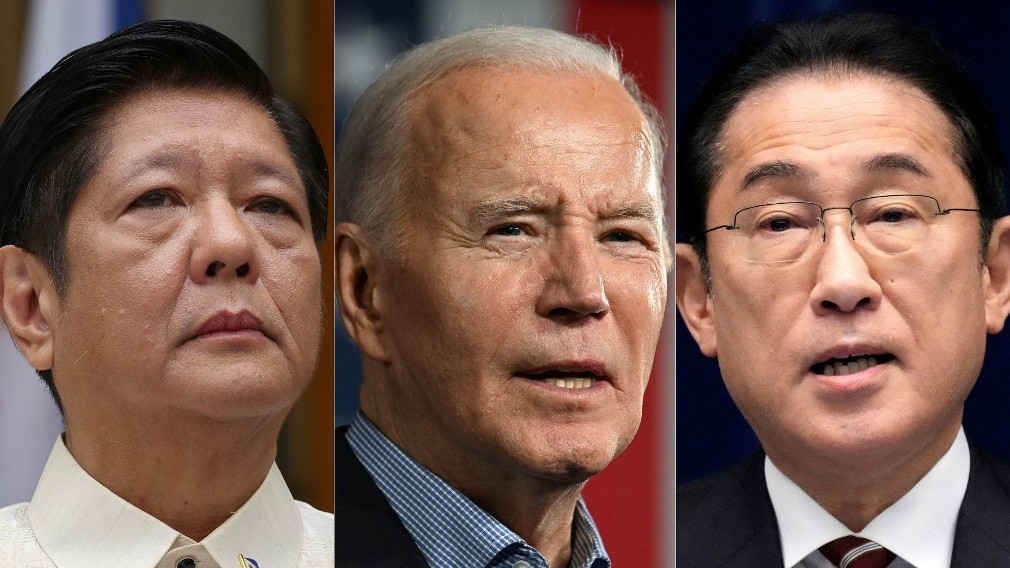
President Ferdinand Marcos Jr. said on Monday that his trilateral meeting with the United States and Japan was not aimed at any specific third party but rather focused on strengthening the institutional relationship between the three nations.
Marcos said this during the annual Foreign Correspondents Association of the Philippines luncheon after he met US President Joe Biden and Japanese Prime Minister Fumio Kishida last week in the inaugural trilateral summit between the nations.
When asked about the trilateral meeting's agenda, Marcos Jr. clarified that the primary agenda revolved around improving security and defense cooperation among the three nations.
"(The meeting) is not directed towards anyone," Marcos Jr. said.
"It is just merely institutionalization of the trilateral relationship between the US, Japan, and the Philippines," he added.
The latest Philippines-US-Japan trilateral meeting came amid rising tensions in the West Philippine Sea (WPS), with overlapping territorial claims among several nations.
Marcos said ensuring freedom of navigation in this area is crucial for maintaining commerce, peace, and stability in the region.
He also emphasized that these goals were at the core of the trilateral meeting.
"We have to maintain commerce, peace, and stability, which is the point of the trilateral meeting," Marcos said.
On a separate note, Marcos emphasized the importance of the existing Mutual Defense Treaty (MDT) between the Philippines and the United States.
"US Secretary Austin explained it very well," Marcos said, referring to a recent meeting with his US counterpart. "If any Filipino serviceman is killed, that will invoke MDT."
Marcos further clarified that the MDT applies not only to uniformed personnel but also to civilians harmed in the course of an attack.
"As long as they have caused casualties," he said, referring to China's maritime militia, "whatever their designations are, it does not matter, that is an attack to the Philippines."
No plans to add more EDCA sites
Meanwhile, Marcos denied any plans to grant the United States access to additional sites under the Enhanced Defense Cooperation Agreement (EDCA).
"The Philippines has no plan to increase EDCA sites," Marcos said, cutting short a reporter's question regarding potential expansion into Batanes, an island province located north of Luzon.
Marcos further downplayed any potential negative reaction from China regarding the current EDCA footprint.
The EDCA, signed in 2016, allows the US to build and operate facilities on designated Philippine military bases.
The agreement has been a point of contention with China, which views it as a threat to its territorial claims in the region.
Earlier this month, two top US Army engineers arrived in the country's northernmost municipality facing Taiwan in preparation for this year's "Balikatan" (shoulder-to-shoulder) military exercises between American and Filipino forces.
It marked the start of unprecedented activities and developments in Batanes, a province better known for its lush hills and rural scenery than its strategic and geopolitical importance, amid regional tensions caused by China's aggressive claims over Taiwan and almost the entire South China Sea.
The Balikatan drills will involve 16,000 troops from both nations from 22 April to 10 May.
Batanes has hosted Balikatan three times, most recently in April 2023, largely for minor infiltration and parachute training contingents.
Larger drills are scheduled this year, but details are still unknown.