




Parallel gab centers on vehicle batteries
Saito: ‘We hope to expand cooperation in important fields to like-minded countries, while keeping Japan and the United States at the core.’

Text size
Saito: ‘We hope to expand cooperation in important fields to like-minded countries, while keeping Japan and the United States at the core.’
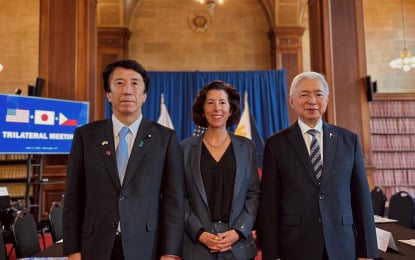
Industry ministers from Japan, the United States and the Philippines, in a side meeting to the Trilateral Summit among US, Japan and Philippine leaders in Washington on Thursday, discussed ways to strengthen supply chains of critical minerals used in electric vehicle batteries.
Attended by Japanese industry minister Ken Saito, US Secretary of Commerce Gina Raimondo and Philippine Trade and Industry Secretary Alfredo Pascual, the discussions were the first of its kind.
“We hope to expand cooperation in important fields to like-minded countries, while keeping Japan and the United States at the core,” Saito told a press conference.
At the meeting, the three trade officials discussed ways in which Japan and the United States can secure a stable supply of nickel and other resources.
A Japanese government official said for the Philippines, a major nickel producer, cooperation with Japan and the United States, which possess the technology for nickel processing, is “important” especially since not many countries have such technology.
Milestone relations
Raimondo said the inaugural Trilateral Economic Ministers Meeting marked a historic milestone in the relations of the three nations.
Pascual said their task as ministers is to inject actionable details into their leaders’ joint vision statement.
The areas of cooperation identified in the Joint Vision Statement include infrastructure and industrial cooperation projects.
During his intervention, Pascual emphasized, “A robust Philippine economy equates to a strong alliance.”
He presented three key projects designed to spur growth in the Luzon Economic Corridor. These initiatives will create strategic connections between the burgeoning areas of Subic and Clark, both former US military bases, and the established manufacturing center in the Cavite-Laguna-Batangas (CALABARZON) region, a prime location for Japanese export-manufacturing firms.
The three projects are the Subic-Clark-Manila-Batangas Railway system, Clark International Airport Development and Expansion initiative, and Clark National Food Hub.
Raimundo and Saito have expressed their support for making the projects happen.
Pascual also stressed the importance of having a critical minerals agreement (CMA) between the Philippines and the US or, as an alternative, for the Philippines to accede to the US-Japan CMA.
This proposed agreement will be a good signal and an incentive for the Private Sector to invest in ore processing in the Philippines.
Three decades after the Marcopper mining disaster devastated Marinduque’s waterways, the province is again pressing the…
Housing is probably the biggest issue affecting people the world over.
Malacañang on Monday called for a more thorough investigation into the questioned flood control projects in Taguig…
The defense on Monday backed the move by senator-judges to exclude a prosecution witness who testified on the firearms…
