
 Daily Tribune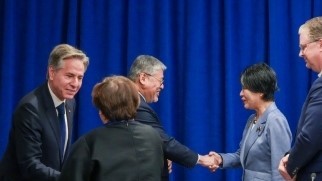
Heads together Japanese Foreign Minister Kamikawa Yoko (second from right) at the UN General Assembly in New York with US Secretary of State Antony Blinken (left) and Philippine DFA Secretary Enrique Manalo (third from left). The ministers discussed the way forward to enhance trilateral cooperation among Japan, the US, and the Philippines. They concurred on the promotion of multilayered collaboration with allies and like-minded countries for upholding and strengthening the free and open international order based on the rule of law, given the recent severe strategic environment including the situation in the South China Sea.
Photograph courtesy of Japan in Manila
The Philippines, United States, and Japan eye having a trilateral free trade agreement (FTA) to deepen their economic partnerships moving forward, an envoy said on Wednesday (US time).
In an interview with the Philippine media delegation in Washington, Philippine Ambassador to the United States Jose Manuel Romualdez said Trade Secretary Alfredo Pascual is set to meet with his counterparts in the US to discuss the possible trilateral FTA.
"We are looking at that seriously. We have been working with our attache here in pushing for specific free trade agreements," Romualdez said.
"I think the United States is more inclined to go into specific sectors for FTA, but the Indo-Pacific Economic Framework (IPEF) — which the United States has initiated, of which we are one of the founding members — is looking at including the entire ASEAN region," Romualdez added.
The Philippines, the US, and Japan are all members of the Indo-Pacific Economic Framework (IPEF), which is run by the US.
US Trade Representative Ambassador Katherine Tai said in April that the bilateral FTA with the Philippines as the government was more focused on the IPEF initiative.
IPEF is a US-led framework for participating countries to strengthen their relationships and work on important economic and trade issues that affect the region, such as rebuilding supply chains.
It's not a deal for free trade.
There have been no plans for market entry or lower tariffs, but trade experts say this could lead to trade deals.
FTAs, on the other hand, lower or get rid of barriers to trade between parties, such as taxes and quotas on goods that can be imported and exported.
Latest data from the Philippine Statistics Authority (PSA) showed that the United States bought $902.33 million worth of Philippine goods in January 2024, which is 15.2 percent of all Filipino goods sold.
Japan came in second with $869.25 million.
Japan sent $789.36 million worth of goods to the Philippines last month, making it the second-largest importer after China, which sent $2.65 billion worth of goods.
The US came in fifth with $671.86 million.
In the same briefing, White House National Security adviser John Kirby said the leaders of the three countries are going to improve their economic, political, and security ties with each other.
"Our three countries embark on this new era of trilateral cooperation as trusted, equal partners, guided by shared values and an unwavering commitment to a free, open, peaceful, and prosperous Indo-Pacific," he said.
"With President Marcos's visit, the trilateral summit and of course the visit today of Prime Minister Kishida this week will clearly illustrate President Biden's continued commitment to strengthening our key alliances and partnerships in the Indo-Pacific, innovating around shares challenges, and exploring new areas of cooperation," he added.


