




Israel gearing up for Rafah
Israel’s retaliatory offensive has killed at least 33,175 people in Gaza, mostly women and children, according to the health ministry in the Hamas-run territory
Text size
Israel’s retaliatory offensive has killed at least 33,175 people in Gaza, mostly women and children, according to the health ministry in the Hamas-run territory
Israeli officials said Sunday they are preparing for military operations in Gaza’s southernmost point of Rafah six months into a “long war,” which has shattered buildings and lives.
Israel pulled its forces out of the southern Gaza Strip on Sunday in a partial withdrawal half a year into the war sparked by the attack against Israel by Hamas militants on 7 October.
But Israel’s Defense Minister Yoav Gallant said troops left the city of Khan Yunis, after months of fighting, “to prepare for future missions, including... in Rafah.”
World leaders have expressed alarm at the prospect of an invasion of the city, near the Egyptian border, where most of Gaza’s population has taken shelter.
“The war in Gaza continues, and we are far from stopping,” said Israel’s military Chief of Staff Herzi Halevi. “This is a long war, with varying intensity.”
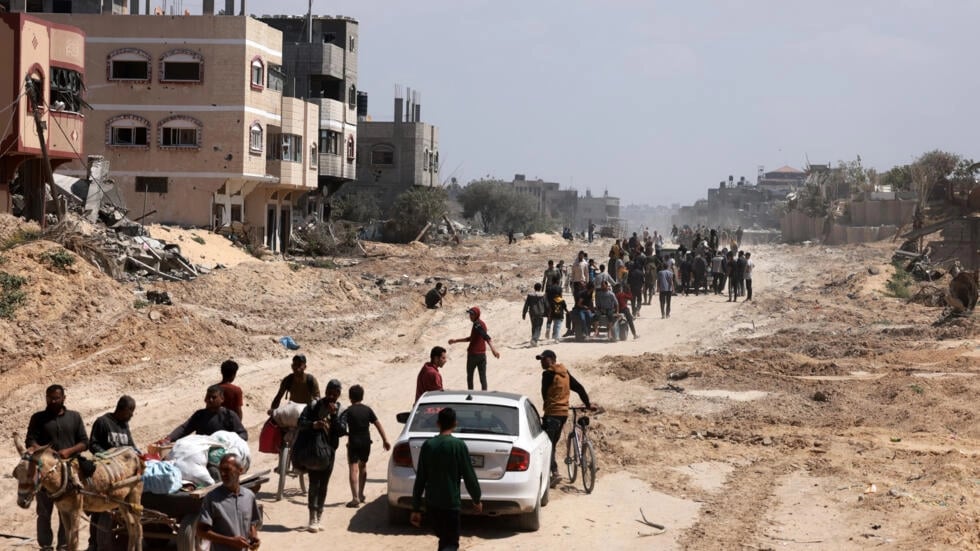
After troops left areas in and around the largely destroyed city of Khan Yunis, a stream of displaced Palestinians walked there, hoping to return to their homes from temporary shelters in Rafah, a little further south.
Prime Minister Benjamin Netanyahu said Israel was “one step away from victory.”
Muhammad Yunis, 51, a Palestinian in northern Gaza, sees nothing but loss.
“Isn’t the bombing, death and destruction enough?” he asked. “There are bodies still under the rubble. We can smell the stench.”
On a day when talks toward a truce deal were set to resume in Cairo, Netanyahu also stressed that “there will be no ceasefire without the return of hostages.”
He is facing intense pressure at home from families and supporters of captives seized by the militants as well as from a resurgent anti-government protest movement.
“Israel is ready for a deal. Israel is not ready to surrender,” Netanyahu told his cabinet in a speech to mark six months since Hamas’ attack that resulted in the deaths of 1,170 people, mostly civilians, Israeli figures show.
Hamas and Islamic Jihad militants also took more than 250 Israeli and foreign hostages, 129 of whom remain in Gaza, including 34 the army says are dead.
Israel’s retaliatory offensive has killed at least 33,175 people in Gaza, mostly women and children, according to the health ministry in the Hamas-run territory.
Israel has faced growing global opposition to the war, and the outcry intensified after an Israeli drone strike killed seven aid workers — most of them Westerners — for the US-based food charity World Central Kitchen on 1 April.
Vast areas of Gaza have been turned into a rubble-strewn wasteland with damage estimated at $18.5 billion to critical infrastructure, mostly housing, a World Bank report said.
Charities have accused Israel of blocking aid, but Israel has defended its efforts and blamed shortages on aid organizations’ inability to distribute assistance once it gets in.
Netanyahu has come under heightened pressure from Israel’s top ally the United States to work toward a truce and hostage deal and to allow vastly more aid into the territory.
Medical supplies were delivered for the first time through Israel’s Erez border point with northern Gaza, AFPTV footage showed.
Khan Yunis is the hometown of Hamas’ Gaza chief Yahya Sinwar, whom Israel accuses of being the mastermind of the 7 October attacks.
Israel’s “98th commando division” left the city, and Gaza, “in order to recuperate and prepare for future operations,” the army told AFP.
Israeli security expert Omer Dostri predicted that, as more displaced Palestinians leave densely crowded Rafah, “within two months there will be a move in Rafah to destroy the remaining Hamas brigades.”
Housing is probably the biggest issue affecting people the world over.
Malacañang on Monday called for a more thorough investigation into the questioned flood control projects in Taguig…
The defense on Monday backed the move by senator-judges to exclude a prosecution witness who testified on the firearms…
