




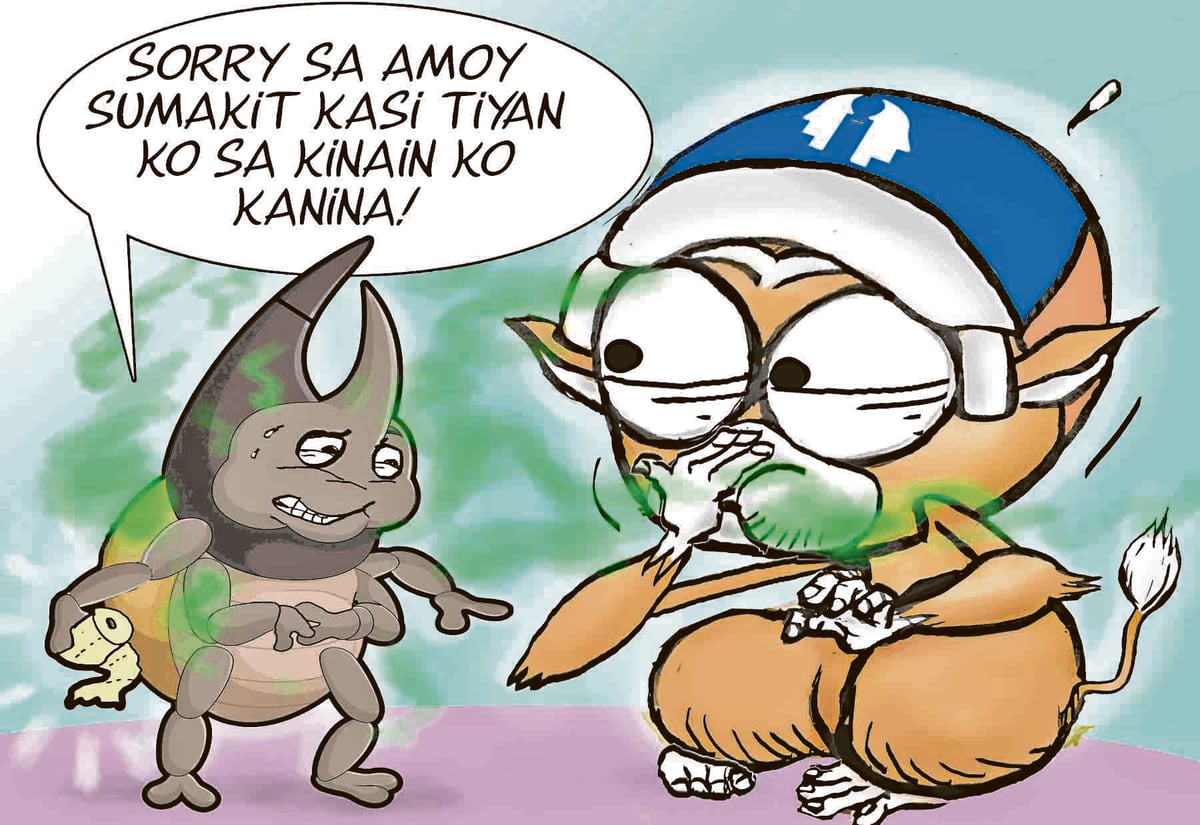
Poo defense
Text size
Share
Share
The use of camouflage is a common defense mechanism of animals. Squids and octopuses mimic the color of their watery surroundings to hide from predators or to catch prey. Some bugs look like leaves or dead wood to mislead unsuspecting larger creatures.
In Queensland, Australia, a researcher discovered a new species of longhorn beetle, but not after mistaking it for something else.
James Tweed told BBC that a tiny white object on a leaf that he noticed in the Gold Coast hinterland in December 2021 was bird poo. Upon closer examination, however, the entomologist realized that it was not poo but a beetle.
“It was about one centimeter long and covered in long, fluffy white hairs. A lot of the hairs stood basically straight upright, and so it gave it a bit of a mohawk-type look,” said the Ph.D. candidate at the University of Queensland.
Later, the Australian National Insect Collection under the science agency CSIRO confirmed that it was an entirely new species of longhorn beetle that it named Excastra albopilosa.
The scientists weren’t sure exactly why the bug was furry, but they thought it had evolved to mimic an insect killed off by a fungus to deter predators, according to BBC.
Meanwhile, off Western Australia’s southern coast, whale watchers recently witnessed a pod of orca attacking a group of sperm whales.
The rare encounter happened at Bremer Canyon, about 50 kilometers off the coast between Albany and Hopetoun on 19 March, with marine biologist Jennah Tucker among the witnesses on board the Naturaliste Charters tour boat, ABC reports.
According to ABC, the sperm whales huddled tightly in a circular formation, heads to the center and tails fanning out before a massive dark bubble rose to the water’s surface.
There was a moment of silence before the orcas were seen moving out and away from the whales. When the scientists on board the tour boat reviewed their video footage, they saw that feces excreted by the sperm whales triggered the bubbles.
“We realized that the big dark bubble we’d seen and assumed might have been blood was actually poo,” Tucker said, calling the whales’ action defensive defecation, according to ABC.
