 Daily Tribune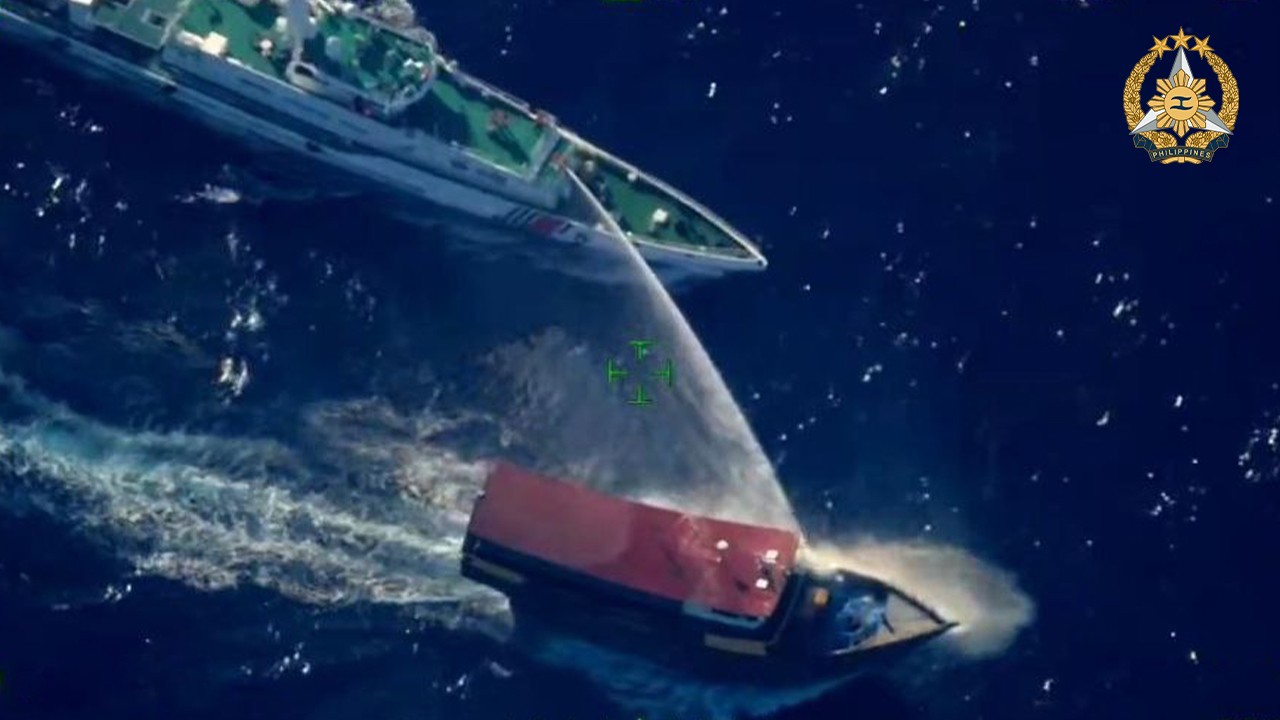
Screengrab of Chinese Coast Guard vessel water cannons Philippine vessel, Tuesday 5 March.
Top envoys of various countries to the Philippines on Tuesday condemned yet another use of a water cannon by the China Coast Guard against Philippine vessels in the West Philippine Sea.
In separate posts on the social media site X (formerly Twitter), diplomats of the United States, European Union, Japan, Germany, and France called out China over its aggressive actions which resulted in damage to the Philippine vessels and injuries to four Filipino crew members.
EU Ambassador to the Philippines Luc Veron said he was “troubled” by what he described as “patterns” carried out by the China Coast Guard and Chinese maritime militia vessels against Philippine vessels engaged in resupply missions in Ayungin Shoal.
“The EU reiterates the call for all parties to abide by the legally binding 2016 Arbitration Award and #internationallaw to peacefully resolve disputes, guaranteeing safety in maritime waters,” Veron said.
US Ambassador to the Philippines MaryKay Carlson, likewise, condemned the incident.
“The US stands with the Philippines and proponents of international law in support of a #FreeAndOpenIndoPacific,” Carlson said.
The Embassy of Japan in Manila also reiterated its “grave concern on the repeated dangerous actions in the SCS including the recent use of water cannon by CCG which resulted in Filipino injuries and a collision.”
“Japan will continue to stand with the Philippines and cooperate with like-minded countries to maintain peace and stability in the region,” the embassy said in a statement.
Meanwhile, Andreas Pfaffernoschke and France Marielle Geraedts, German and French Ambassadors to the Philippines, also expressed concern about the incident.
Both diplomats called on China to abide the international law, including the 2016 Arbitral Award on the South China Sea, which cemented Manila’s claims in the WPS.
Earlier in the day, the National Task Force for the West Philippine Sea confirmed that the CCG and Chinese maritime militia vessels harassed, blocked, deployed water cannons, and executed dangerous maneuvers against the Filipino vessels conducting a rotational and re-provisional mission to BRP Sierra Madre.
The BRP Sierra Madre is a decommissioned naval vessel of the Philippine Navy that served as the military post of the country in Ayungin Shoal.
The Department of Foreign Affairs, for its part, summoned Chinese Deputy Chief of Mission Zhou Zhiyong in the afternoon after the incident in Ayungin Shoal.
The DFA said Zhou was summoned to “convey the Philippines’ protest against the aggressive actions undertaken by the China Coast Guard and Chinese Maritime Militia against the rotation and resupply mission undertaken by the Philippines.”
It noted that China’s interference in the West Philippine Sea, which is well within the country’s 200-nautical-mile EZZ, was “unaccepted.”
During the meeting, the DFA emphasized to the Chinese official that China's actions at Ayungin Shoal “infringe upon the Philippines’ sovereign rights and jurisdiction.”
“The Philippines demands that Chinese vessels leave the vicinity of Ayungin Shoal immediately,” the department said.
It stressed that Ayungin Shoal, a low-tide elevation, is within the Philippines’ EZZ and continental shelf.
“In accordance with the 1982 UN Convention on the Law of the Sea and the final and binding 2016 Arbitral Award, it cannot be appropriated for sovereignty claims. International law affirms that the Philippines exercises sovereign rights and jurisdiction over the feature,” it said.


