
Sun streaming water to farms
The highest palay harvest was recorded last year with a volume of 20.06 million metric tons, or MT, enabling the government to cut its rice import volume to 3.5 million MT last year from 3.8 million MT in 2022.


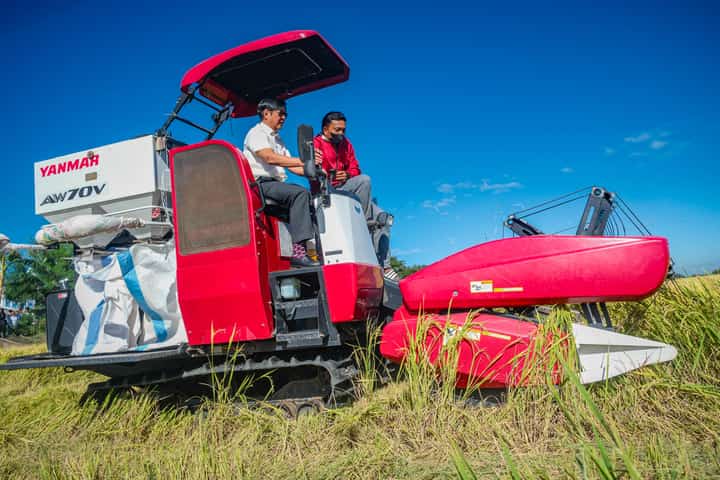
Driving agriculture forward President Ferdinand Romualdez Marcos Jr. tries his hand at operating a rice combine harvester, or RCH, during a ceremonial harvesting event and distribution of assistance at Barangay Mandili, Candaba, Pampanga on 3 February. The RCH is said to be ‘climate change resilient and suitable for local conditions and for major rice producing areas,’ says a government site.
PHOTOGRAPH BY YUMMIE DINGDING FOR THE DAILY TRIBUNE @tribunephl_yumi
President Ferdinand “Bongbong” Marcos Jr. has adopted the recommendation of the Department of Agriculture to provide farms with a solar irrigation system and has directed Agriculture Secretary Francisco Tiu Laurel Jr. to work out the funding for the project.
Under the program, the government seeks to install thousands of solar-powered irrigation units that will be among the measures to counter the onslaught of the El Niño phenomenon.
The Philippine Atmospheric, Geophysical and Astronomical Services Administration, or PAG-ASA, said a “strong El Niño” will prevail over the country until February, while the global climate models predict it would persist until May.
Economists said an economic spurt of 6.5 percent to 7.5 percent is possible this year if agriculture picks up pace.
Economist legislator Albay Rep. Joey Salceda said despite the weather anomaly this year, the prospect of farm output improving is good with Laurel’s firm grasp of the agriculture sector.
The latest data from the Philippine Statistics Authority, or PSA, reveal the country recorded economic growth of 5.6 percent in 2023, wherein agriculture contributed nine percent of the gross domestic product during the period.
Agricultural output in the last quarter of 2023 recorded a 1.2 percent growth rate.
Moreover, the highest palay harvest was recorded last year with a volume of 20.06 million metric tons, or MT, enabling the government to cut its rice import volume to 3.5 million MT last year from 3.8 million MT in 2022.
Speaking during the ceremonial palay harvesting and distribution of various assistance for farmers in Barangay Mandili, Candaba, Pampanga on Saturday, Marcos stressed the urgent need to prepare for the impact of the drought season.
He said he had discussed the initiative with Laurel, who accompanied Marcos’ official visit to Vietnam, the country’s top source of imported rice.
Marcos mused that Vietnam’s use of solar technology in agriculture can be replicated in the Philippines.
“This year, we will expand the irrigation for our farmlands through the Philippine Solar Irrigation Project for small-scale irrigation projects to increase the production and income of farmers,” he said.
Each solar-powered irrigation unit will power up irrigation pumps for 20 hectares.
“We will install thousands of these, and we are already discussing where to source out the budget for the project,” Marcos added.
He ordered the DA to work on the budget, which included the supply chain, harvesting, processing, and marketing of produce, to help the small-scale farmers.
Once the project is completed, Marcos said the country will have an additional 180,000 hectares of irrigable land, making it possible for a third cropping cycle in a year.
In an interview last month, Laurel said the DA would implement the intervention and create more water-impounding areas and facilities.
Based on DA’s monitoring, the El Niño phenomenon had affected farms in Western Visayas and the Zamboanga Peninsula, with at least P109.44 million in income lost.
The prolonged dry spell in the two regions hit 2,602 farmers, tilling 2,177 hectares of land, with an estimated production loss volume of 4,738 metric tons—most of which were rice produce.
Agri laborers, farmers to get aid
The government will expand production support, extension services, research and development as well as irrigation network services in the country this year, Marcos indicated.
The effort will form part of the government’s National Rice Program, utilizing the Rice Competitiveness Enhancement Fund.
A huge chunk of the fund, he said, will go to the procurement of tillers, tractors, seeders, threshers, rice planters, reapers, driers, and other farm machinery.
“We will continue to utilize the budgets from the Rice Competitiveness Enhancement Fund so we can strengthen our agricultural laborers and the farmers,” according to the Chief Executive.
He added that the government will provide additional sources of capital for farmers.
“Financing will be administered by the Land Bank of the Philippines and the Development Bank of the Philippines (both state-owned institutions),” he said.
Marcos said the Philippine Center for Postharvest Development and Mechanization, Philippine Rice Research Institute, Agricultural Training Institute, and Technical Education and Skills Development Authority will also strengthen the modern farming training for Filipinos.
Modernization targeted
“We think that with these steps, we will achieve not only uplifting the standard living conditions of farmers but also the modernization of the agricultural sector,” he added.
Marcos feted Filipino farmers for their dedication and sacrifices in farming.
“Every grain of rice you plant will grow and serve as a pillar of a stronger and more abundant tomorrow),” he told the farmers.
The Department of Agriculture’s national rice program has been allocated P30.8 billion under the P5.768 trillion national budget for 2024.
MoU on rice supply chain inked
Moreover, as a step towards ensuring a stable supply of the staple grain, the Department of Agriculture, Department of Trade and Industry, and National Irrigation Administration recently signed a memorandum of understanding that focuses on the creation of alternative markets.
“The MoU seeks to promote the Integrated Rice Supply Chain Development Program, a project that will foster an efficient supply chain; develop a business-to-business online market platform; create alternative market access for buyers and sellers; enhance farmers’ income; promote proper rice branding and classification; and make rice affordable to consumers,” the DA said.
Laurel said the agreement creates a “formwork for collaboration” in implementing a project that ensures the transformation of the rice supply chain.
He added that the country could improve its agricultural products’ status internationally through cooperation in rice production, classification, marketing, and distribution.
“We aim to enhance the income of our hard-working rice farmers through more efficient market and supply chain arrangement,” Laurel said.
“We envision a future where our rice is not only of high quality but is also recognized and appreciated in the market,” he added. “The sector employed around 25 percent of the 49.7 million Filipinos in the labor force as of November.”